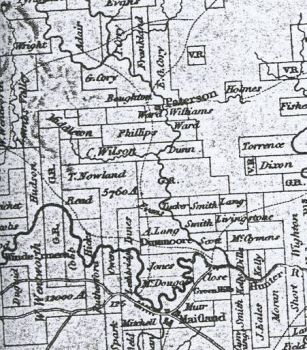
hunter valley settlers 1837

Select from the maps on the left for more settlers

Maitland - Hunter River - Windermere -  Paterson River

2

Adair G. Cory E.G. Cory Cory J.H. Boughton William Dun William Evans Captain James Phillips Dr. George Shaw Rutherford Andrew Lang- Dunmore John Galt Smith John Tucker Susannah Matilda Ward George & Vincent George Williams Woodville Dunmore Bellevue Albion Farm Bona Vista Tillimby Leitrim Thomas Valentine Bloomfield - Dagworth


Hunter Valley Settlers on this Map

James Adair   George Adair   Samuel Adair   John H. Boughton   Edward Gostwyck Cory   John Cory   Gilbert Cory   William Dun   William Evans   George Jackson Frankland   Andrew Lang   James Phillips   George Shaw Rutherford   John Galt Smith   John Tucker   Susanna Matilda Ward   George & Vincent George Williams  T.V. Blomfield    

John Galt Smith

Woodville

John Galt Smith was born in 1794. He arrived in Van Diemens Land on the Britomart on 4th February 1822. Also on board were Robert and Helenus Scott, young men travelling to Australian with their father. The brothers were also destined to become landowners in the Hunter Valley although their father died on the voyage out. In March 1822 John Galt Smith and Robert and Helenus Scott wrote a letter to the Sydney Gazette thanking Captain Peache, the master of the Britomart for their accommodation on the vessel and to state that their voyage was made more comfortable and agreeable by Captain Peache's attentive and gentleman like conduct.19

John Galt Smith applied for a land grant in 1822 and was granted 1000 acres and assigned four convict servants.13 He selected his land on the Paterson River and named it 'Woodville'. Woodville comprised three separate grants totalling 2340 acres, a portion of which was a grant by Governor Brisbane to John Galt Smith's wife Eliza Walsh and was situated on the eastern bank of the Paterson River adjoining Alexander Livingstone's 'Bowthorne' and Walter Scott's 'Wallalong'.

John Galt Smith resided in the Windsor area for some time. He married Elizabeth Walsh at St. Luke's church Liverpool. Elizabeth was a settler at Kurrajong and had arrived in the Colony in 1819 with her brother in law on the 'Globe'. (Elizabeth was a sister in law of Frederick Drennan a former Deputy Commissary General of NSW).  In 1824 Smith travelled from Windsor to his farm 'Woodville' with his servants and cattle 13

In 1828 he was employing Timothy Buckley as his overseer at Woodville.  Buckely was a 25 year old ticket of leave holder who had arrived on the ship Isabella in 1823.5 Buckley was from Cork as was Smith's wife Elizabeth. He had first been assigned to Smith at Windsor in January 1824 and so probably made the trip overland with the cattle later that year.

Convicts assigned to Smith and living at Woodville in 1828 were William Chipperfield who had arrived on the Norfolk in 1825. (Chipperfield received his ticket of leave in 1833) and William Wells a 24 year old stockman who had arrived on the Minerva in 1824.5

John Galt Smith died in 1847 aged 53. He had arisen from bed in the early hours of the morning and while lighting a candle in a nearby room his clothes caught fire. His groans alerted a servant girl who came to his assistance and found him still alight. She alerted the household and Smith was put to bed and medical assistance called. His injuries were extensive however, and he died ten hours later. He is buried in the cemetery of St. Paul's Church, Paterson14

.


Andrew Lang

Dunmore

This land was a grant of 1000 acres that was selected by George Lang in 1822. George Lang had arrived in Van Dieman's Land in August of 1821 and proceeded to Sydney soon after. He applied for the position of Principal Clerk at Newcastle in 1822, however was appointed Storekeeper at the Commissariat Department at  Liverpool instead. 13

A slab hut was erected on the grant. When George died in 1825 aged 23 the 1000 acre grant, named 'Dunmore' after George's mother, passed to George's brother Andrew.  Andrew had followed George and their eldest brother John Dunmore Lang to Australia.

Andrew and his father William worked hard to establish Dunmore however William drowned in 1830 when the vessel he was sailing to Sydney was wrecked in a squall. Andrew continued on at the Estate and a mill, Presbyterian Church and school were completed.  Dunmore House, built before the death of William was a two story stone building facing towards the river.

Andrew Lang was involved in the community and on many committees such as the Maitland District Pastoral Association, Committee to collect subscription for the distressed in Ireland; Hunter River Vineyard Association;  Committee for Maitland Hospital; Judge at Hunter River Agricultural Society show.14

In August 1844 Andrew's mother Mary Dunmore died at  his residence 'Dunmore' aged 75. It was written of her -

 ' Mrs. Lang has been long and extensively known, both in this district and in Sydney, as a person of a remarkably vigorous mind, of great decision of character, of unbending religious principle, and of warm active and untiring benevolence. She will be long and deeply regretted.'26

On the 8th November 1849 Andrew Lang married Emily, the eldest daughter of Lieutenant William Caswell at Balickerra, Williams River.27


William Evans

Bellevue

Travellers by land from Maitland to Paterson in the 1830's would ford the Hunter River and pass through lands belonging to McDougall and Jones and enter the grant of Dunmore belonging to Andrew Lang. Here there was a cross roads where they could proceed west towards Luskintyre or east to meet the road to Port Stephens or continue north on to 'Bellevue' the property of Dr. William Evans. Evan's house was situated on the banks of the Paterson River. After leaving Evans' property, travellers would enter a church grant which occupied both sides of the Paterson River. Here had been built a lockup and a school house. On the opposite side of the river to Bellvue was the farm of  John Tucker and adjoining Evans to the west was the estate of Timothy Nowlan.

William Evans, was 30 years old and employed as a surgeon in London before he travelled to Australia on the Indispensable in 1809.   On board the Indispensable he was employed as Ship's surgeon in charge of 62 female convicts, one of whom died on the voyage. They sailed into Port Jackson on the 18 August 1809. 3

Evans was appointed assistant Colonial Surgeon in 1809, replacing Charles Throsby. By the end of 1809 he had been dismissed from this position for speculating in colonial paper currency. 10 His request to be reinstated was refused and by the end of 1810, Evans had been imprisoned for debt to William Hobart Mansel.  Mansel was a Sydney trader who had previously been employed as a clerk by Simeon Lord but became a trader in partnership with Thomas Abbot.13 Meanwhile, Evan's wife had obtained passage on board the convict transport Indian and arrived in December of 1810, probably to find her husband in prison. Evans was supported in his efforts for release from prison by Dr. Wentworth, and by 1811 had been appointed Assistant surgeon at Newcastle.

By the middle of 1811 Evans was once more arrested - this time for misconduct.  He was sent to Sydney while an investigation took place into his alleged misconduct. After the investigation he was reinstated in his duties at Newcastle and two years later was given 100 acres of land at Hunter river. He was supplied with stock from the Government herd  and convict servants were assigned to him to be supplied from the Stores at Newcastle for 18months. Evans did not reside at the Hunter River property however as he continued in his capacity as surgeon at Newcastle.

After 1813 the convict population at Newcastle increased as the Sydney facilities became overcrowded and convicts were sent from there to Newcastle. Supplies at the settlement were  inadequate and Evans wrote to the authorities of the venereal disease at Newcastle and the desperate need for medical supplies and later in 1815 recommended that patients be sent to Sydney as he had no medicines to assist them. By 1816 conditions were still appalling in the hospital and Evans informed the authorities that there were only three blankets for 25 patients, some patients having also to lay on the ground. 10

In 1814 he made complaint regarding the poor repair of his house and he was given permission to have furniture made.

He was in further trouble in 1817 after he returned to Newcastle after a sojourn in Sydney where he had hoped to receive surgical treatment for his hand which he injured in an accident when a gun exploded. On his return to Newcastle on this occasion he brought spirits with him, despite the objection of Commandant James Wallis. Although Evans had protested that the spirits were for his own use, Wallis complained that the alcohol had caused drunkenness and irregularity in the Colony.

By 1822 he requested to retire because of the injury to his hand. He also requested his grant on the Hunter's River be extended. He retired from Government employ, perhaps to his property on the banks of the Hunter, hoping to run it more efficiently than it had been in his absence. As it was many hours travelling up river to reach the farm, he had been compelled to leave it in the hands of his assigned convicts while he continued his work at Newcastle. The farm did not give sufficient returns he thought, because of the dishonesty of the people working there. He did however have on the property a log barn which was thatched and a log and stone cottage as well as an orchard.11 Seventy acres had been cleared and 23 head of cattle and 150 sheep were kept there.28  His farm was plundered by bushrangers in 1825. The infamous 'Jacob's Mob' took nearly all the clothing belonging to his family.

Some convicts who were assigned to Evans in 1824 were Fergus Cunningham who had arrived on the Lord Sidmouth in 1821. Cunningham was murdered ten years later in 1834; and George Davis who arrived on the Neptune in 181810

In 1828 convicts at Bellevue estate included 22 year old Isaac Clay who arrived on the Sesostris in 1826 and received his ticket of leave in 1834, and Richard Scaddens a 61 year old boat builder who arrived on the Globe in 1819.15 Scadden died at Newcastle in 1833.

William Evans died in 1860


John Tucker

Albion Farm

When John Tucker senior died at Patterson Plains on 23 June 1834, he was described as having been a most trustworthy officer in the Commissariat Department at Newcastle. He had been appointed Storekeeper in the Commissariat in 1804 when Newcastle was established as a penal settlement and accompanied Lieutenant Menzies on the Lady Nelson to Newcastle. His salary for this position was £91.5.0. Tucker was responsible for meat rations for the convicts - they received fresh meat three or four times a year, or otherwise salted provisions. The Commissariat Store was not large enough for the settlement's wants having only air holes about a foot long and five or six inches wise instead of windows and the floor remained un -flagged which was difficult to keep clean. Tucker had three assistants to help serve out provisions to representatives of the convict barracks and gaol every Saturday and Wednesday.29 He remained in the Commissariat Department (except for a brief interlude when William Sutton held the position) until 1822 when he applied for a colonial pension. As well as the pension he had been granted land which adjoined that of his son John, at Patterson's Plains. Here John senior settled with his wife Ann Vales (Viles) and they raised cattle and sheep. Twenty three year old stockman Joseph Charles who had arrived on the Mangles in 1820 was assigned to the Tuckers in 1824 after being assigned to John Earle beforehand. Charles was still in service to John Tucker four years later when James Walsh also came to work on the grant. In 1828 Tucker owned 46 head of cattle and a horse as well. 5. Perhaps in his retirement from Government duties he had time to reflect on his long life.

He had been convicted almost forty years before on 28 October 1789 at the Old Bailey for the the theft of various articles from his employer George Jeremy (with whom Tucker had lived for 6 months). George Jeremy was a linen draper in partnership with Henry Small in Tavistock Street. They had missed a large quantity of linen, cambric, muslin, calico and handkerchiefs and John Tucker admitted to stealing them. Jeremy then proceeded to Tuckers parents residence where some of the goods were produced. Tucker was charged with stealing the goods and his father Stephen and step mother Mary with receiving stolen goods. John tried hard to extricate his stepmother from the situation he had placed her. He stated in Court -' I wish to say that my mother is totally innocent; I imposed upon her, by telling her I obtained the goods in the city; and she asked me at different times, how I came by them; and I always told her that I had bought them; and she asked me whether I was sure of it, that I came by them honestly, and I told her that I came by them honestly; I have nothing else to say.' 18

John and his step-mother were convicted of the crimes.  Stephen was found not guilty. John and Mary were to be transported on the Neptune in 1790 however did not embark on this transport. John arrived on the Active in 1791. Mary was sentenced to transportation for 14 years but appears not to have proceeded to Australia.

In 1794 John Tucker married  twenty six year old Ann Vales who had arrived as a convict on the Royal Admiral in 1792.  A son John was born to the couple in 1795 and daughter Charlotte in 1797. Their farm was called 'Surrey Farm'. Both John and Charlotte were to spend their lives in the Hunter Valley.  John ( junior ) married Catherine Flynn when he was just twenty years old however she was drowned in a boating accident shortly after they were married. He next married Frances Turner in 1818 and by 1828 they were living on their farm 'Albion Farm'. Charlotte Tucker married mariner John Powell and they settled on a farm up river from her brother John.  Later in 1822 William Dun  was to select the land next to Powell's acreage. 11


Captain William Dun was granted this land below the present town of Paterson in 1821 by Sir Thomas Brisbane. He had arrived in Australia on board the Mariner with recommendations to become a free settler and by 1822 had travelled to Newcastle on the Elizabeth Henrietta before sailing/rowing further up the Hunter and Paterson Rivers to make his land selection. His was the first major land grant on the river. He was assigned four convicts and provided with supplies from the Stores at Newcastle for the convicts and his family.

Unlike some other Hunter Valley land owners, Dun remained on his estate and became involved in the community in various ways.  He performed church services near 'Duninald' at the request of the Commandant at Newcastle and received a further land grant for this duty.

In 1822 he was appointed  correspondent member at Newcastle of the Committee of the Agricultural Society of New South Wales, and in 1825 his appointment as Coroner was announced.

On the Duninald estate, Dun constructed his residence of sand stock bricks with two chimneys  at either end of the shingled roof. A verandah in the front and three rooms faced east with three more facing the west. 15

One of William Dun's daughters, Maria married George Faircloth in 1847 and another, Frances, married Charles Reynolds who later owned 'Duninald'


Susannah Matilda Ward

Clarendon Park, Cintra.

In 1820 William Gordon Ward, a veteran of the Peninsula wars and newly arrived on the Dromedary, was granted 1000 acres of land by Governor Macquarie. Ward died soon after and his wife Susannah Matilda Ward (nee Baldwin) was allowed to retain the 1000 acre grant. 13 She selected land in Castle Hill and on the eastern bank of the Paterson River which she called Clarenden Park. Later Susannah was granted additional land -  500 acres in the Parish of Butterwick by Governor Darling in 1828. 25 Her other estate she named Cintra. One of her daughters, (also) Susannah Matilda was born in Cintra, Portugal.

Susannah Matilda Ward was just one of many settlers who had led fascinating eventful lives before settling near the quiet waterways of the Hunter Valley. Probably in Sydney she had been reacquainted with soldiers who served with her husband and had also fought at the Battle of Waterloo. Perhaps like Susannah, they had attended the ball given in Brussels in 1812 in the hours before the army was called to Battle.

When William died in 1820, Susannah was left in a strange country with six children to raise. She must have longed to return to Europe and soon requested that the Government pay her passage however by 1821 she had accepted the demanding position of Matron at the female orphanage at Parramatta where she was to spend the next three years. 13

Susannah had friends living in Paterson, perhaps this is why she determined to move there. Sadness struck the family in 1836 when Susannah's son William died in Java from fever while on the brig 'Children' on passage from Sydney to Canton. He was only twenty one years old. 19

In 1841 when she was 52, Susannah married another Paterson river land owner, Robert Studdert.  Studdert was employed as Clerk to the Bench of Magistrates at this time. Susannah Matilda's daughter Susannah married Frederick Bedwell who purchased part of the Cintra estate calling it Valentia Lodge 4


Captain James Phillips

Bona Vista

Captain James Phillips, veteran of the Peninsula wars and free settler to New South Wales, arrived in Port Jackson 20 May 1822 on board the female convict transport Mary Anne. Accompanying him were his wife Lydia, and five children.  The Mary Anne had departed Portsmouth on Christmas day five months before with the Phillips family and 102 convicts on board. There were a total of 12 children on the ship.

The Phillips family may have resided for a time at the female orphan school at Parramatta where their good friend Susannah Matilda Ward had been appointed matron. No doubt they were all pleased to be re-acquainted. Phillips' wife Lydia applied for a Government position for him at this time.13

Phillips was granted 2000 acres of land and six convicts were assigned to him in 1822. After gaining permission to travel to Newcastle Phillips soon set out on the journey with seven men accompanying him. After reaching Newcastle, he would have travelled up the Hunter River then to the Paterson, his convict servants rowing part of the way until the tide turned and sails were unfurled. He selected land on the banks of the Paterson River naming the grant Bona Vista. The town of Paterson now adjoins this land. He later arranged for his belongings to be shipped to Newcastle also. Phillips was allowed 20 head of cattle from the government herd and soon had wheat and corn crops planted13

Along with many other Hunter Valley settlers he was granted a town allotment in Newcastle in 1824.

In 1825 he requested that the government assign a  carpenter to him in place of carpenter Charles Watkins who had been assigned to him in 1822. Watkins and Cotteral were probably two of the six convicts who accompanied Phillips to the Paterson river to select his land in 1822. He had the usual problems with assigned servants and in 1825 requested that he be assigned six convicts to replace those that had absconded. One month later he requested that servants assigned to him but presently in Sydney gaol, be returned to his service.

Phillips later (1840) subdivided part of his property to sell by public auction. Like other landowners in the Hunter he also commenced tobacco manufacturing in 1844. 14 The tobacco factory on Bona Vista was a large slab building with the slabs set into the ground and not sunk in sleepers. It was divided into three apartments. The overseer slept in one and tobacco leaf was stored and the manufacturing process carried out in the other two. The Factory was broken into in 1849 and approximately 1000lbs of tobacco was stolen. The chief suspects were later found not guilty and were discharged from court.26

James Phillips died at Bona Vista in 1851 and the estate was auctioned in 1855 15


George and Vincent George Williams

Brisbane Grove

*For a full account of George Williams' family see   - ' The Williams Family of Australia' by  Annie and Wal Lotocki
 

Free settlers George Williams and his son Vincent George Williams arrived in Australia in 1814 on board the female convict transport Broxbornebury. Vincent George was eleven years old. They may have thought themselves fortunate to have arrived safely after witnessing the appalling state of affairs on board the Surrey which had left England in company with the Broxbornebury. The Surrey had an outbreak of typhoid shortly after leaving which necessitated them putting into harbour. Despite this, the disease was to claim the lives of convicts, crew, Ship's surgeon and Captain before the voyage was over. The Broxbornebury on meeting with the Surrey off the Coast of NSW put a crew on board to see her safely into Sydney3

After arriving in Sydney, George found employment as a Cryer at the Supreme Court and was to receive a grant of land. However he forfeited this entitlement due to misconduct in 1816 and in 1821 was employed as a printer. Vincent George aged 18, was living at the residence of Mr. Hunt, a cabinet maker in George Street, Sydney in 1822. 13

In 1824 George was again granted land. Governor Brisbane granted 500 acres on 11 March in this year and on 6 August his son Vincent George was granted 60 acres of land. They took up their land grants on the Paterson River near Susannah Matilda Ward's 'Cintra' and 'Clarendon park' and named their properties 'Brisbane Grove' and 'Vincent Vale'.

John Booth (Hooghley) who was later to marry Eliza Tye in Newcastle, and Irish convicts 20 year old James Burns and 15 year old Garrett Coughlan who had arrived on the Borodino 23 in 1828 were assigned to the Williams in that year. They were all working at Brisbane Grove. Mary Carrol (John Bull) who was free was employed at Brisbane Grove in 1828 also. By this time the Williams and their assigned convicts had cleared 90 acres of land with 50 acres under cultivation. They also owned a herd of 28 cattle.5

Vincent George married Ann Townsend in 1832 at St. James Church in Sydney and soon Brisbane Grove was sold to Caleb and Felix Wilson who subsequently leased it to Joseph Tucker who had arrived in 1838.

Vincent George was living in Maitland in the 1840's and working as a cabinet maker, the trade he probably learned twenty years earlier while living with Mr. Hunt in Sydney. He was involved in the community being secretary of Maitland Union Benefit Society and making a subscription for building St. John the Baptist Church at West Maitland


John H. Boughton

Tillimby

John Henry Boughton was born in Devon and arrived in Australia on board the Fame in 1822.  Also on board were his future wife Charlotte Maria Westbrook and James Cann, also from Devon, who was to be employed as Boughton's overseer. 

Boughton came with the usual recommendations and was granted 2000 acres of land and assigned six convicts to work his property. He was supplied from the Government stores for six months and was issued cows from the government herd.13 Land was selected at Paterson which he named 'Tillimby', and it was here he established his home. The land was located just north of of where Paterson stands today and as can be seen on the map, adjoined Susannah Matilda Ward's property 'Cintra'.

 In 1823 he also received an allotment of land in Newcastle.

Boughton returned to his estate at Paterson in 1832 after several years absence and in 1833 was granted almost 150 acres of land at Lake Macquarie. He purchased a further 450 adjoining acres in 1834. Here he established a saltworks where his assigned servants were employed. Although he travelled to Lake Macquarie each fortnight, the area became an outpost for cattle thieves and absconders and after a complaint from the authorities, Boughton closed the saltworks.22  As a member of the Stock Protection Society at the Hunter he was probably very keen to stamp out cattle stealing.

Boughton's overseer, James Cann who had accompanied him on the Fame, was granted 60 acres of land in 1824 although he remained employed as overseer at Tillimby until at least 1828. Cann married Mary Chapman, widow of William Chapman in 1829. Mary had been employed by the Boughtons as a house servant. James Cann died in 1834.

In 1828 James Andrews who arrived on the Hercules in 1825 and William Cash who arrived on the Royal Charlotte  also in 1825 were assigned to Boughton and worked on the Tillimby estate under overseer James Cann. In 1831, James Cann had perhaps left the estate to work his own land as the property was being managed by W. Locksdale.

 When Boughton returned to his estate in 1832 more convicts were assigned to him: Patrick Quin who arrived on the City of Edinburgh in 1832 and could plough and reap;  Thomas McManus a farm labourer and soldier who had arrived on the Captain Cook in 1832; Michael McCluskey, a stableman and labourer who also arrived on the Captain Cook in 1832; Michael McCluskey and another assigned servant Benjamin Petty who had arrived on the Georgiana in 1831 absconded from Tillimby in 1836.19

In 1837 James Baldwin who arrived on the Hive in 1835 and  James Barrow per Norfolk in 1837 were assigned to Boughton and joined the other assigned servants at Paterson

Later Dr. Isaac Scott Nind ex surgeon of the 57th Regiment occupied a small area of the Tillimby estate. Here he had his residence and a small hospital he kept for the convenience of the settlers to send their Government men to when sick.

John H. Boughton drowned in an accident on Lake Macquarie in 1854


Edward Gostwyck Cory

Gostwyck

Edward Gostwyck Cory arrived on the Allies in 1823. He was recommended as a free settler and received assigned convicts and a land grant of 2030 acres. He was given permission to proceed to Newcastle in the 'Fame'. Also on board were Edwards's wife Frances and John Cory. They were accompanied on the Fame by their friend from Devon, John H. Broughton who had purchased land on the Paterson after arriving the previous year. 13

Edward selected  his land naming it 'Gostwyck'.  He and his wife and six convicts were to be supplied from the government stores for six months and they received eight cows from the Government herd. Two of the convicts who accompanied the Corys to Paterson in 1823 were twenty year old John Darling who arrived on the Ocean in 1823. Darling died in 1841 at Paterson; and Edward Donnelly who arrived on the Earl St. Vincent in 1823 and died at Paterson in 1837 aged forty four. 23

In 1825 Cory recommended William Chapman for a land grant. Chapman had arrived on the Allies with Cory and had, with his wife Mary, been employed by John Boughton at nearby Tillimby The Chapman's young daughter Emma was residing the the Corys in 1828.

Edward Cory owned other land also. In 1829 he selected 560 acres of land at Wangi Wangi on Lake Macquarie. This encompassed all of the peninsula.  Unlike his friend John Boughton, who attempted to develop his Lake Macquarie land, Cory did little to develop Wangi and cattle thieves often frequented the area. 6  He purchased with others, land at Murrurundi. In 1831 he traversed the Moonbi Ranges opening up the land beyond the valley. He squatted for a time on land near the Tamworth area, purchasing some at Uralla which he later sold.

In 1832 mention is made of Vineyard cottage being a former residence of Cory's but soon to be used as an Inn as Cory had built a new house 'Gostwyck'. Vineyard Cottage was  on the property that had belonging to George Frankland who had died in 1825, the property subsequently being purchased by the Corys 24

In July of 1832 Sir Edward Parry entertained Mr. Cory at Tahlee. They dined with other Officers from the Australian Agricultural Company. No doubt the two had much to discuss as Sir Edward Parry had recently returned from his journey to the Liverpool Plains and passed through the Page's River area where the Corys owned land.

Edward Cory seems to have had more trouble than some  with his assigned servants. James Cotton who arrived on the Mangles in 1824 and was first assigned to A.B. Sparke before being reassigned to Cory. Cotton absconded in 1826. Twenty six year old William Sampson who arrived on the Henry in 1823 also absconded in this year.

Silvester Grougan, a miller who arrived on the Hercules in 1830, absconded in 1831 along with Charles Burkham a thirty year old colt breaker who had arrived in 1829 on board the 'Norfolk'. In 1833 Thomas Holland absconded.19

In October of 1833 Cory almost lost his life after being assaulted by one of his disgruntled servants. Joseph Coleman had arrived on the Marquis of Huntley in 1830 when he was 21 years old. On the morning of the assault other convicts had been allowed to spend an extra ten minutes for breakfast as their flour had not been issued on time. When they did not come out to work when the horn sounded, Cory went to investigate. He directed Coleman, who had already eaten, to work in the quarry and obtained a spade for him from one of the huts. Coleman then struck Cory on the side of the head with the spade rendering him unconscious. Coleman stated that he had 'done it to get hanged as he could not stand the tyranny on the farm any longer; he said he had done his best to kill him, and if he had missed he was sure there were some others on the farm who would do it effectually'. 8 Despite objections, Coleman was later hanged at Bellevue. This did not deter more convicts from absconding however, James Kenney a 28 year old cloth maker from Plymouth who arrived on the Parmelia in 1832, absconded in 1834, and two years later Michael Johnson per Larkins  absconded and was apprehended just before Christmas in 1836.

In 1835 controversy was sparked in the colony when the editor of the 'Colonist' recorded that Cory had been accused of cattle stealing. Cory was apparently absent from Paterson at the time as he was establishing his property on the Liverpool Plains. A disgruntled employee, William Lucas (possibly constable William Lucas who had apprehended Joseph Coleman two years earlier), decided to steal a bullock from the bush and lay the blame on Cory who had not brought out Lucas' wife and children from England as promised. Lucas told a fellow farm worker Daniel Keating that he would rather be in an iron gang or road party than on the farm. Lucas was charged with cattle stealing himself when several workers  - John Taylor, Thomas Priest, Robert Fish and Thomas Holland - testified against him. He was later sentenced to a penal settlement for life.27

At Gostwyck, Cory constructed a water mill in 1831. It was situated just above the navigation of the river and ground at the rate of 8 bushells an hour which was a great acquisition to the area as before hand mills were used or the grain was sent away to be ground. 24  No doubt he found his assigned servant Silvester Grougan useful on his farm as Grougan was a miller. Years later in 1848 when obtaining workers was not so easy, Cory had to advertise for a miller. Mr. Brewner was working the mill in the 1840's.14

Cory became interested in raising blood stock and entered a blood horse in the Hunter river Agricultural Show in 1847. He also owned a copper mine 2 miles from Paterson in 1847

In 1836 Edward Gostwyck Cory worked on a committee to raise funds for a church to be built at Paterson.14  He was buried in the grounds of St. Paul's Church with his wife thirty seven years later.


Gilbert Cory

Vacy
 

Gilbert Cory, younger brother of Edward left England on board the Elizabeth on 8th September 1829 bound for his family's estates in the Paterson River district. Also on board the Elizabeth was Henry Dangar returning to Australia with his new wife.  Gilbert inherited land at the Paterson called Vacy. Vacy was situated on the western bank of the Paterson and the next property along the river after John Boughton's Tillimby.

Gilbert and his wife Jeanette had a large family - Gilbert was born in 1839, John in 1838, Josephine in 1841 Henry in 1844, Jeannette in 1847, Alfred in 1848, Mary in 1851, Francis in 1853 and Louisa in 1854 before Jeanette died in 1854 aged 39. Their eldest son Gilbert was 15 years old when his mother died and may have been away at school in Parramatta. 

In 1876 Gilbert(sen) married Charlotte Elizabeth Hingston in Maitland. They also had a large family, the two eldest daughters being Mary who was born in 1869 and Gertrude in 1871.

John Cory died in 1839 aged 38 and his property passed to Gilbert who then held the titles to both Cory Vale and Vacy. Some of the convicts assigned to him were Shadwick Ratcliffe in 1832 and Charles Carrol a 27 year old from Tipperary who arrived on the Earl Grey in 1837; William Taylor and John Howard who arrived on the Royal Sovereign in 1835; Charles Brown and John Smith who absconded in 1833 and Michael Johnson who was apprehended after absconding in 1836

Gilbert was involved in the community and  in 1844 he was elected district Councillor.

Gilbert's eldest son Gilbert, was later to settle in Toowoomba. He overlanded by horse to the district in 1858 when he was just 19. He later became the Mayor of Toowomba (1891).


John Cory

Cory Vale

John Cory arrived in Australia on the Allies in 1823. Later that year he travelled to the Paterson River district with  Edward Cory and their friend from Devon John Boughton .

After this he  requested from the government a land grant or a government appointment citing in his request his military career. At the Paterson, land was selected and named Cory Vale and Vacy (Vasy). Cory Vale was situated where the Allyn river meets the Paterson.  There was a track running through the grant of Cory Vale which easterly met the track leading to Wallaroba or to the west entered Adair's grant and then headed south through Vacy, Tillimby, Cintra, Tocal, Dunmore and on to the Hunter River.


George Jackson Frankland

Vineyard cottage


George Jackson Frankland was master of the ship 'Anne'. In 1822 he was recommended as a free settler in VDL. He travelled between Van Diemans Land and Sydney and in 1824 he was paid from the Colonial Fund for passage of the Colonial Botanist and plants from Van Diemen's Land.

A son George was born to George and Sarah in 1823. George Jackson Frankland was later granted 2000 acres of land in New South Wales. He applied to have convicts assigned to him and in 1824 Thomas Connor who had arrived on the Isabella was to be victualled from the stores at Newcastle for 6mths. Frankland was living in Parramatta at this time. Later in 1824 Frankland, his wife and child were also being supplied from the government stores from Newcastle.  The land Frankland selected was 4 miles above Paterson between the grants of Edward and John Cory. Here a dwelling was constructed and named Vineyard Cottage. It contained 2 parlours, 3 bedrooms, cellars and offices.

Early in 1825 he was recommending to the Government that John Hillier be granted land . John Hillier was a leasee of the Shipp Inn in Newcastle, one of the two Inn operating in the first few years after the town was opened for settlement.

In December 1825 George Frankland died aged 33. His son George was just two years old. By January of 1826 his house and land were being advertised in the Sydney Gazette to be let for seven years. Edward G. Cory was occupying Vineyard Cottage by 1829 while his house 'Gostwyck was being constructed. Later this dwelling was to become an Inn, one of the first in the area.11 Vineyard Cottage Farm was again advertised in the Maitland Mercury in August of 1855. It was occupied by Henry Boyce and there were 70 acres of arable land and 2000 acres of grazing land. Interested parties could contact Gilbert Cory of Vacy or G. Frankland of Sydney


In the 1832 directory it was stated that after leaving John Cory's grant of Vacy, and crossing the Paterson one would enter the estate of Mr. Adair. On their right they would find 'Pattimore', the residence of Mr. Adair.


George Adair

In 1826 George Adair, a free settler, was to receive supplies from the Store at Newcastle along with his convict servants James Bradley who had arrived on the Ann & Amelia, Andrew Hopkins who arrived on the John Barry, Henry Thomas who arrived on the Asia and and James Coleman on the Earl St. Vincent. George Adair died 1827 age 25.


James Adair

Assigned to James Adair were the following convicts:

1828 James Benstead per Midas.   'Cairdness' Patterson Plains

1828 Alexander Cameron per Agamemnon. Residing at  'Cairdness' , Patterson Plains

1832 William Parker a stonemason who arrived on the Nithsdale  in 1830 . Paterson

1832 Charles Williams a shoemaker  who arrived on the Isabella in 1832 . Paterson

1833 Raphael Gabey, a tobacconist who arrived on the Camden in 1833. Paterson

and  Peter Parkinson, a blacksmith who also arrived on the Camden in 1833. Paterson

James Adair was Secretary of Stock Protection Society in 1834 and in 1836 was on the Committee to raise funds for a Church at Paterson. Other members on the Church committee were Richard Jones, Captain Johnstone, Lieutenant Frederick Bedwell, George Townsend,  Rev. G.K. Rusden,  James Phillips, John Boughton, E.G.Cory  and Alexander Park

On 3 March 1843 the Maitland Mercury carried an advertisement for James Adair. He was missing a bay horse from 'Lennoxton' estate at Paterson. By October he was in trouble financially and as so many other settlers  in the 1840's was declared insolvent.

James remained in the district and in 1846  he lost an appeal against a conviction for a breach of the Licensing Act: This was an appeal against a conviction by the Bench of Magistrates at Paterson, for selling spirituous liquors in less quantity than two gallons without being licensed thereto according to law.

'Patrick Burke was called who stated that he was in Mr. Adair's service for thirteen weeks and four days in the early part of the present year; that on the 17th March last he got a gallon of wine and three bottles of brandy from Mr. Adair; that it was given him by Mr. Adair himself, on his farm, from the still-house; that the liquor witness got from him in the bottles was brandy, for he tasted it. Witness afterwards took the brandy and wine to Mason's house, near Mr. Adair's farm; when there, he drank part of the three bottles; remained with Mr. Adair till April and then on leaving him closed accounts with him; the papers handed in before the Court were those which he received of Mr. Adair at that time. Witness, after the settlement, not feeling satisfied, went to the court house at Paterson where he saw the chief constable Sullivan who on seeing the papers laid an information against Mr. Adair.

Burke said he asked for brandy, and he got it - not 'strong stuff'; that a man named Mason was present when he got it from Mr.. Adair; that the brandy was perfectly pure as it came from the worm, and unmixed; that he drank the brandy in it purity.

Charles Mason was then called, who stated that he lived about a quarter of a mile from Mr. Adair; that he remembered seeing Burke on St. Patrick's Day last, about dinner time; that he brought some liquor there with him, and after wards both witness and Burke went to Mr. Adair's ;a they then got something there' he must have got something from the state he was in afterwards but he did not know who was there at the time or who gave it to him.'

The conviction was confirmed with Adair to pay £5 for the costs being charged as well

In 1849 an auction took place at James Adair's 'Lennoxton'. Luncheon was provided. Mr. Dodds the auctioneer advertised the following items:

50 gallon copper still

1 washing machine

2 cedar presses

1 large cedar vat - 400 gallons

1 winnowing machine

1 Stanhope Gig

10 tons of Lucerne hay

3 acres growing crop of Lucerne

3 top swarms of bees,

A small well selected library of books

Bullocks, cattle and horses

In October 1850 Lennoxton was advertised for sale with immediate possession offered. Comprising 600 acres of rich arable and pasture land, unsurpassed for fertility. Lennoxton was situated 6 miles from Paterson township with a good road and a magnificent fresh water frontage bounded by the Paterson River for nearly two miles. The land was said to be sheltered from the southerly winds by Mount Johnson and from the west and north west winds by Mount George.


Samuel Adair

Samuel Adair was assigned the following convicts, who all arrived on the Captain Cook in 1832:

John Connolly a spadesman,  Samuel Boylan a seaman and Michael Brown  a weavers boy all from Dublin and John Cinnamond from County Antrim.  Cinnamond could plough and reap.

Samuel Adair died 1852 aged 62.


Dr. George Shaw  Rutherford

This land was 2000 acres granted to John Cramer Owen in 1822, however John Owen returned to England without taking up the grant. John Owen's brother Henry Dixon Owen was granted 1,100 acres adjoining this estate in 1822. The land was granted to Dr. George Shaw Rutherford, a surgeon superintendent on convict ships to Australia :- Prince of Orange 1820, Shipley 1822, Commodore Hayes 1823, Marquis of Hastings 1826, Lady Rowena 1826, Eliza II, 1827, Lord Melville II 1829 and Royal Admiral 1830.3. George Rutherford was assigned a convict servant in 1822 and arranged permission for a passage to Newcastle later that year.

It seems likely that George Rutherford was  born in 1789 at Cornastalk, Leitrim, Ireland and later in Australia called his estate on the Hunter River after his home 'Leitrim'.

In 1846 Rutherford gave notice that those cutting down trees on his property, 'Leitrim' or 'Rutherford Farm' would be prosecuted. 14


Sources

1. Australian Medical Pioneers Index

2. Backhouse, James, A Narrative of a visit to the Australian Colonies in 1843

3. Bateson, Charles, The Convict Ships 1787 - 1868, Library of Australian History, 1983

4. Boyle, H.F., Lieutenant Commander Frederick Bedwell R.N, Paterson Historical Society

5. Census of New South Wales. 1828

6. Clouten, Keith H., Reid's Mistake; the story of Lake Macquarie from its discovery until 1890. Boolaroo NSW; Lake Macquarie Shire Council, 1967

7. Convict Indents

8. Decision of the Superior Courts of New South Wales 1788 - 1899

9. Early Days of Port Stephens - Extracts from Sir Edward Parry's Diary. Dungog Chronicle

10. Hainsworth, D.R. The Sydney Traders, Simeon Lord and his Contemporaries, Cassell Australian, Melbourne, 1872.

11. Hunter, Cynthia., The Settlers of Paterson's Plains, Paterson Historical Society, 1997

12. Hunter Valley Gazette

13 Colonial Secretary's Index

14. Maitland Mercury

15. Mitchell, C., Hunter's River, Estate of Cecily Joan Mitchell, 1984

16 Newcastle Coal Report: History of Newcastle Mines under Crown and Australian Agricultural Company

17 BDM

18 Proceedings of the Old Bailey

19. Sydney Gazette

20. Sydney Morning Herald

21 The narrative of a voyage of discovery performed in his majesty's vessel the Lady Nelson to NSW

22. Turner, J.W., Manufacturing in Newcastle, 1801 - 1900. Newcastle History Monographs No 8., Newcastle Public Library 1980

23. Uebel , L., The Port Jackson Convicts Anthology, 2001

24. 1832 Directory

25. Sydney Gazette 9 April 1835

26 Maitland Mercury 17 October 1849

(27) Maitland Mercury 10 November 1849

28 Wood, Allan, Dawn in the Valley, Wentworth Books, Sydney, 1972. p131.

29 Turner, J.W. Newcastle as a Convict Settlement: The Evidence before J.T. Bigge in 1819 - 1821, p.128

This page was last updated on 19/11/2008