|
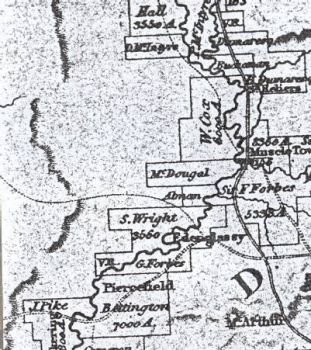
Hunter Valley Settlers on this Map
Francis Allman Joseph Horton
Bettington William Buchanan William Cox
Colonel Henry Dumaresq Sir Francis Forbes
George Forbes Captain John Pike Captain
Samuel Wright
Captain John Pike
'Pickering'
Captain
John Pike first came to New South Wales with Colonel Lachlan Macquarie
and the 73rd regiment in 1809. He returned on the ship Phoenix in
1825 with his wife and daughter and was granted 2000 acres.
He brought with him on the Phoenix 10 saxon ewes and 4 rams and
10 merino ewes. He
travelled to the Hunter River area soon after to select his land and
returned to Sydney at the same time as William Ogilvie and Peter
Cunningham having decided on the future site of Pickering. He and
his wife and daughter travelled by dray to their new home soon after.32
Edward
Duffy, Alexander McBean, John Sadler and William Duggan were four
convicts who probably accompanied him when he first travelled by dray to
Pickering.
Joseph Horton
Bettington
'Piercefield'
Joseph
Horton Bettington was a brother of James Brindley Bettington and John
Henshall Bettington.
William
Carter held the title deeds to this land in 1828. Carter became
insolvent after disastrous land and stock deals and the deeds were
issued to James Brindley Bettington in 1836. Bettington had arrived in
Sydney on the Ionia in 1827 to represent a merchant firm in which
he was partner. He served as a director of the bank of New South Wales
and married a daughter of Lieutenant William Lawson of Veteran Hall
Prospect (former Commandant at Newcastle). After the family partnership
was dissolved, John Henshall
Bettington managed the estate Martindale.
James Brindley Bettington retained Brindley Park at Gummun Plains.
Captain Samuel Wright
'Bengalla'
This
land was a reserved grant to John Bell and a grant to George Cavenagh.
John Bell was commander of the convict ship Minerva and after
several trips to Australia had decided to settle with his family. He
purchased cattle and stocked his land with it while he was away in India
and England. He had been issued with a ticket of occupation while
he was absent from the colony however these were invalid from August
1826 and the land in his absence was granted to Captain Samuel Wright.
Captain Bell settled in Hobart.
George
Cavenagh sold his 1000 acres adjoining Samuel Wright's land and his
right of of occupation on the church land to James Bettington which
Bettington later sold to Samuel Wright. Captain Wright built the stone
house that came to be known as 'old Bengalla' on this land.
Samuel
Wright was born in County Cavan, Ireland
circa 1788. He joined the Buffs, the 3rd Regiment
(Infantry) of the British Army on 6 March 1806 as an
ensign with a purchased commission and was promoted
to Lieutenant by 1810.
He fought many battles with his
Regiment in the Peninsular wars and was wounded at
Albeura in 1811 and in 1813 at Bayonne. He spent
time with the Regiment in Canada when North America
was seeking independence. The Regiment then returned
to Europe and Ireland.
Wright arrived in Australia in
1822 on the Richmond. He became Commandant at
Macquarie Harbour penal colony, Commandant of the
Port Macquarie penal settlement and Superintendent
of Police at Newcastle. His estate 'Bengalla' was
next to the estate of Francis Allman junior.
Samuel
Wright
and Captain Francis Allman had fought together in the
Peninsular Wars and Allman had also been wounded at
the Battle of Albeura
Wright returned to Ireland in 1842
and arrived back in Australia in 1844. He died on 24
March 1852.
George Forbes
'Edinglassie'
George Forbes arrived
in New South Wales in 1824 and was granted 2000 acres in September of
that year. Another 4000 acres were reserved for purchase. He stocked
Edinglassie with fine wool sheep and acted as superintendent for his
brother's estate Skellator. Peter Cunningham described the area in 1826
- 'You enter first upon Edinglassie, the property of Mr. George Forbes,
brother of our amiable Chief Justice who possesses many thousands of
aces here which he is stocking with fine woolled sheep. To the right is
Captain Dickson's farm and on the left in succession the farms of Messrs
Carter, Mills and Ogilvie.'
Edinglassie was
purchased by James White. James White
had arrived in 1826 on the Fairfield employed by the Australian
Agricultural company to bring a flock of sheep which on arrival he
took to 'Retreat Farm at Parramatta before moving them to Port Stephens.
In 1830 White left the Australian Agricultural Company and moved to
Ravensworth, the property of James Bowman where he was employed as
superintendent. He purchased Edinglassie in 1839.
30
In 1852 employees at
Edinglassie included Thomas Way, Joseph Roe, Robert Nicholson,
Thomas Larrance, Kenneth Urquhart, Thomas Byrnes, William Dean, John
Trainer, Patrick Byrnes, Elijah Cartwright, John McPhee, John McCullum,
James Cornish and Benjamin Curn
James White died in
1842.
Sir Francis Forbes
'Skellator'
Sir Francis Forbes
- Chief Justice of
New South Wales. Forbes was born in Bermuda and
later, after studying law in London became attorney
general of Bermuda. In 1816 he was appointed Chief
Justice of Newfoundland. Back in London in the early
1820's he influenced the drafting of the Act for the
better Administration of Justice in N.S.W. and Van
Diemen's Land under which the Legislative council
was formed. He arrived in Sydney in March 1824 on
board the 'Guildford' and by 1828 was in conflict
with landholders over the breaking up of large
holdings and with Governor Darling who attempted to
have him recalled. Unwell, he returned to England in
1836 and was knighted in 1837.
Sir Francis
died in 1841. In 1846 10,049 acres, part of the
'Skellatar' estate owned by 'the late Sir
Francis Forbes' was purchased by George
Bowman. 26
Captain Francis
Allman
'Overton'
Captain Francis Allman was formerly Commandant at Newcastle and veteran
of the 48th Regiment. He became
a prominent settler at Rathluba near Maitland.
Overton was a grant of
2000 acres order by Sir Thomas Brisbane to Francis Allman as a Civil
Servant. A reserve of 2000 was also set aside for future purchase beside
the grant. A new grant was made in 1827 to conform with new land
Regulations. Allman's purchase land was reduced to 640 acres at his
request.
Overton was sold in
1833 to John Kerr McDougall, the eldest son of Andrew and Elizabeth
McDougall. However Captain Allman retained 640 acres of purchased land
of the Overton estate.
William Cox
'Negoa'
William Cox arrived with some of his family in 1800 on board
the 'Minerva'. With his son William, he purchased
8000 acres of land in 1825, naming the estate 'Negoa'.
Colonel Henry Dumaresq
'St. Heliers'
Sir
Edward Parry, on his visit to St. Heliers in 1832
found much beauty about the estate, however the
greater part of the best land, the flats next to the
river, were liable to be covered with water in
floods. Sir Edward found a good deal of the
land in front of the house was under cultivation and
two miles distant was situated what Colonel Dumaresq
called 'the farm', 70 acres of tolerable land. There
was an overseer's cottage and men's huts at the
farm. These huts were well built with little
verandahs in front and very neatly kept. Sir Edward
thought that the men seemed very comfortable in every
respect.
The house at St.
Heliers was considered a very good one, built of
substantial stone however the lime was of poor
quality being procured from an inferior limestone
found 2 or 3 miles from the farm. Parry had remained
at St. Heliers for the weekend, his party with drays
and servants camping at the river on Friday night
where they were supplied with milk and various other
refreshments by Colonel Dumaresq. However Sir Edward
decided to send the party with drays and servants,
ahead to travel beyond St. Aubins on Saturday
morning. He attended a Sunday service performed by
Colonel Dumaresq in the morning at 'the farm' two
miles from the homestead and in the evening a
service was performed at the home to enable said
Colonel Dumaresq, 'all the servants to attend at
least once a day'. This may not have been viewed
with favour by his assigned servants as they, being
expected to attend Sunday service, would have been
unable to travel far on their one day free of
labour!
In 1834 Henry
Dumaresq took over the position of Commissioner of
the Australian Agricultural Company when Sir Edward
Parry returned to England. Dumaresq and his family
moved to Tahlee House at Port Stephens.
Four years later
on 5 March 1838, he died at Port Stephens after a
short illness. His body
was taken on the steamer William IV and
shipped on the Sophia Jane to Green Hills,
there to be conveyed to his estate of St. Heliers.
William
Buchanan
Marsheen later known as
Dartmouth
William
Buchanan received a grant of 1000 acres in June 1824. He was a civil
engineer at Norfolk Island in the following two years and did not have
the financial means to take up his grant. After Norfolk Island he was
employed as Assistant Engineer at Liverpool
and in 1831 was Superintendent of Public Works and Deputy Postmaster at
Newcastle.
In 1839 the Sydney
Gazette advertised that 1200 acres of land promised to William
Buchanan had been granted to H.C. Sempill
Sources
1. Australian Medical Pioneers
Index
2. Backhouse, James., A Narrative
of a visit to the Australian Colonies in 1843
3. Bateson, Charles,
The Convict Ships 1787 - 1868, Library of
Australian History, 1983
4. Boyle, H.F.,
Lieutenant Commander Frederick Bedwell R.N, Paterson
Historical Society
5. Census of New South Wales.
1828
6. Clouten, Keith H.,
Reid's Mistake; the story of Lake Macquarie from its
discovery until 1890. Boolaroo NSW; Lake Macquarie Shire
Council, 1967
7. Convict Indents
8. Decisions of the
Superior Courts of New South Wales 1788 - 1899
9. Early Days of Port
Stephens - Extracts from Sir Edward Parry's Diary.
Dungog Chronicle
10. Hainsworth, D.R. The
Sydney Traders, Simeon Lord and his Contemporaries,
Cassell Australian, Melbourne, 1872.
11. Hunter, Cynthia., The
Settlers of Paterson's Plains, Paterson Historical
Society, 1997
12. Hunter Valley Gazette
13. Index to the Colonial
Secretary's Papers, 1788 - 1825
14. Maitland Mercury
15. Mitchell, C.,
Hunter's River, Estate of Cecily Joan Mitchell, 1984
16. Newcastle Coal
Report: History of Newcastle Mines under Crown and
Australian Agricultural Company
17. New South Wales Registry of
Births Deaths and Marriages
18. Proceedings of the Old Bailey
19. Sydney Gazette
20. Sydney Morning Herald
21. The narrative of a voyage of
discovery performed in his majesty's vessel the Lady
Nelson of sixty tons burthen, with sliding keels; in the
years 1800, 1801, and 1802, to New South Wales
22. Turner, J.W.,
Manufacturing in Newcastle, 1801 - 1900. Newcastle
History Monographs No 8., Newcastle Public Library 1980
23. Uebel , L., The Port
Jackson Convicts Anthology, 2001
24. 1832 Directory
25.Roope,
C., Gregson, P., An Organised Banditti, 2002
(26)
Maitland Mercury 7 January1846
30. White, Judy, The White Family of Belltrees,The Seven Press, Sydney
1981.,
32
Wood, W. Allan, Dawn in the Valley, Wentworth Books, 1972. p.99
This page was last updated on
16/11/2008 |