|
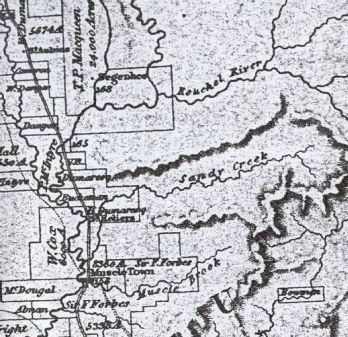
Hunter Valley Settlers on this Map
|
Hugh Cameron William Dangar
William Dumaresq - St. Aubins Thomas Potter Macqueen - Segenhoe Peter
McIntyre
Peter McIntyre
Peter
McIntyre was born in Perthshire, Scotland in 1783,
the son of Donald and Mary McIntyre.
In 1824 he was
appointed agent for Thomas Potter Macqueen who had received a 10,000 acre grant of
land in New South Wales. McIntyre organised
immigrants, livestock and supplies and sailed on the
Nimrod and Hugh Crawford arriving in
Sydney in 1825.
McIntyre also
secured a 4000 acre grant from Governor Darling for
himself and another 4000 acres for his brother John
('Weedon'). He was involved in legal battles with
government surveyor Henry Dangar culminating in
Dangar's suspension from the position. McIntyre's
estate 'Blairmore' was situated near Aberdeen.
McIntyre guided
Allan Cunningham over the Liverpool Ranges in 1827
and the McIntyre River is named in his honour. He
and his brother Donald had squatting runs on the
Liverpool Plains - Byron Plains, Falconer, Kayuga,
Waterloo and Guyra. He was replaced as Macqueen's
agent by Hamilton Collings Sempill in 1830.
Peter McIntyre
died at Pitnacree near Maitland on 13 January 1842.
William Dangar
William
Dangar was born at Lampen, England close to
the village of St. Neot on 10 March 1800. He
travelled to Australia on the 'Cumberland' in 1825
with his brother Thomas. Their brother Henry Dangar was already in the colony.
Henry was employed as Government Surveyor and
William managed Henry's estates for over ten years.
He also acquired land for himself - 800 acres near
Scone was granted ('Turanville') and he was
given permission to purchase 1800 acres adjacent to
Turnaville between Dartbrook and Kingdon Ponds. Later, in 1837 a stock
station of 35,840 acres - 'Kangaroo Hills' was added to his
properties. He employed a superintendent to run this property and
was advertising the position in 1848
14
Thomas Dangar was postmaster at Scone and proprietor
of the St. Aubin's Arms Inn. A younger brother
Richard Cary Dangar arrived in 1836 and commenced a
Store in Muswellbrook. Brother John, died in
1847 aged 37 and was buried in St. Luke's
Churchyard, Scone. Their sister Elizabeth married
Samuel Wellington Cook.
As
well as managing his Estates and those belonging to
his brother Henry, William was Churchwarden of St.
Luke's Church and a District Councillor at Scone.14
He was also a partner in the meat cannery at
Newcastle.
William returned to England in 1857.
He
died in Cheltenham, England on 16 April 1868 and was
buried in St. Neot. A memorial plaque in St.
Neot Church records:
'Sacred to the memory of William Dangar, who died at
Cheltenham on 16th April 1868; in the 68th year of
his age. He was one of the earliest settlers in New
south Wales, where, during a continued residence of
thirty five years he attained by his energetic
spirit of enterprise, and by ceaseless activity , an honorable position, whilst he also largely
contributed to the success of that Colony, in which,
as well as in this parish, his memory will be
respected'
29
Hugh
Cameron
Hugh
Cameron was the Scottish settler who was responsible
for the name 'Scone' being adopted for the nearby
township after he petitioned the Surveyor General,
Thomas Mitchell.
Cameron had been
granted 1280 acres of land by Governor Darling on 18 October 1828. His station at Kingdon Ponds was robbed in 1831 by bushrangers
Bowen, Duffy, Finney and Mason and Hugh Cameron was
a witness at their trial. He stated that knew John
Mason and Hugh Duffy who absconded from the service
of Mr. Dangar. The bushrangers were apprehended by
Sgt. Quigley of the mounted police. They had with
them a few farming implements, seed and provisions
and hoped to go far into the bush to settle. Mason
and Duffy along with Edward Bowen and Patrick Finney
were found guilty of robbing Cameron and were
sentenced to death.
In 1839 Hugh Cameron and his wife wife
Janet conveyed this land to William Black. William Dangar later claimed
Deed of grant to this land.
31
Captain
William Dumaresq
'St. Aubins'
Sir
Edward Parry visited St. Aubin's in 1832. He had previously
visited St. Heliers, the estate of Colonel Henry
Dumaresq and found it a beautiful estate however
when Colonel Henry Dumaresq's brother William took
him on a tour of his own estate St. Aubins, Parry
was far less impressed stating afterwards that he
did not like it at all. St. Aubins was an estate of
13,000 acres owned by William, who had recently
resigned from his position of surveyor of roads and
bridges in the colony and moved there where probably
with the use of convict labour he built a wooden
homestead.
Convicts at St.
Aubins in 1832 included William Kennealy, Lewis
Ward, William Jones and Robert Morrison.
William had
married Christiana Susan Macleay, daughter of
Alexander Macleay in 1830, and on 3 December 1832
Christiana gave birth to a son at St. Aubins. Six
years later Alexander Macleay accompanied the body of
William's brother Henry on the long journey back to
St. Heliers after Henry had died at the
Australian Agricultural Company settlement at Port
Stephens.
Thomas Potter Macqueen
'Segenhoe'
Sir
Edward Parry visited 'Segenhoe', the estate of
Thomas Potter Macqueen, in March 1832. He arrived on
a Monday morning having been driven by Captain
Dumaresq of 'St. Aubins'. Sir Edward had heard much
of Segenhoe estate and was eager to see it. He found
it 'most excellent and desirable' with fine well
watered land and good natural boundaries. No expense
had been spared on the roads in that area and Sir
Edward thought they were equal to and much
resembling the roads in a gentleman's park in
England. He was very impressed and
preferred it to any estate he had seen so far in the
Colony. He was received by Mr. Sempill's wife
and sister, Mr. Sempill being absent at the time.
However Sir Edward
had met Mr. Sempill previously. It was a chance
meeting in Sydney in January 1831 that changed the
future of the Australian Agricultural company (and its workers). Mr. Sempill on meeting Sir Edward offered to sell
on behalf of Mr. MacQueen, a threshing machine. In
the course of the meeting he informed Sir Edward of
excellent quality of land on the Liverpool Plains
for sheep breeding. They went immediately to the
Surveyor General's office to inspect maps which
convinced Sir Edward to arrange for the exchange of
the company's coastal land for land at Warrah and
Goonoo Goonoo on the Liverpool Plains.
There were
numerous assigned servants at Segenhoe in 1832 who
may have been working on the estate when Sir Edward
visited. Among servants assigned at Segenhoe in 1832
were: William Powell and John Taff who arrived on
the 'Portland', Henry Hall a glass cutter from
Warwick and Dominick Herkins a soldier and labourer
who had been convicted in Jamaica, both arrived on
the Asia in 1832 and Charles Bevan carpenter and
joiner who arrived on the Adrian in 1830
There was also
a hospital on the estate, as in 1833 John McLeod
Gillies was employed as a hospital assistant. John Porteus and Benjamin
Lee were indented servants. Benjamin Lee arrived on the
Thames in 1829. He was sent by Macqueen from England to be assistant
Superintendent at Segenhoe under orders of P. McIntyre, Macqueens agent.
Although under employment contract, he waited many months for wages,
eventually instigating court proceedings to recover funds owing to him.
John Porteus (Portus) was a millwright and arrived on the Hugh
Crawford in 1825. He became well known throughout the district and
constructed a steam mill in 1840 known as Morpeth Wheat Mills.
Thomas Potter
Macqueen was born at Segenhoe Manor, Ridgmont,
Bedfordshire in 1791 to Malcolm and Marianne
(Potter) Macqueen. After reading the Bigge report
with interest, Macqueen evolved a plan to develop
the colony with settlers with sufficient capital to
employ convicts on their own account.
He was granted
10,000 acres of land by Governor Brisbane in 1825
and appointed Peter McIntyre as
his Manager. McIntyre selected mechanics, farmers
and shepherds and equipped with farm machinery,
stores, sheep, horses and stud cattle sailed for New
South Wales on the ships Nimrod and Hugh
Crawford. Once in New South Wales, McIntyre
selected this land near Scone which was named
Segenhoe. The indented servants and assigned
servants then began clearing and establishing
buildings and gardens.
However, Macqueen
was apparently dissatisfied with McIntyre's work as his manager
and he had replaced McIntyre with Hamilton Collins Sempill by 1830. H.C.
Sempill's wife Susannah who greeted Sir Edward Parry on his arrival at
Segenhoe in March 1832 was a sister of John Dow who in later was employed as a superintendent at Sempill's
'Belltrees'. Her sister with her at Segenhoe that day was Agnes Dow who
later married James Busby.
Hamilton Collins Sempill and his
family occupied the main homestead at Segenhoe until 1834 when Macqueen
decided to come to Australia. The Sempills were then forced to find
other accommodation, first living in a smaller unsatisfactory building
and then later building a permanent home at Belltrees. Sempill had acquired much land on his own behalf since his arrival -
Ardenhall, Huntingdon and Aberfoyle among them and also the beautiful 'Belltrees.'
Later Sempill was to run into financial difficulties in the 'hungry
forties'. He sold his properties and returned to Scotland where he
remained. 30
In 1833,
MacQueen's wife Anne Astley had passed away and by 1834 Macqueen sold his English
estate to the Duke of Bedford and journeyed to New
south Wales himself. He arrived in Hobart on
the 'Bardaster' in June 1834 and travelled to
Segenhoe where we was appointed Magistrate for the
district by July of that year. He became known for
his extravagance at the estate. A town house was
also purchased at Darlinghurst, Sydney and in 1835 Macqueen attended a levee at Government House,
Sydney to celebrate the King's birthday.
By January 1838,
Macqueen was in financial difficulties and a notice
appeared in the Sydney Gazette of the
extensive sale of his stock. He was to sell by
auction all of his 'fine woolled sheep and other
stock'
prior to leaving the colony and by
1852 he was living in Banbury, Oxford and all his
estates had been sold
Thomas Potter
Macqueen died in 1854.
|
Sources
14. Maitland Mercury
29. Dangar, Elisabeth Mary, William Dangar of
Turanville, Scone & Upper Hunter HIstorical Society
1968
30. White, Judy, The White Family of Belltrees,The Seven Press, Sydney
1981.,p17
31 SG. 2 July
1839
32
Wood, W. Allan, Dawn in the Valley, Wentworth Books, 1972.
This page
was last updated on
16/11/2008 |