|
|
|
|||||||
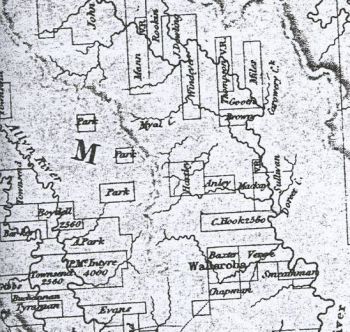
Major Smeathman was granted 1280 acres of land by Governor Darling on 18 February 1828. He was employed as coroner in Sydney and performed the inquest on bushranger Jack Donohoe in 1830 at the Fox & Hounds public house in Castelreagh Street. In 1832 the following advertisement was placed in the Sydney Herald "Valuable Grant of 1280 acres of land for sale without reserve. Mr. Ironside has the honor to announce to the public, that he has received instructions to sell by auction, at the Royal Hotel, on Saturday the 15th September next in one or two lots that valuable Grant of land known by the name of Smeathman's Grant. Containing 1280 acres of land free of quit rent, situate within 3 miles of the navigation of Williams' River, and but 2miles distant from Clarence Town, having 3 1/2 miles of river Frontage, and about 400 acres of valuable Brush abounding with cedar. The grass herbage is most luxuriant, and the grazing part may be said to be boundless, there being in the rear an extensive government reserve. The locality of the Grant and the excellence of the soil renders this a most desirable speculation for either Agriculturists or Capitalist. the Terms will be made known at the time of sale which will be highly advantageous to the Purchaser. " In 1839 a Claim to a grant of land was made by the 'Representatives of the late Major T.C. Smeathman. '
1828 Granted 2560 acres of land in the county of Durham 1832 Appointed first resident Magistrate of Port Macquarie on 9th June 1832. Remained in the position until 1835 1832 - Estate Thalaba situated at the confluence of the Wangi or Thalaba River - 1832 Directory 1832 assigned servants: John Bright - Williams River, William Burley - Hunter river, Richard Bickerton - Williams River, John Byrne - Williams River, John Anstiss - Williams River, John Weston - Hunter River, James Lonergan - Williams River, Thomas Ryan - Williams river 1833 - Thalaba sold by Major Sullivan to Horatio Nelson Matchens for 6/- per acre 1838 - Margaret Snodgrass Sullivan. Wife of Major Benjamin Sullivan. Died of apoplexy at Brandon Hall on 19th February1838 1839 - Police Magistrate - Raymond Terrace 1842 - Present at a meeting of pewholders at Christ Church Newcastle 1847 - Appointed Police Magistrate at Wollombi replacing David Dunlop 1847 - Married Isabella Barbara Ogilvie at Court House, Wollombi on 16 May 1847 1848 - Sworn in as Coroner for Wollombi 1848 - Police Magistrate Wollombi 1848 - Gave address to Lord Bishop of Newcastle, Rev. Tyrrell at Wollombi
Duncan Forbes Mackay In January 1838 Duncan Forbes Mackay was granted 2560 acres of land near Dungog, an original grant to Grayson Hartley. However Mackay was in the district much earlier than this. He arrived on the Orpheus in 1826 and was appointed Superintendent of Public Works at Newcastle in 1826, taking over from Frederick Dixon. Later that year he became embroiled in a controversial court case after a dispute with Captain Robinson who was stationed in Newcastle. Mackay was responsible for many improvements in the township including converting a former blacksmith's shop to barracks for the convicts. Possibly as early as the 1830's a stone homestead was constructed on his land at Dungog, which fronted the Williams River and in 1831 he was purchasing seed wheat from Mr Burnett of the Australian Agricultural Company. By 1833 he had been appointed Clerk to the Bench of Magistrates and was active on the Committee of the Stock Protection Association. Some of the convicts who were assigned to Mackay at Dungog were labourer Michael Casey who arrived on the Brampton in 1823, Patrick Wood who arrived on the John Barry in 1821 Thomas Ivory a 67 year old who arrived on the Fergusson in 1829, 16 year old farm boy James Lawler who died in Newcastle Hospital in 1849; and later 17 year old Henry Ellis who arrived on the John Barry in 1836. Also assigned to Mackay in 1832 was William Spetch a young boy who arrived on the 'Hercules'. Mackay was one of about 15 Hunter Valley settlers to receive young lads who arrived on the ships 'Planter' and 'Hercules' in 1832. The boys, mostly under 16 years of age, were to stay with the master they were assigned to for the duration of their 7 year sentence and not to be transferred or re-assigned in any way. The settlers were instructed by the authorities to make endeavours to instruct and care for their charges until they should reach manhood 31
My thanks to Paul Anley for supplying the following information. PAnley@sydneyports.com.au Ferdinand Wright Anley was born on 30th October 1788 to Ferdinand & Mary Elizabeth Dumaresq. In Australia he was granted 1280 acres of land in 1828 in the County of Durham which he named 'Mountjoye'. William Spelman who arrived on the Ann & Amelia in 1825 was assigned to Anley here. The property was situated on the road from Wallarobba to the Upper Williams River area. Travellers to the farm would pass the north west corner of Mathew Chapman's 'The Grange' estate and then cross the Wallarobba Creek and follow its course through the grants of A.M. Baxter and John Verge where there was a village reserve. John Hook's grant was next and situated to the east of Tabbit Hill. After crossing Tabbit Creek the estate belonging to Ferdinand Anley could then be found. 28 Ferdinand Anley died in July 1837 aged 49. Captain Philip Nicolle Anley was related to Ferdinand Anley. He was born on 30th October 1795 in Maitland St. Clements Jersey to Peter Bonamy Anley & Mary Nicolle. He married Harriet Allez of Guernsey in July 1821 and served in Ireland 1826 -7, Rochdale 1828 and Chartham in 1829 before departing UK for New South Wales in September 1830. Anley was a Captain of 17th Regiment of Foot Leicestershire - also known as 'The Lilywhites, the Green tigers and later 'Bengal Tigers'. They served in India then in 1831 - 1835 at Parramatta and Maitland. He arrived in Hobart, Tasmania on the convict ship 'John' on 28th January 1831, and was appointed Justice of the Peace soon after. In August 1831, Anley served as Magistrate in a controversial rape case at Maitland NSW, (R v. Foley). Timothy Foley was later tried in Sydney and found not guilty as no evidence was offered. Captain Anley was promoted to Major in July 1833 and in October 1834 it was announced in the Sydney Gazette that he would be returning to England. Fifty six residents of the Maitland area signed a letter thanking Captain Anley for his work as a Police Magistrate,30 however it was around this time that an outspoken 'Correspondent' of the Sydney Gazette remarked on the difficulties of appointing Officers in marching regiments to be Police Magistrates. 'When they have gained experience, which, in a Magistrate, constitutes everything, why then off they go to India, and another Officer takes the Magisterial Chair, to be drilled in the same manner into office; and by the time he is competent, why off he goes also. Surely the Government could find gentlemen in every way capable of discharging the duties of a JP and who with a more liberal salary than Police Magistrates are at present allowed who would be willing to establish themselves as fixtures. If we want disciplinarians retired officers both of the army and navy are made of 'Stern Stuff'.29 Phillip Anley departed NSW for England in charge of an invalids detachment on 22nd February 1835 on the Roslyn Castle. He sold his commission on 10th February 1837 in England and died on 16th November 1877 at Marylebone.
Offered for sale in June 1844 - 1020 acres - a grant to John Mann in 1828 in lieu of a former selection in the name of Samuel Furneaux Mann. Convicts assigned to John Mann in the 1830's included: Andrew Caldwell who arrived on the Countess Harcourt 1827 (whitesmith) Benjamin Redwood who arrived on the Portland 1832 (Potboy) Finley Ferguson who arrived on the Marquis of Huntley 1830 (Shearer and Shepherd),
Archibald Windeyer arrived in New South Wales on the James Pattison in December 1838. Through his brother Charles, he bought this property of 1000 acres. He purchased 'Kinross' near Raymond Terrace from G.T. Graham and 'Deepwater' near Glen Innes in 1839. In 1847 he was advertising to let this property 'Tilligra' near Dungog.
In addition to Cairnmore at Williams river, Crawford L. Brown also owned land at Patrick Plains - Blackford. Brown served as a Magistrate at Dungog. He was sworn in at Maitland Quarter Sessions in 1845. In January of 1846 he was serving as Magistrate the day his assigned servant Thomas Fry was sentenced to two years in irons after he assaulted Brown. In 1850 he wrote a letter to Edwin Hickey which was presented at a meeting of the Australian Society regarding the extent of cedar remaining in his district : Cairnmore, 17th July 1850 My Dear Sir, I have to acknowledge receipt of your letter of the 7th instant, and in reply beg to say that I perfectly recollect the conversation you allude to respecting the cedar ranges of the Upper William and Chichester Rivers. You will also remember my showing you one of the largest cedar trees growing in my heifer paddock that I ever saw, even in this district of cedar trees. It still stands untouched as you saw it that day. I believe I could find on my farm 50,000 feet of sound marketable timber, equal to any cedar ever sent to market. As to the flats on the banks of the River William, I believe it is nearly all cut that is easy of access; but the mountain ranges, I am credibly informed, are inexhaustible. That talented surveyor, Mr. G.B. White who surveyed those mountain ranges at the request of the Surveyor General, told me that cedar was the principal timber on these ranges; and from what I have seen of them in collecting my stray cattle on some of these ranges, above Mr. Foster's farm, on the east bank of the William River, I must add that Mr. White's remarks to me appear to be fully borne out. The reason why these fine forests of cedar are still growing is, that they are at present inaccessible to the cedar trade, from their great distance from water carriage, and consequent expense in conveying to market. But it is not difficult to see that all obstacles of that sort will be removed as the colony advances, from railways etc.
James Dowling was born in London in 25 November 1787. He married Maria Sheen in 1814 and on his appointment as Judge in the Colony they travelled together to Australia. He was granted 2560 acres of land in 1828 and established Brougham Lodge in Woolloomooloo and also took up land on the Williams River. In 1829 Justice Dowling travelled to Maitland where he held the first Circuit Court in the town. He was appointed Chief Justice in 1837 and was knighted in 1838. He has been described as industrious, meticulous, urbane, mild mannered and indefatigable. Worn down by hard work and financial difficulties, he died in 1844. The Sydney Dispatch carried the following obituary {Extract}: 'We feel deep sorrow to have to announce the death of Sir James Dowling, chief Justice, who expired yesterday about three o'clock in the afternoon. Amongst the various circles of society in this colony, we know of none in which this intelligence will not spread deep gloom and unfeigned regret. Few, very few men in his exalted situation, with the severe, responsible and arduous duties which he had to perform, have so deported themselves as to ensure that almost unanimous feeling of respect and esteem which pervaded almost every mind towards our lamented Chief Justice. As a judge, learned, patient, and impartial - impressed with a deep sense of the solemnity and responsibility of the duty entrusted to him - acting ever with that strictness of integrity, that unbiased and unwarped judgment, which gave to all his decisions the sanction of an implicit trust in the justice of the man who pronounced them. As a man, how many, how very many in this colony will have to lament the death of sir James Dowling. How many a vacant place will appear in these circles both of social intercourse, and benevolent and charitable communion, in which it was his lot to move. Men perhaps of higher talent, of more glittering abilities there may be in this colony, but none, we will venture to say, who joined to a deep sense of the duties he had to perform - the industry, the capacity to act up to the requirements which that sense imposed upon him.... Long and faithfully did he fulfil the trusts reposed in him; long and faithfully has he served his Sovereign, and the people among whom his lot has been cast. In the discharge of those duties - alas that it should be so - domestic ties, the clinging to life, the careful sustenance of health have been alike disregarded. Gradually under the pressure of that burden Sir James Dowling gave way. The energies which had been so long so usefully exerted, performed their functions to the last. Ours alas, is the loss, his the relief. "After life's fitful fever, he sleeps well," but amidst the annals of these earlier days in the history of Australia, we prophecy the pen of the historian will still assign one page of respectful and affectionate remembrance to the name of Sir James Dowling.' The pension due to his wife on his death was not immediately forthcoming and in 1848 Lady Dowling, still dealing with financial issues, was forced to apply to Earl Grey for the amount of her pension to be paid from the date of his death to the date the pension was granted. A tragedy occurred on this estate in 1849. The grandson of a settler on the estate was drowned while trying to reach his sister who was in danger of being swept away after attempting to cross over the river on a log. Thomas Trotter's eight year old grandson Richard Robinson lost his footing and was instantly carried out of sight along with the log which was forced from its position by the strength of the current. The Williams River had risen from eight to ten feet in less than an hour and Richard's body was not found for two days.
Signed address to the governor Sir Richard Bourke on the occasion of the governor's visit to Newcastle in 1833 Property situated on the Chichester River. Convict labourer in July 1836.
Francis Blower Gibbes was a Lieutenant in the Royal Navy and was on board the British owned 'Redridge' which ran aground off the coast of Jamaica in 1805. He arrived in Australia on the Hugh Crawford in 1825. He was granted 2000 acres in the upper Hunter in 1825 by Sir Thomas Brisbane. Soon after he transferred this grant to William Bell Carlyle and Francis Little and moved to the Paterson area where he increased his holdings by purchasing land. He settled at 'Norwood'. Gibbes or his son, also Francis, was a Magistrate at Paterson in 1842. They established an extensive run of paddocks on their estate which was used for horses. In the 1840's they were advertising for grooms and horse breakers for the property. Lieutenant Gibbes died on 17th July 1844 at Hanover, Jamaica
John Hook was granted 2560 acres of land in 1828 which he took up near Dungog. In this year he employed John Wood who had arrived on the Prince Regent as his overseer. Edward Byrne who arrived on the Earl St. Vincent and Dougall Campbell were also employed on the estate. George Berwick per 'Prince of Orange' was an assigned servant in 1828. In 1839 one thousand acres were advertised for lease for a term of ten years at Crookes Park. They were to be let in small farms from ten to one hundred acres each. The land was described as being on the banks of the Upper Williams River with rich alluvial soil that produced wheat and tobacco even in drought. The conditions of the lease were that the first five years would be rent free to compensate for bringing the land into cultivation and the remaining five years to be at a rent of one pound per acre per annum. A Flour Mill was erected on the property. 32In 1845 John Hooke passed away and the following notice appeared in the Maitland Mercury: 'Died this day at one clock at his residence, Crook's Park, in this district, John Hooke, sen., Esq., leaving a large family to deplore his loss. Mr. Hooke is much and deservedly regretted by all who knew him. He was a kind father and a generous landlord. He had a long and severe illness. He will be interred on Tuesday next, in his family vault, on the estate of Crook's Park.33 John Hooke junior continued farming in the Dungog district and in March 1847 he was advertising a small farm of 16 acres to let. Then in May of that year disaster struck: 'On Friday evening last Mr. Hook, a farmer near Dungog, lost the whole proceeds of his harvest by an accidental fire. It appears that about five o'clock in the afternoon, a man in Mr. Hooks employ was proceeding from the house to the field, and in passing along he was lighting his pipe from a brand he held in his hand. He passed close by the pigsty, and went on his way. From the pigsty to the corn shed, a space of some six or eight rods, lay a regular train of corn husks, dropped in carrying corn to the pigs and it is supposed a spark from the brand fell on the husks, and taking fire at length, a high wind assisted the aflame till it ran along the train and caught the shed. Soon after it caught, Miss Hook , who was in the house, saw the flames and immediately gave the alarm, but unfortunately all the men were at work in the field. Before they could arrive, the shed and its contents, and a barn filled with wheat, which stood close by, were burning fiercely, and by ten o'clock the whole was a mass of ashes, into a vestige being left of barn or shed. The house escaped, and no further damage was done. There were about 300 bushels of corn in the shed, and the same quantity of wheat in the barn.'
In 1836, 2560
acres in the Upper William's River promised to Archibald Mossman by
Governor Darling on 6th February, 1829 was re-advertised
in favour of John Lord. In March 1844 the Maitland Mercury
reported the following incident that took place on this estate 'Fatal Accident. A
melancholy accident occurred in this neighbourhood on
Friday, the 16th February. A day or two previous Mr.
John Ashworth, Mr. Lord's superintendent at the
Gloucester, had missed some sheep. On the morning of the
16th he, with some other parties, went in search of
them. While passing a native camp they saw the
aborigines sitting round the fire, and very deliberately
roasting some mutton. Mr. John Ashworth called to the
party to surround the blacks to make prisoners of them,
but they started immediately. The ground was very rough
and broken, and Mr. Ashworth putting his horse to speed,
he stumbled, and Mr. A. was thrown on his forehead. He
was picked up immediately, and medical aid sent for, but
on the 21st he died, deeply regretted by all who
knew him. He was in the bloom of life. I should have
mentioned that previous to the party going in search,
the shepherd who had the sheep in charge had come on the
blacks while slaughtering them when they threatened to
kill him unless he promised he would say nothing of it.'
. Sources 1. Australian Medical Pioneers Index 2. Backhouse, James., A Narrative of a visit to the Australian Colonies in 1843 3. Bateson, Charles, The Convict Ships 1787 - 1868, Library of Australian History, 1983 4. Boyle, H.F., Lieutenant Commander Frederick Bedwell R.N, Paterson Historical Society 5. Census of New South Wales. 1828 6. Clouten, Keith H., Reid's Mistake; the story of Lake Macquarie from its discovery until 1890. Boolaroo NSW; Lake Macquarie Shire Council, 1967 7. Convict Indents 8. Decisions of the Superior Courts of New South Wales 1788 - 1899 9. Early Days of Port Stephens - Extracts from Sir Edward Parry's Diary. Dungog Chronicle 10. Hainsworth, D.R. The Sydney Traders, Simeon Lord and his Contemporaries, Cassell Australian, Melbourne, 1872. 11. Hunter, Cynthia., The Settlers of Paterson's Plains, Paterson Historical Society, 1997 12. Hunter Valley Gazette 13. Index to the Colonial Secretary's Papers, 1788 - 1825 14. Maitland Mercury 15. Mitchell, C., Hunter's River, Estate of Cecily Joan Mitchell, 1984 16. Newcastle Coal Report: History of Newcastle Mines under Crown and Australian Agricultural Company 17. New South Wales Registry of Births Deaths and Marriages 18. Proceedings of the Old Bailey 19. Sydney Gazette 20. Sydney Morning Herald 21. The narrative of a voyage of discovery performed in his majesty's vessel the Lady Nelson of sixty tons burthen, with sliding keels; in the years 1800, 1801, and 1802, to New South Wales 22. Turner, J.W., Manufacturing in Newcastle, 1801 - 1900. Newcastle History Monographs No 8., Newcastle Public Library 1980 23. Uebel , L., The Port Jackson Convicts Anthology, 2001 24. 1832 Directory 25. General Return of Convicts to New South Wales 1837 (26)Roope, C., Gregson, P., 'An Organised Banditti,The Story behind the Jewboy Bushranger Gang.,Lake Macquarie, 2002 (27) Sydney Herald,December 10th 1840. (28) 1832 Directory (29) Sydney Gazette12 May 1835 (30) Sydney Gazette 4 October1834 (31) AO 1046 6/6007 CSOL 1832 -1833, 32/972 (32) Commercial Journal 4 September 1839 (33)Maitland Mercury 24 May 1845 (34) Sydney Gazette 4 June 1831 This page was last updated on 31/01/2010
|
||||||||
Free Settler or Felon © 2006 - 2010
![]()