Your browser does not support inline frames or is currently configured not to display inline frames.
Search The Database
Hunter Valley Settlers 1837
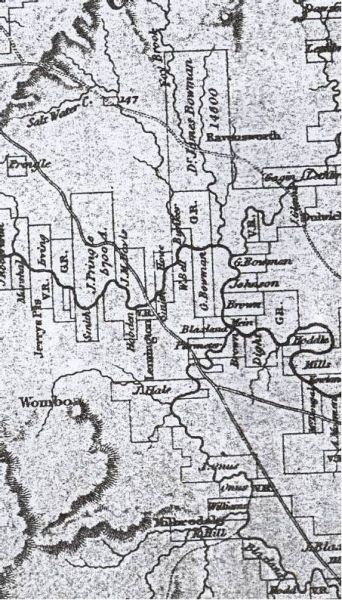
Map 5
Site Search
(Doesn't include the Database)
Settlers
Hunter Valley History Connection - Post your family history on the message board or add pages
Colonial History - 19th Century Medical terms - Military - Journals - Norah Head - Convicts.....
Colonial Events Year By Year - 1788 - 1844 Bushranger Index - Hunter Valley Bushrangers 1800 - 1850.........
Hunter Valley Medical Practitioners Index -
Maitland
*Have you found the information and Maps on these pages useful? Please acknowledge the Free Settler or Felon site if you wish to reproduce anything from these pages
Click on a name on the map below or scroll down the page to find settlers on this page
Select from the menu on the left for more maps and settlers
Hunter River - Dulwich - Ravensworth Mibrodale - Jerry's Plains - Foy Brook
Hunter Valley Settlers on this Map
William Simms Bell (Cheshunt) Geoge Bowman James Bowman (Ravesworth) John Martin Davis Robert Dawson (Goorangula) George Dight John Gaggin James Glennie (Dulwich) Rev. Richard Hill Richard Hobden (Great Lodge) Robert Hoddle John Howe (Mibrodale) Sampson Marshall George Galway Mills Archibald Mossman Joseph Onus Dr. Parmeter J. Pringle Robert Adamson Rodd
Select here to read 'Industry and Perseverance' - a history of David Brown & family of Jerry's Plains.
'Goorangula'
Robert Dawson was born in Essex in 1782. In 1824 he was appointed Agent for the Australian Agricultural company. He sailed for Australia with livestock and supplies and employees of the Company on two ships, the Brothers and the York in 1825. Some of those accompanying him on the York were: William Barnes, shepherd, Charles Beal, carpenter; Charles Hall, woolsorter; William Telfer, Overseer.
And on the Brothers: John Adams, Blacksmith; John Armstrong, surveyor; Henry Blackford, butcher; John King, ploughman; Everitt Simmonds, groom; John Simmonds, groom; William Smyth, wheelwright; John Stokes, dairyman; Andrew Telfer, shepherd; Thomas Tulk, bricklayer and Dawson's nephew John Dawson.25
Dawson worked hard to establish the Company's estate at Port Stephens however his tenure with the Company was fraught with difficulties from the time he reached Australia. He clashed with the very influential committee members of the Company who undermined his achievements. This resulted in his suspension from duties after a hasty enquiry. His wife and daughter had died during his time in Australia however he returned to England where he published details of his experience with the Sydney Committee and London Directors.15
Later Dawson returned to Australia with a new wife and young son. He had received a land grant of 1280 acres from Governor Bourke in March 1836, and after visiting the area east of Singleton and being impressed with the beauty of the area he determined to take up his grant at Goorangula Creek. He named the property 'Goorangula'.19
In 1840 he received a grant of 100 acres at Little Redhead which he sold 20 years later to James Mitchell when he returned to England. 15
Robert Dawson died in England in 1865.
.
James Glennie 'Dulwich' One evening at the end of May in 1847 a small group of settlers in Singleton sat down to a public dinner in the 'tastefully decorated' long room of Mr. Ledingham's Sir Thomas Mitchell Inn. The occasion was in honour of James Glennie who was leaving the district to reside on his station 'in the interior'. At six o'clock everyone sat down to a sumptuous dinner. Everything that the epicure could desire was placed upon the table; the wines were of first rate quality. The chair was taken by Charles Simpson, guest of honour James Glennie was seated on his right; Mr. J.C.S. McDouall on his left; Also present were Theophilus Foote, Henry Bailey and Mr. Carter. Mr. Simpson gave the toasts. After toasting the Queen, he next proposed a toast to the guest of honour, stating that Glennie had been an inhabitant of the district for the last twenty years and during that time had earned the good feelings of all classes. The health of Mr. Glennie was then raised, with nine times nine. Mr. Glennie then returned thanks. He felt himself at a loss for words to express his feeling upon this occasion. He felt sorry that he was not a public speaker, but he hoped they would take the will for the deed, and accept his sincere thanks for the honor they had done him. Many toasts were then drank and Mr. Robinson gave a very long and eloquent speech regarding education. Several songs were sung during the evening by Messrs. Bailey, Williams, Ravenscroft and other with the party breaking up at 11 o'clock. So ended James Glennie's years in Singleton.14
James Glennie
'Dulwich'
One evening at the end of May in 1847 a small group of settlers in Singleton sat down to a public dinner in the 'tastefully decorated' long room of Mr. Ledingham's Sir Thomas Mitchell Inn. The occasion was in honour of James Glennie who was leaving the district to reside on his station 'in the interior'. At six o'clock everyone sat down to a sumptuous dinner. Everything that the epicure could desire was placed upon the table; the wines were of first rate quality. The chair was taken by Charles Simpson, guest of honour James Glennie was seated on his right; Mr. J.C.S. McDouall on his left; Also present were Theophilus Foote, Henry Bailey and Mr. Carter. Mr. Simpson gave the toasts. After toasting the Queen, he next proposed a toast to the guest of honour, stating that Glennie had been an inhabitant of the district for the last twenty years and during that time had earned the good feelings of all classes. The health of Mr. Glennie was then raised, with nine times nine. Mr. Glennie then returned thanks. He felt himself at a loss for words to express his feeling upon this occasion. He felt sorry that he was not a public speaker, but he hoped they would take the will for the deed, and accept his sincere thanks for the honor they had done him. Many toasts were then drank and Mr. Robinson gave a very long and eloquent speech regarding education. Several songs were sung during the evening by Messrs. Bailey, Williams, Ravenscroft and other with the party breaking up at 11 o'clock. So ended James Glennie's years in Singleton.
He had arrived in Australia forty three years previously on board the Guildford a convict transport with 159 prisoners with their guard, a detachment of the 40th Regiment under Lieutenant Thornhill. On the 11th March 1824 the Sydney Gazette recorded that the 'Guildford' had arrived to the 'joy of the whole colony, alarming apprehensions being entertained for her safety.'19
On arrival, James Glennie was granted 2080 acres in 1824 at Falbrook and along with convict servants, was supplied from Government Stores for six months. Glennie's servant Abraham Carter accompanied him to Australia on the Guildford.
Glennie's estate was known as Dulwich and Falbrook was renamed Glennies Creek in his honour. James Glennie married Susan White in 1832 and their daughter Mary Helena was born in 1833. Their son James Halliday was born in 1836 however died in childhood. 17
Just a few months before James Glennie left Singleton the Governor Sir Charles Fitzroy was scheduled to pay a visit to the Hunter. A great deal of planning went into his visit by the various towns. In Singleton Glennie joined with other inhabitants John Browne, John Smith, David Stolworthy, Walter Rotton, Thomas Hope, John Johnston John Holden, Alexander Munro, William Lesley and Alfred Levien in calling for a public meeting to arrange matters connected with the reception for the Governor and to plan an appropriate address to be given. Despite inclement weather the Governor visited Singleton in February and Glennie was introduced to him along with others settlers in the district. Governor Fitzroy later called at Dulwich for refreshments before continuing his journey.
In April 1848 the Estate of 'Dulwich' situated one mile from Camberwell Church was advertised to be let. The estate consisted of a good dwelling house and offices both in excellent order. The entire 3000 acres were all fenced with a considerable portion cleared and water was plentiful as there was three miles of water frontage. A 15 acre garden containing 10 acres of vines of the best description had been established. There was said to be an unlimited supply of surface coal and the public pound was situated on Dulwich as well. A number of tenants were on the estate paying rental of 140 pounds per annum.
Archibald Mossman Early in August 1834 an aboriginal native Wong-ko-bi-kan (Jacky Jacky) arrived in Sydney on the steamer William IV, having left Newcastle in a dreadful state. He was entirely naked and the irons on his legs had cut through to the bone. He was seen to cry most bitterly at his situation. 8 Until a few days previously Wong-ko-bi-kan had been living with others in his tribe quietly on the Station of Archibald Mossman on the Williams River. He would fetch firewood and water for workers such as Jonathon Webster who was employed by Mossman - probably in exchange for tobacco or food. For some reason tribe members attacked a station on Mossman's property. The pursuit party raised - apparently to capture ringleaders of the attack - consisted of seven armed, mounted men from both Mossman's station and the station of nearby Magistrate Mackenzie. Upon finding the tribe, a battle ensued and John Flynn was speared through the shoulder blade by a native said to be Wong-ko-bi-kan who with others tried desperately to escape by ascending a nearby hill. However the men ran them down and he and several women and children were captured. After much mistreatment he was eventually forwarded to Sydney where despite the testimony of Jonathon Webster that Jacky Jacky (Wong-ko-bi-kan) was peaceful and unlikely to commit such a crime, he was convicted of manslaughter.8 Archibald Mossman the settler on whose property this tribe resided was born 15 October 1799. His twin brother George was also a settler in the district. Archibald arrived in New South Wales on board the Civilian on 24 August 1828 after spending time growing sugar in the West Indies. Once in Australia, Archibald became involved in both the whaling and pastoral industry. Terence Murphy and Patrick Leary were assigned to Mossman at Williams River 1832 and were possibly still on the property when the above incident took place. 19 Archibald's brother George remained in the Williams River district however in 1838 Archibald settled on 'Furracabad' station near Glenn Innes. In 1836 he forfeited 2560 acres of land in the Upper Williams River area which had been promised to him by Governor Darling in 1829. This land was later advertised in favour of John Lord 19 Archibald married Harriet Farquarson in December 1847 and died in 1863.
Archibald Mossman
Early in August 1834 an aboriginal native Wong-ko-bi-kan (Jacky Jacky) arrived in Sydney on the steamer William IV, having left Newcastle in a dreadful state. He was entirely naked and the irons on his legs had cut through to the bone. He was seen to cry most bitterly at his situation. 8
Until a few days previously Wong-ko-bi-kan had been living with others in his tribe quietly on the Station of Archibald Mossman on the Williams River. He would fetch firewood and water for workers such as Jonathon Webster who was employed by Mossman - probably in exchange for tobacco or food.
For some reason tribe members attacked a station on Mossman's property. The pursuit party raised - apparently to capture ringleaders of the attack - consisted of seven armed, mounted men from both Mossman's station and the station of nearby Magistrate Mackenzie.
Upon finding the tribe, a battle ensued and John Flynn was speared through the shoulder blade by a native said to be Wong-ko-bi-kan who with others tried desperately to escape by ascending a nearby hill. However the men ran them down and he and several women and children were captured.
After much mistreatment he was eventually forwarded to Sydney where despite the testimony of Jonathon Webster that Jacky Jacky (Wong-ko-bi-kan) was peaceful and unlikely to commit such a crime, he was convicted of manslaughter.8
Archibald Mossman the settler on whose property this tribe resided was born 15 October 1799. His twin brother George was also a settler in the district. Archibald arrived in New South Wales on board the Civilian on 24 August 1828 after spending time growing sugar in the West Indies.
Once in Australia, Archibald became involved in both the whaling and pastoral industry.
Terence Murphy and Patrick Leary were assigned to Mossman at Williams River 1832 and were possibly still on the property when the above incident took place. 19
Archibald's brother George remained in the Williams River district however in 1838 Archibald settled on 'Furracabad' station near Glenn Innes. In 1836 he forfeited 2560 acres of land in the Upper Williams River area which had been promised to him by Governor Darling in 1829. This land was later advertised in favour of John Lord 19
Archibald married Harriet Farquarson in December 1847 and died in 1863.
Colonel George Galway Mills
Colonel George Galway Mills was appointed Registrar of the Supreme Court of New South Wales and arrived in Sydney in 1824. He was granted 2000 acres by Governor Brisbane and this was increased under Governor Darling to 2,560 acres. He died from a self inflicted injury in 1828.
Robert Hoddle
1794 Born in England.
1823 Assistant Surveyor. Surveyed Bell's track from Richmond to Cox's River and explored for better road to the Hunter River settlements,
1824 28 December. Granted 1000 acres of land at Warkworth by Sir Thomas Brisbane
1837 Appointed senior surveyor at Port Phillip
1881 Died 24 October 1881
Thomas
De Quirosville
Select: Dr. Thomas Parmeter (Hunter Valley Medical Practitioners)
Or
A Visit to my Daughter - For an account of a journey taken by Thomas Parmeter
George Bowman
George Bowman arrived in 1798 with his parents on the Barwell. His father John settled on the Hawkesbury river and in 1821 George was promised a land grant of 600 acres. This was located on the northern banks of the Hunter river in the Parish of Ravensworth. Although he lived on his farm at Richmond, George took up another grant in 1824 of 1130 acres which became 'Arrowfield' where he established a stock station. He purchased another 2000 acres adjoining his grant in 1825. This was situated on the southern bank of the Hunter opposite the junction of Fal Brook with the Hunter. This property was named 'Archerfield'.
William Simms Bell
'Cheshunt'
William Simms Bell was the eldest son of Archibald Bell of Windsor and brother of Archibald Bell of 'Corinda'
He was granted 700 acres of land near Leamington by Sir Thomas Brisbane on 14 July 1825, although a stock station had already been established prior to this date at 'Cheshunt'. Despite the very dry conditions - (Donald McIntyre reported that he had less than 48 hours of rainfall between 1827 and 1829) - Bell had a crop of wheat planted in 1827 - 28. This crop suffered badly when a blast of hot wind from the west destroyed crops throughout the region.
In August 1827 probably along with many other settlers of the district, he attended a function at Castle Forbes to celebrate the marriage of James Mudie's daughter.
In 1845 notices were placed in the Maitland Mercury advertising that Bell's belongings and 5126 sheep and 800 head of cattle were to be sold by public auction at 'Cheshunt' by order of trustees
John Howe
John Howe was born in 1774 at Redbourn in Hertfordshire, England. He arrived free on the Coromandel in 1802 and received a grant of 100 acres. He became an auctioneer at Windsor and worked on road and bridge construction projects before being appointed Chief Constable at Windsor in 1814 and Coroner in 1821.
After his first wife, who accompanied him to Australia died, he married Jane Kennedy, sister of explorer Edmund Kennedy. Jacky Jacky, the native who accompanied Kennedy was from the Jerry's Plains tribe and Adoniah Vallack of Singleton was appointed surgeon on the rescue attempt for the expedition. Vallack arrived in Port Albany on the 'Ariel' in 1848 to find Kennedy had perished at the hands of a hostile tribe.
John Howe received grants of land in the Hunter Valley after his expeditions in 1819 and 1820 to find an alternate route to the new settlements and to open up more grazing land to the north. On his 1820 expedition he travelled down the Valley (Howe's) beside the Bulga mountains and then passed through Mibrodale.
His land grants consisted of 700 acres east of Singleton which was named Redbourn Bury Estate and this 500 acres in the Parish of Ravensworth. He was in dispute with James Mudie over ownership of land at Patrick Plains in 1823 however left the running of his properties to his family while he lived at 'Raworth' near Morpeth. 'Raworth' was a 200 acre estate granted to James Griffiths in 1823
John Howe died at 'Raworth' in 1852 and was buried in the Cemetery at Morpeth.
Dr. James Bowman
Ravensworth
Dr. James Bowman was appointed Principal Surgeon for the colony of New South Wales after arriving on the John Barry in 1819.
He married Mary Isabella Macarthur in 1823 and by 1832 had established a sheep run on more than 11,000 acres at Ravensworth.
In March 1832 Dr. Bowman's farm, 'Ravensworth', was visited by Australian Agricultural company Commissioner Sir Edward Parry on his journey to the Liverpool Plains.
Parry and his party had left Maitland at 9 am and reached 'Glendon', the estate of Helenus and Robert Scott by 4pm. The following day they left 'Glendon' at 10am and proceeded across Black Creek. After this the road passed Major Mudie's 'Castle Forbes' through Dangar's 'Neotsfield ' to the Hunter River crossing near Singleton's 'Plough Inn'. After crossing the river the first property was James Glennie's 'Falbrook' and the road then went via Ravensworth where they arrived at at 3 o'clock. They were kindly received by Mr. & Mrs. White who were formerly in the service of the Australian Agricultural Company. Here he was comfortably lodged although he did not think highly of the Estate. He thought a great deal of money must have been spent to clear and stump large home paddocks. The flat land near the Foy Brook, Mr. White did not consider good and the higher land was too thickly timbered with ironbark to be of any good or even middling quality. Dr. Bowman was building a substantial stone cottage for the use of Mr. White. Their garden consisted of 8 acres fenced with a paling fence and a little stream running through it. It was partly laid out in a tasteful and ornamental manner. Sir Edward thought that if 5 or 6 men could always be employed it could soon be a very handsome garden however he thought it too large for a private estate like Ravensworth.
By 1840 Bowman had retired to Ravensworth. The infamous Jewboy Gang robbed nine drays near his estate in November of that year. In 'An Organised Banditti', Colin Roope and Patricia Gregson given an account of the robbery:
'On Sunday November 22, opposite Dr. Bowman's Ravensworth estate, about half way between Singleton and Muswellbrook, Marshall, Davis and Shea held up nine drays, five in one spot and four some distance further on and a short time later. Their actions during these raids showed they were very familiar with the set up of the drays.
The robberies were reported in the Sydney Herald:
Patrick Plains: On Sunday last, the 22nd instant, nine drays belonging to different parties were stopped near Dr. Bowman's estate, by three armed men, and a great deal of property was destroyed. Altogether there were twenty men with the drays, and some of them well armed, and it is evident therefore that there must have been some collusion between them and the bushrangers.
The Colonial Secretary, on behalf of the Governor requested Police Magistrate Percy Simpson to conduct an enquiry into the circumstances of the robbery and he took depositions from men at Bowman's estate. William Lineham stated that he was a farm constable on Dr. Bowman's estate - "Yesterday morning there were four drays encamped on the road outside the fence near Ravensworth on their way up the country. One of the draymen, whose name I don't know, informed me that three armed Bushrangers had robbed the drays of spirits and other articles that morning Another of the men with the drays told me that the Bushrangers had made him give up two muskets and two pistols, and a watch and some powder and shot, out of a box which he had in his possession on one of the drays." 27
James Bowman died in August 1846 at his residence Ravensworth. After his death Ravensworth was purchased by William Russell and eventually in 1882 by Duncan Forbes Mackay.
John Martin Davis
John Martin Davis' estate was named Maryville. His wife gave birth to a daughter here on 17 February 1839.
Convicts assigned to him in 1832 included John Clarke, Patrick Slattery, James McIlvane and John Sinnet
John Martin Davis also owned land in the Wollombi district near Millfield called Glenmore where he was raided by the Jewboy gang in 1840.
In 1848 his wife gave birth to a son at Currabubla on the Liverpool Plains.
Great Lodge
In 1846 twenty eight year old Richard Hobden, described as of respectable parentage and considerable property - sober, industrious, honorable, intelligent and amiable, respected and beloved from his infancy by all who knew him - was committed for trial, placed upon the chain and forwarded down the country to be tried before a jury. He was accompanied on this humiliating journey by his father-in-law Thomas Ellis, brother in law William and Patrick Fox. William Ellis, Richard Hobden and Patrick Fox were indicted for cutting and maiming one John Waters and Thomas Ellis for stealing money from Waters.14
Richard Hobden was the eldest son of Richard Hobden who had arrived on the Earl of Spencer in 1813 and his wife Albenia Walker. Richard Hobden senior had received a land grant from Sir Thomas Brisbane in 1824. 13
Richard junior's mother Albenia died when he was eleven and in 1838 he married Jane Ellis in the Presbyterian Church at Whittingham. Jane was the daughter of Thomas Ellis a respected employee of George Bowman of Harrowfield. They continued to live at 'Great Lodge' , the family property near Jerry's Plains. Richard's sister Elizabeth also possibly remained on the property as in 1848 she was advertising a reward for a lost or stolen mare.14
Thomas Ellis was employed as a superintendent by George Bowman and John Waters was employed by Thomas Ellis and living with the family on their property. Waters had apparently made certain advances to a daughter of Mr. Ellis at which time his employment was terminated.
Waters then made two complaints to George Blaxland Esq, Magistrate of the district of being robbed of his money and a portion of his ear cut off by three men who had done so with the purpose of making him put out his tongue with the intent of cutting it off.
The next day a warrant was issued for the apprehension of Thomas and William Ellis, Richard Hobden and Patrick Fox. Chief Constable Everness of Merton placed them in handcuffs in the lockup at Merton before accompanying them to Maitland.14
Their case did not come up until September and they may have remained in Gaol in Maitland in the intervening months. When their case was finally heard John Waters was absent and could not be found. The Solicitor General thought there was reason to believe that the charges he had preferred were not honest and he had no desire that the prisoners would remain in custody for a indefinite period. The prisoners solicitor Mr. Windeyer applied for a discharge on their own recognizance to appear and answer the charges preferred against them should they be so required to be do by the Attorney General. 14
J. Pringle Carrington Park managed by Robert Pringle in the 1830's. Part of an 1822 grant of 2000 acres to Thomas Horton James who sold to Solomon Wiseman and Robert Pringle in 1832. Robert Pringle arrived in 1824 in the Denmark Hall. He acquired extensive extensive sheep and cattle stations at Liverpool Plains Sampson Marshall Select here to find out more about Sampson Marshall
J. Pringle
Carrington Park managed by Robert Pringle in the 1830's. Part of an 1822 grant of 2000 acres to Thomas Horton James who sold to Solomon Wiseman and Robert Pringle in 1832.
Robert Pringle arrived in 1824 in the Denmark Hall. He acquired extensive extensive sheep and cattle stations at Liverpool Plains
Sampson Marshall
Select here to find out more about Sampson Marshall
Joseph Onus
Joseph Onus (Oness) arrived on the Glatton in 1803 after receiving a life sentence in 1801 in Kent. The Sydney Gazette recorded the arrival of the Glatton on the 19th March - the Glatton had put into Rio de Janeiro en route and arrived in Sydney Cove with 263 male convicts and 130 female convicts, twelve having died on the way. One hundred scurvy weakened convicts were put on board the Supply the day before the Glatton arrived in Sydney Cove. Half of these were sent immediately to the Sydney Hospital to recover
Joseph Onus lived in the Windsor district and he and his assigned servants made several journeys with cattle in the 1820's from Windsor to the farm of Benjamin Singleton. Joseph was allowed temporary occupation of land at Cockfighters Creek to use as a grazing run in 1825.13
He died 22nd June, 1835.
John Gaggin
John Gaggin possibly moved to this property belonging to his father in law John Brabyn situated at Fall Brook after leaving his farm on the Hunter River.
Rev. Richard Hill
'Mibro Dale'
In 1832 the chief settlers on the Wollombi were Messrs. Dunn, Townshend and Rodd. Mr. Blaxland kept his sheep on about 8000 acres and on the west bank at Parsons Creek could be found Mibro Dale, the 2000 acre estate of the Reverend Richard Hill.
Reverend Richard Hill arrived on the Hibernia in 1819. He worked as assistant to Reverend Cowper and was secretary of the Benevolent Society, Director of the Natives Institution and a trustee for various corporations.
In 1834 Mibrodale was advertised to be let or sold. The property included 600 sheep, 17 working bullocks, 250 head of cattle and 15 horses. There was a slab cottage, a stone barn, sheep pens, tobacco sheds, carpenter's shops, blacksmith's forge and vineyards.
Reverend Hill died in June 1836.
Robert Adamson Rodd
Robert Adamson Rodd arrived in Australia in 1821. He was granted land by Sir Thomas Brisbane in 1825 and made his selection on Wollombi Brook nearby John Blaxland and George Blaxland and also land that adjoined property of J. H. Townsend.
Convict servants assigned to Rodd in 1828 were James Charington who arrived on the Malabar in 1819, Christopher Welsh on the Asia, Thomas Westwood on the Neptune, John White on the Castle Forbes, William Shepherd on the Norfolk and Samuel Smith on the Hercules
In 1832 Rodd was involved in an extraordinary altercation with his nearby neighbour J. H. Townsend, culminating in his being indicted for maliciously shooting at Townsend with a pistol loaded with powder and ball with intent to murder.
It began on the 21st November 1832 when Townsend was disturbed from his bed at 10 o'clock by a noise in the house. Upon investigation he observed two of his female servants leave together. Townsend stealthily dressed and followed the young women who proceeded across a creek and towards Rodd's house where they then met Rodd under his verandah. The three then proceeded towards Townsend, one of the servants arm in arm with Rodd. Upon reaching him Rodd cocked, presented and fired his pistol in the' most cool and reckless manner' at Townsend, saying as he did 'you are a dead man'. Townsend was not hit and came forward out of the cover of darkness, stating his name. They had words and then both returned to their homes. Townsend was furious and a few days later Rodd received notice that he was to appear before the Bench to answer the charge. The case was heard in the Supreme Court in February 1833 and fortunately for Rodd, several Magistrates testified that he was a mild tempered, amiable young man. He was then acquitted of the charge
After this narrow escape, Rodd seems to have lived a quieter life. In the 1840's he gave a subscription for the repair of the roads and bridges in Wollombi and he has warden of the district Council.
In 1840 he married Amelia Marshall, and in 1845 at Tremayne, Wollombi, Amelia gave birth to a son, Dud
Rodd seems to have survived the years of
Sources
1. Australian Medical Pioneers Index
2. Backhouse, James., A Narrative of a visit to the Australian Colonies in 1843
3. Bateson, Charles, The Convict Ships 1787 - 1868, Library of Australian History, 1983
4. Boyle, H.F., Lieutenant Commander Frederick Bedwell R.N, Paterson Historical Society
5. Census of New South Wales. 1828
6. Clouten, Keith H., Reid's Mistake; the story of Lake Macquarie from its discovery until 1890. Boolaroo NSW; Lake Macquarie Shire Council, 1967
7. Convict Indents
8. Decisions of the Superior Courts of New South Wales 1788 - 1899
9. Early Days of Port Stephens - Extracts from Sir Edward Parry's Diary. Dungog Chronicle
10. Hainsworth, D.R. The Sydney Traders, Simeon Lord and his Contemporaries, Cassell Australian, Melbourne, 1872.
11. Hunter, Cynthia., The Settlers of Paterson's Plains, Paterson Historical Society, 1997
12. Hunter Valley Gazette
13. Index to the Colonial Secretary's Papers, 1788 - 1825
14. Maitland Mercury
15. Mitchell, C., Hunter's River, Estate of Cecily Joan Mitchell, 1984
16. Newcastle Coal Report: History of Newcastle Mines under Crown and Australian Agricultural Company
17. New South Wales Registry of Births Deaths and Marriages
18. Proceedings of the Old Bailey
19. Sydney Gazette
20. Sydney Morning Herald
21. The narrative of a voyage of discovery performed in his majesty's vessel the Lady Nelson of sixty tons burthen, with sliding keels; in the years 1800, 1801, and 1802, to New South Wales
22. Turner, J.W., Manufacturing in Newcastle, 1801 - 1900. Newcastle History Monographs No 8., Newcastle Public Library 1980
23. Uebel , L., The Port Jackson Convicts Anthology, 2001
24. 1832 Directory
25. Pemberton, P.A Pure merinos and others: the "shipping lists" of the Australian Agricultural Company, Canberra: Australian National University, Archives of Business and Labour, 1986
26. Diary of Felton Matthew
27. Roope, C., Gregson, P., 'An Organised Banditti,The Story behind the Jewboy Bushranger Gang.,Lake Macquarie, 2002
28. Rev. J.D. Lang. Historical and Statistical Account of N.S.W. Vol 1 p 228
Top
This page was last updated on 31/01/2010
Free Settler or Felon © 2006 - 2010