
Henry Dumaresq - Settler
St. Heliers - Map 7
Henry Dumaresq was the son of Colonel John Dumaresq of the Channel Islands.
Colonel John Dumaresq gave his three sons, Henry, William John, and Edward their start in life. He served through the American War of Independence and for services rendered, his sons were given the advantage of education at the Military College at Great Marlow, since removed to Sandhurst.
Henry Dumaresq was 16 years old when he entered the Army. He rose by his own ability, as his brothers did, without resorting to the usual practice of the day, and buying his rank. He served in six campaigns in the Peninsula, one in Canada, and the last at Waterloo, where he was shot near the lungs. He carried the bullet to his grave[2]
He attended the famous Ball held by the Duchess of Richmond in 1812 on the eve of the Battle of Waterloo. He fought and was seriously injured during the Battle.
The Ball held by the Duchess of Richmond was also said to have been attended by Paterson settlers James and Lydia Phillips and William and Susannah Matilda Ward.
Arrival in Australia
As Lieutenant-Colonel of the 9th Regiment on half-pay, he came to Australia in the ship Philip Dundas in October 1825. [2]Henry Dumaresq returned to England in 1827 where he married Elizabeth Sophia elder daughter of Hon. Augustus Richard Butler Danvers, son of Brinsley second Earl of Lanesborough in England in 1828. They returned to Australia on the Waterloo in 1829.
Land Grant - St. Heliers
His original grant at St. Heliers was extended by further grants and purchase.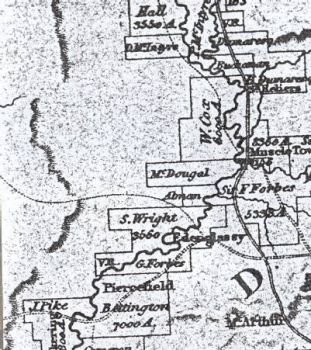
Sir William Edward Parry
Sir William Edward Parry, Commissioner of the Australian Agricultural Company, on a visit to St. Heliers, the estate of Henry Dumaresq in 1832 found much beauty about the estate, however the greater part of the best land, the flats next to the river, were liable to be covered with water in floods. He found a good deal of the land in front of the house was under cultivation and two miles distant was situated what Colonel Henry Dumaresq called the farm, 70 acres of tolerable land. There was an overseers cottage and mens huts at the farm. These huts were well built with little verandahs in front and very neatly kept. Parry thought that the men seemed very comfortable in every respect.The house at St. Heliers was considered a very good one, built of substantial stone however the lime was of poor quality being procured from an inferior limestone found 2 or 3 miles from the farm.
Sir William Parry remained at St. Heliers for the weekend. The rest of his party with drays and servants camped at the river on Friday night where they were supplied with milk and various other refreshments by Colonel Dumaresq. They moved on to travel ahead beyond St. Aubins on the Saturday morning, while Sir William remained, attending a Sunday service performed by Colonel Dumaresq in the morning at the farm two miles from the homestead.
Australian Agricultural Company
In 1834, when Sir William Edward Parry returned to England, Henry Dumaresq took over the position of Commissioner of the Australian Agricultural Company and he and his family moved to Tahlee House at Port Stephens.Lieut. George Pulteney Malcolm
The St. Heliers estate was visited By Lieutenant George Pulteney Malcolm in October/ November 1835.....Lieutenant Malcolm had arrived on the Henry Porcher in 1835 and spent over a year in New South Wales travelling extensively. He kept a journal throughout the voyage and afterwards on his travels in Australia. A copy of the journal is held by the State Library of New South Wales. Lieutenant Malcolm spent six weeks in the Hunter region where he also visited James Bowmans estate Ravensworth, Robert and Helenus Scott at Glendon and William Dumaresq.Squatting Stations
Henry Dumaresq claimed a vast squatting station for himself on the New England tablelands - 100,000 acres which he named in memory of his family connections with the Seigneur de Saumarez in the Channel Isles. He sent a large contingent of men, livestock and machinery to occupy Samaurez, under the control of his superintendent, Adam Wightman. A head station, store and stables were set up above Saumarez Creek. Within a few years Wightman had also built a shearing shed and mens' huts. Henry Dumaresqs estates were highly praised by Rev. Dr. John Dunmore Lang.James Backhouse at St. Heliers
St. Heliers was visited by Missionaries James Backhouse and George Washington Walker in June 1836. Superintendent Adam Wightman accompanied the Missionaries. Later Backhouse gave an Account of the Estate.In July 1836 Backhouse visited Henry Dumaresq at Tahlee.......
At Sawyers Point we found a boat waiting for us, having sent by the postman to request one, and in about an hour we landed at Tahlee House, the residence of Henry (Lieutenant-colonel) and Sophia B. Dumaresq : the latter spent many years with her relations at Nun Appleton, near York : we were kindly entertained by her, in the absence of the Colonel, who was gone to Newcastle; and had the mutual pleasure of conversation respecting many places and persons well known to us both. Before retiring, we had some religious service in the family. We took leave of Colonel Dumaresq and his family, in which Maria Bell, a very respectable female, is an inmate, and assists Sophia Dumaresq in the charge of her children and household. A boat conveyed us to Booral, up the Karua river, which is navigable to this point, and is of considerable width. (1)
Death
Henry Dumaresq died on 5 March 1838 at Port Stephens.His body was taken from Port Stephens on the steamer William IV and shipped on the Sophia Jane to Green Hills, there to be conveyed to his estate of St. Heliers.
On the death of Henry his widow Elizabeth Sophia, inherited the successful Saumarez station. Saumarez was managed by William Dumaresq, whose New England property Tilbuster adjoined Samaurez. Elizabeth Sophia returned to England in 1841 to educate her family. She and seven children departed for London on the barque Lord Eldon on 14 January 1841. She was accompanied by Mr. Butler. Campbell France R.N., was returning to England on the same vessel, having arrived as Surgeon Superintendent on the King William in 1840.
Description of St. Heliers
In 1925 the Maitland Weekly Mercury published a description of St. Heliers and the subsequent owners....One of the oldest places of settlement in the Upper Hunter district is the St. Heliers Estate, which is situated about five miles from Muswellbrook, in a north-easterly direction, and is passed on the west by the Great Northern-road. It was a Crown, grant to Colonel Dumaresque early in the past century, as old letters in relation to it have been seen that were dated as far back as 1824.
The old homestead in a central part of the property still stands in a very fair state of preservation, particularly the stone and wood work. The walls of the house are constructed of freestone obtained on the estate, and the woodwork of ironbark still thoroughly sound. There are yards made of this timber within view of the house, supposed to be a century old, with little or no sign of decay, the hard nature and durability of the timber being truly remarkable.
Conspicuous in the eastern portion of the property is Bells Mountain, stated to be 2,600 feet above sea level, and which can be seen from afar.- It is thickly timbered, and when viewed from, a distance presents a dark blue colour that is strikingly impressive. Close by is another mount known as the Colonels Knob, and called after the property's first owner. Unfortunately all the old records of the place, that would furnish abundant, material for interesting history were taken away many years ago, and cannot now be traced. Permanent proofs, however, remain of fine work done in the old convict days in wood and stone. The stone walls were skilfully chiseled, and some of the wood work is truly wonderful, such as iron bark pillars supporting a verandah, most tastefully turned, and as sound now as when placed in position.
The old flour mill was built and still stands beside the dwelling house. It had a large storeroom, and some of its machinery was of unique structure. A wooden cog-wheel between four and five feet in diameter, is to be seen apparently as sound as when in use, and is a remarkable product of skilful workmanship.
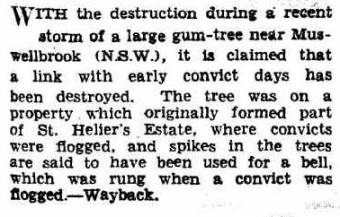
About fifty yards from the house, in an elevated position, is a gum tree high up in the fork of which are spikes, from which a Bell was formerly hung and sounded to let the convict labourers know when it was time to start work and cease toiling. Nearly forty years ago the bell fell - down; and it was taken to Muswellbrook and for some time used there as a firebell. . . .
When Colonel Dumaresq died the estate was managed by Mr. John Hudson Keys for a long period, and when he became the owner of Bengalla, now possessed by his grand son, Mr. J. M. Keys, Mr. Ebenezer Hall became, the proprietor of St. Heliers, which was then managed by Mr. H. H. Brown, formerly member for Durham. In course of time the younger members of the Hall family inherited the place, and it was eventually bought from them by the late Mr. Malcolm Campbell, and for years managed by the late Mr. John Crockett, member, of an old Maitland family.
The old dwelling referred to was the second place of residence of Colonel Dumaresq, his first habitation on the estate having been on an, eminence close to the Muswellbrook Aberdeen : road, and called Mount Brown, after the member for Durham. It was there the colonel was buried, but under the direction of Mr. John Hudson. Keys the remains were afterwards taken to the Church of England cemetery, Muswellbrook, and a monument placed over them with an inscription thereon setting forth the valued service the deceased officer had rendered his country during his honorable career.
The present owners of the property are Mrs. S. C. Campbell, relict of the late Mr. Malcolm Campbell, and her son, Mr. J. M, Campbell. Each has a residence on plateaus some distance apart, and from which there are on all sides splendid views of picturesque country. Mrs Campbell's home retains the old name, ~St. Heliers, and her son's is Gelston. Going to the former an avenue of pepper trees is passed through, and for a considerable distance Gelston is approached by a natural highway, pleasant to drive on. Maitland Weekly Mercury 14 February 1925
Convicts Assigned to St. Heliers
Some of the convicts assigned to Henry Dumaresq at St. Heliers included:1827
Walker, Joseph Albion 1827
Hodgson, William Albion 1827
Larmard, Charles Albion 1827
Bartlett, John Albion 1827
1829
Costley, John Ferguson 1829
Jones, Robert Layton 1829
Squelch, John Layton 1829
1831
Priestly, Maria Roslin Castle 1830
Sears, Mary Roslin Castle 1830
Andrews, Charles Georgiana 1831
1832
Falloon, James Captain Cook 1832
Boulger, Michael Captain Cook 1832
Jennings, Benjamin Surry 1831
Lewis, George York 1831
Robinson, Mary Elizabeth 1828
Hughes, David Portland 1832
Cushion, William Marquis of Hastings 1827
Notes and Links
William Allen, a member of a notorious bushranging gang led by Gentleman Dick in 1839, had absconded from St. Heliers estateDumaresq River - Named by Allan Cunningham for Henry Dumaresq in 1827
Museum of Applied Arts and Sciences
References
[1] Extracts from the letters of James Backhouse: whilst engaged in a Religious Visit to Van Diemens Land, New South Wales and South Africa accompanied by George Washington Walker, London 1842, Volume 1, p.77[2] Smiths Weekly 1 June 1935
↑