
James Phillips - Settler
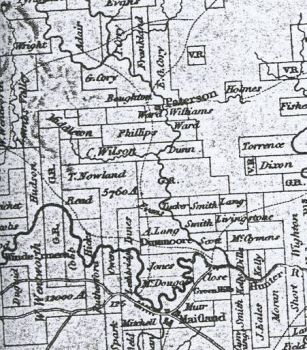
Bona Vista - Map 2
James Phillips arrived in Port Jackson 20 May 1822 on the female convict transport Mary Anne. Accompanying him were his wife Lydia, and four children. The Mary Anne had departed Portsmouth on Christmas day five months before with 102 female convicts, the Phillips family and another free settler Dr. Francis Moran. There were a total of 12 children on the ship.
Land Grant
In an order dated 30th May 1822, James Phillips was granted 2000 acres and assigned six convict servants to work the land. On that same day he received permission, with Francis Moran and John Cordeaux, to take a passage to Newcastle on the Elizabeth Henrietta [2]. He probably selected his land at this time.On 27th July 1822 James Phillips received permission to proceed to Newcastle with seven men. Others given permission on that same day included Dr. William Evans, Mr. Rhode, Robert Dillon, Alexander Livingstone and Ann Matthews [3]. It is not clear when James Phillips proceeded to the Hunter, however he was absent from Parramatta by 15th August.
Lydia Phillips
Lydia Phillips and their children may have resided for a time at the female orphan school at Parramatta while they waited for the location of the grant to be settled. Family friend Susannah Matilda Ward was employed as Matron at the orphan school.In correspondence dated 15th August 1822 and written from the Orphan House, Parramatta, James Phillips' wife Lydia applied for a Government position for him.......
Sir,
Understanding that a vacancy has lately occurred in your Office in consequence of the resignation of the Assistant Secretary Mr. Atkinson, I have taken the liberty to solicit your kind interference with His Excellency the Governor to have Mr. Phillips appointed to the situation, hoping the strong testimonials he has received from those under whom he has had the honour to serve and his having been so many years accustomed to Duty of that nature and likewise the strong recommendation to the protection of His Excellency and yourself may influence you in his behalf - I hope you will pardon the liberty I am taking in addressing you. Mr. Phillips being at present at the Coal River consequently cannot have the honour of waiting on you himself to ask the favour and the anxiety I feel for the welfare of a young and helpless family has induced one thus to trouble you, which if you will be pleased take into your favourable consideration will confer a lasting obligation on myself and family, I have the honour to be Sir
Your Obedient servant
Lydia Phillips [1]
Bona Vista
After reaching Newcastle, James Phillips would have sailed up the Hunter River and then to the Paterson. He selected land on the banks of the Paterson River naming the grant Bona Vista. The town of Paterson now adjoins this land.James Phillips was allowed 20 head of cattle from the government herd and soon had wheat and corn crops planted.
Convict Servants
The following prisoners were assigned to James Phillips in the years 1822 - 1825 and were therefore the among the first convict workers at Bona Vista:Samuel Catterall per Guildford, assigned 17th August 1822
William Evans per Guildford, assigned 24th July 1822
Patrick Flannagan per Mary, assigned 11th April 1822
Robert Johnson per Elizabeth, assigned 8th October 1822
Thomas Ounan per Lord Sidmouth, assigned 30th May 1822
Patrick Hardiman per Three Bees, assigned 30 May 1823
George Berwick per Prince of Orange, assigned 30th May 1823
John Fitzgibbon per Minerva, assigned 16 June 1823
Ralph Deane per Eliza, assigned 30th May 1823
John McNamara per Minerva, assigned April 1823
Charles Watkins per Speke, assigned prior to 1824
William Shepherd per Asia, assigned 1825
Charles Fowler per Speke, assigned 29th June 1825
Edward Hughes per Glory, assigned 8 July 1824
Patrick Boyle per Mangles, assigned on arrival in 1826
In correspondence dated 20th March 1824 he requested that government assign him a carpenter in place of Charles Watkins. His frustration in having been assigned Charles Watkins is apparent in the following correspondence...
{Extract}.....Charles Watkins assigned to me as a Carpenter has never worked as a carpenter until he went into the Lumber Yard at Sydney, where he was only about nine months before he came to me. I have suffered great loss and inconvenience by his not knowing the trade. After he had been with me six months I was obliged to employ another carpenter who found it necessary to pull down all the buildings which he (Watkins) had erected, as they were considered unsafe. He is incapable of making a Door or a window, nor can he even stick a common moulding.....Before he came to this country he was a servant and in that capacity I have found him most useful. I have the honour to request a most particular favour that you will have the goodness to permit me to pay what I may be indebted to the Government either in wheat or corn, to be delivered into Stores at Newcastle, for I most solemnly assure you I have not the means of paying it in any other manner. I have expended on stock and improvements on my farm even to the last shilling - The stores here are completely shut against us by the Merchants in Sydney[4]
He had the usual problems with assigned servants and in 1825 requested that he be assigned six convicts to replace those that had absconded. One month later he requested that servants assigned to him but presently in Sydney gaol, be returned to his service. The following convicts were among those assigned to James Phillips at Bona Vista in 1828:
Patrick Brennan per Isabella
Charles Fowler per Speke
Thomas Briant per Marquis Hastings
Samuel Freestone per Marquis Hastings
William Briggs
Charles Hollowell per Hercules
Hanna Warren per Elizabeth
Roger McNamara per Mangles
John Williams per Mangles
Patrick Moran per Morley
Henry Singer per Hadlow
Thomas Phillips per Mangles
William Finch per Marquis Hastings
Ann Kennedy aged 13 employed as house servant
Paterson Hotel
Architect John Verge designed the Paterson Hotel for James Phillips about 1835Bona Vista Sub-Divided
Under financial pressure around 1840 James Phillips subdivided part of his estate to sell by public auction. The Paterson Hotel was sold to Felix WilsonTobacco
Among the crops he grew was tobacco. This proved successful and he also commenced tobacco manufacturing. The tobacco factory on Bona Vista was a large slab building with the slabs set into the ground and not sunk in sleepers. It was divided into three apartments. The overseer slept in one and tobacco leaf was stored and the manufacturing process carried out in the other two. The Factory was broken into in 1849 and approximately 1000lbs of tobacco was stolen. The chief suspects were later found not guilty and were discharged from court.Death
James Phillips died at Bona Vista in 1851 and the estate was auctioned in 1855. Two of James Phillip's daughters married medical practitioners - Isabella Phillips married David Sloan in 1840 and Lydia Phillips married Richard Ryther Steer Bowker in 1858. Another daughter Jane married John Skottowe Parker who was Coroner for the district for many years having taken over from William Dun in 1840.Notes and Links
1). Rovings in the Pacific, from 1837 to 1849 was written by a young adventurer Edward Lucett who came to Australia as crew on the convict ship Mangles. He describes a voyage from Sydney to Bona Vista in 1837......Being invited to pass a few weeks with some friends up the Paterson River, situated to the northward of Sydney, I entered a steamer, and enjoyed a pleasant trip. You enter the river Hunter, off the mouth of which there is a dangerous reef, terminated by a bluff rock, called Nobby's; the township of this port has received the name of Newcastle, derived from its supplying the country with coal, like its prototype in England. The aspect of the place is not inviting, the beach being a barren waste of sand hills. The river is a pretty sheet of water, but continues salt for thirty or forty miles, when it branches, forming the Williams and Paterson rivers.
It was harvest time, and the banks being in many parts highly cultivated, hundreds of acres teeming with rich yellow wheat, I was reminded of old England. Still the eccentricities of a new country betrayed themselves. Beside a patch of corn a maze of forest trees would entangle their white glancing spectral limbs. In one place, land just broken up; in another a green crop advancing; and again, you would see a spot under process of clearing, with trees just felled, and stumps yet smoking.
The steamer moored at a place called the Green Hills, why, I can't say, as it certainly does not possess a very verdant appearance; and the name, since the erection of a few houses, appears to be giving way to that of Morpeth. The country in many parts betokens richness of soil, but there is nothing of the picturesque in the neighbourhood to tempt the wanderer. I passed the night at Morpeth, and the next morning my young friend called to escort me to his new residence. We struck across the country, - country in that sense when it is said, 'God made the country, and man made the town,' as, with the exception of a rude fence here and there, indicating the boundaries of different properties, it was country in its primeval state. I was delighted with the excursion. Thousands of parrots mingled their chatterings overhead with the silvery tinkling notes of the bell bird, the smacking of the coachman's whip, the wild shriek of the laughing jackass, and the ever-varying cry of the mocking bird; and every lagoon, or marshy swamp, would send forth its squadron of ducks at our approach, to wing a rapid flight of eddying circles.
By a circuitous route we arrived at Bona Vista, a pleasantly situated farm on the banks of the Paterson. The land of this district is in many parts well and extensively cultivated, the soil is extremely rich, and the river, winding between high verdant banks, is fresh and sweet. Whilst on this visit, I was fearfully convinced of the deadly venom of the reptile tribe. The proprietor of the estate, observing a small yellow snake glide under some sawn timber, called his men to remove it, that it might be killed; as they were lifting the logs, the snake darted between the legs of one of the men, and brushed him in passing. 'Oh! my God!' cried he, what a narrow escape I've had! I declare it touched me with its tail.' The snake was killed, and the men returned to their work, the proprietor remarking to me, as we turned away, 'If it had bitten anyone, the bite would have caused instant death; ' and he related several instances that had fallen under his own knowledge where death had followed the stroke of the reptile's fangs. I listened with all respect to his recital, but scarcely deemed it possible that the insignificant little object lying stretched before me could subdue to the earth the bulky frame of a powerful man.
But too soon was I to receive an awful demonstration of the truth of his assertions. I had walked as far as the township, and had been absent half an hour, when on my return I was met by a party bearing the startling intelligence that the man who cried out he had been touched by the snake's tail was dead. Scarcely crediting the report, I hastened to the hut, but there he lay, green and festering; for strange as it may appear, decomposition had already commenced, and a fetid foam was issuing from his mouth. Two minute punctures on the poor fellow's skin were the only marks discernible. It appears that about five minutes after he had been struck, he complained of feeling faint and sick, and his mate was only in time to save him from falling: he struggled convulsively a minute or two, and then a lifeless clod was all that was left of the stoutest and apparently the healthiest man on the farm. The medical man who was sent for cautioned me against too curious an investigation of the body. That same evening, on his return home, his dog happening to disturb another snake, was struck by it on the nose, and thereby received instantaneous death; as the doctor assured us, it turned on its side, and scarcely uttered a cry. The cast skin of the snake that destroyed the farm labourer was discovered near the spot, where it sought concealment; and I was informed by those acquainted with the natural history of these reptiles, that immediately after shedding their skins, they are more than usually irritable and venomous -
Rovings in the Pacific
References
[1] Ancestry.com. New South Wales, Australia, Colonial Secretary's Papers, 1788-1825 (NRS 897) Main series of letters received, 1788-1825 Item: 4/1761 Page: 110[2] Ancestry.com. New South Wales, Australia, Colonial Secretary's Papers, 1788-1825. Series: (NRS 937) Copies of letters sent within the Colony, 1814-1825 Item: 4/3505 Page: 352
[3] Ancestry.com. New South Wales, Australia, Colonial Secretary's Papers, 1788-1825. Series: (NRS 937) Copies of letters sent within the Colony, 1814-1825 Item: 4/3506 Page: 90
[4] Ancestry.com. New South Wales, Australia, Colonial Secretary's Papers, 1788-1825 Series: (NRS 897) Main series of letters received, 1788-1825 Item: 4/1810 Page: 68-9
↑