William Hicks - Settler
Melville - Map 2
In 1818 William Hicks arrived as First Officer on the convict ship Friendship. He requested to remain in the colony after the departure of the Friendship but permission was denied owing to certain considerations respecting the conduct pursued towards the female convicts during the voyage of the Friendship.
William Hicks departed for England on the Laurel in April 1818.
Second Arrival
He next arrived in Australia four years later as First Officer on the brig Admiral Cockburn. The Admiral Cockburn under Captain Briggs sailed from England via Madeira and the Cape of Good Hope arriving in Hobart in November 1822 and in Port Jackson at the end of December.A valuable cargo was carried including a 20ft cutter which was later offered for sale [6]
The Admiral Cockburn departed Sydney in March 1823 bound for the Isle of France via Hobart. Although William Hicks was to sail with her this apparently did not happen. Instead he decided to settle in Australia.
Land Grant
In a memorial to Governor Brisbane dated 4th February 1823 he applied for a grant of land:Sir,
I beg leave to acquaint your Excellency that I have recently arrived from England in the ship Admiral Cockburn and that I am desirous of settling in the Colony and becoming an Agriculturalist. I therefore request your Excellency permission and also that you Excellency will grant me such a portion of land and other indulgences as may appear to your Excellency consistent. I have the Honor to be, Your Excellency's Most Obedient and Humble Servant William Hicks, Lieutenant, R.N.[2]
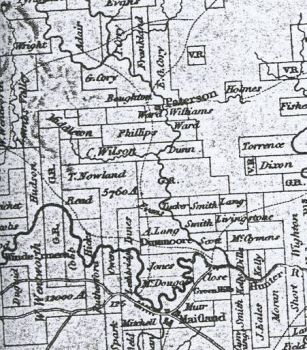
He was granted 1120 acres of land on 27th February 1823 and in November 1823 also applied for a grant of land in the town of Newcastle which had recently closed as a penal settlement.
He was granted permission to sail to Newcastle on the Angerstein in March and probably selected his land on the Hunter River at this time.
Lieutenant Hicks returned to Newcastle and his Hunter River grant in April 1823 accompanied by Mr. Thomas White Melville Winder and assigned servants Thomas Smith and Bartholomew Duffy.
Neighbourhood Dispute
Soon afterwards he came into dispute with neighbours when he refused to allow cedar gangs to remove cut timber from his land, threatening to shoot them if they attempted it. Later that year he was also in dispute with neighbour James Reid, again over land.In 1824 William Hicks was once again in opposition to his neighbour Magistrate James Reid when he supported Captain Gillman in his dispute with Vicars Jacob. Read more about this dispute in the Australian 14 October 1824 - King V. Gillman - Military or Civil Society.
Town Allotment
His name also appears on a list of about 100 settlers who were granted allotments in the township of Newcastle in 1823[3]Marriage
On 18 November 1823 at St. Phillips in Sydney Lieutenant William Hicks married Sophia Hickey, a daughter of John Hickey of Bent Street Sydney. Sophia had arrived on the Friendship in 1818 with her mother Ann Hickey and other brothers and sisters.Bushrangers
The Melville estate was robbed by marauding bushrangers Jacob's Mob on 8th July 1825. Lieutenant Hicks was more fortunate than neighbour James Reid whose house Rosebrook was burned down by the bushrangers.Joseph Underwood
Joseph Underwood purchased the estate Melville for £670 in 1826 [7]Melville Island
In 1827 William Hicks departed New South Wales in command of the Mary Elizabeth. Accompanied by H.M.S. Success, Marquis of Lansdown, and the Amity and their Officers and crew, Lieutenant Hicks on the Mary Elizabeth set sail for the fledgling British settlement Fort Dundas in Australia's north. .....The Success, shortly after her return from Bateman's Bay, proceeds on a voyage of survey along the coast to the northward. She is to be accompanied by the Government vessel the Mary and Elizabeth, having on board a number of mechanics who have volunteered their services, and a detachment of the 39th under the orders of Captain Smith of that regiment. The Government brig Amity accompanies the Success and the brig Mary and Elizabeth as far as Melville Island where she is to leave a supply of provisions and proceed to King George's Sound. [5]
Conditions were harsh and attempts at settlement were not successful. In February 1828 the Sydney Gazette reported the death of Dr. Wood at Port Raffles and of Mr. Green, storekeeper at Melville Island who was speared by natives, as was Dr. Gold. Their bodies were discovered by Lieut. Hicks.....The Sydney Gazette told of the disaster -
Melville Island.- In our last number, it was our melancholy duty to announce the lamented death of Dr. Wood, which occurred at Port Raffles, as also the death of Mr. Green, at Melville Island, the son of a Gentleman in this Colony that is sincerely es-teemed. We have since been favoured with a document which furnishes some particulars respecting these disastrous events. By a letter from Lieut. Hicks, R. N. commanding the Mary Elizabeth, it appears that Mr. John Henry Green and Mr. John Gold were destroyed by the natives at Melville Island, on the 2d of November last. The following is an ex-tract from the document already referred to :- p. m.6.15. The alarm given that the natives had surrounded Mr. Green and Dr. Gold, who had walked towards the path ; shortly afterwards the body of Mr. Green was found and brought dead into the fort, and Lieutenant Bates and myself attentively examined it, and found the following wounds: Mr. Green had received in all 17 wounds from spears - three were in his throat, one through his arm, ten in front of his body, and one in his back ; he had also two severe cuts on the head, one was about six inches long, the lips above two inches deep, the skull laid open, so that the brains could be distinctly seen. Nov. 3,A. M 7. the body of Mr. Gold brought into the fort by the party who had been sent in search of it, and had the following wounds in it as were found by myself and Lieut. Bates. On the body 31 spear wounds, in seven of which the heads were still sticking, several of the spears had gone through the body and head, and one appeared to have penetrated the bowels, several wounds were in his legs, and from every circumstance I should fear he had died very hard. [4]
Death of Sophia Hicks
In 1828 the Hobart Town Courier reported the death at Melville Island of Lieutenant Hicks' wife Sophia and their two children - William b. 1825 and another.William Hicks arrived back in Sydney on the Mary Elizabeth in August 1828. He remained in command of the Mary Elizabeth making voyages to Port Macquarie and Moreton Bay.
In 1830 it was announced that he was to depart for the Isle of France with the intention of bringing back cargo on the return voyage.
In 1838 Henry Usher of Newcastle applied for the deed of grant for William Hicks' allotment of land at Newcastle, Hicks being absent from the colony.
Notes and Links
1). Cross, Joseph. Map of the River Hunter, and its branches [cartographic material] : shewing the Lands reserved thereon for Church purposes, the Locations made to Settlers, and the Settlement and part of the Lands of the Australian Agricultural Company at Port Stephens together with the Station of the Mission to the Aborigines belonging to the London Missionary Society on Lake Macquarie, New South Wales 1828. MAP NK 646.References
[1] Sydney Gazette 15 March 1823[2] Colonial Secretary's Papers, Memorials to the Governor, 1810-25. Series 899, Fiche 3001-3162. 4/1834B. Number 138. p. 843. State Records Authority of New South Wales. Kingswood, New South Wales, Australia. (available at Ancestry)
[3] Special Bundles, 1794-1825. Series 898, Reels 6020-6040, 6070; Fiche 3260-3312. 9/2652, p. 75., State Records Authority of New South Wales. Kingswood, New South Wales, Australia.
[4] Sydney Gazette 25 February 1828
[5] The Australian 9 May 1827
[6] Hobart Town Gazette 23 November 1822
[7] Sydney Gazette 11 February 1826
↑