
Hunter Valley Bushrangers
Jacob's Irish Brigade
Jacob's Irish Brigade, also known as Jacob's Mob, were the first organised gang of bushrangers in the lower Hunter. As a result of their reign of terror Horse Patrols were established after this time to deal with bushrangers [4].
The gang consisted of the following men:
-
Patrick Riley - Arrived on the Castle Forbes in 1824; sentenced to transportation for Life in county Meath in 1823; considered to be the leader of the gang although some reports state Lawrence Cleary to be the leader.
-
Patrick Clinch - Arrived on the Isabella in 1823 and was assigned to Vicars Jacob by March 1824; In 1825 a reward was offered for his capture and he was described as - Age 28; native of Longford; 5ft 5in; hazel eyes; brown hair; pale, little freckled complexion
-
Aaron Price - Arrived on the Guildford in 1824 the same vessel that brought Chief Justice Sir Francis Forbes; Price received a sentence of transportation for Life in 1823; was assigned to Vicars Jacob in 1824; occupation: blacksmith. His description in 1825 - Age 21, native of Oxford; 5ft 6 1/2in; hazel eyes, brown hair, brown complexion.
-
Lawrence Cleary - Arrived on the Mangles in 1824; sentenced to transportation for Life at the Old Bailey in 1823.
-
Thomas Moss - Arrived on the Minerva in 1824.
-
Michael Cassidy was found guilty of receiving stolen goods.
The map below shows some of the area the gang terrorized
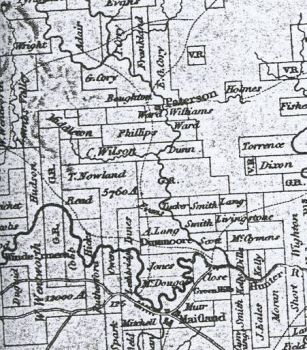
On 1 July 1825 James Reid J.P., acting for Vicars Jacob, charged Patrick Riley with neglect of duty and losing four sheep. Riley was sentenced to receive 50 lashes and ordered to Newcastle for punishment. On the way to Newcastle he escaped.
Rosebrook
That night he stole several horses from James Reid's Rosebrook estate and the next day he was joined by three prisoners from Vicar's Jacob estate - Clinch, Price and Cleary, in a raid on the farm.These four were later joined by John McDonnel, a runaway from A. B. Spark's estate, and Thomas Moss, a servant of Francis Moran. On 5 July the original four men robbed Standish Lawrence Harris' farm at Phoenix Park taking from there a brace of brass barrelled pistols; on the 8th, David Maziere's and James McClymont's farms (McClymens on the map) were raided.
William Hick's Farm
Lieutenant William Hicks' farm was also raided........Mr. Jacob's men and two others, all armed, took him by surprise a little after seven o'clock in the evening. Mr. Hicks had been in the habit of visiting his barn after sunset, to ascertain if all was correct; when returning, on turning the corner of his house four men armed, appeared; to resist was impossible, as he found during his absence they had secured his men, entered the house, took his watch, blunderbuss and musket. Mrs. Hicks was greatly frightened being en famille; one of the marauders threatened to shoot her; they did not leave him a charge of ammunition, carried all off, in addition to a quantity of wearing apparel. Mr. Hicks described them as well armed with bayonets, pistols, and muskets. [2]
Wallis Plains
On 2 August the gang was captured and taken to the Wallis Plains lockup. Two days later they overpowered their guards, seized weapons and ammunition and escaped. They also took a musket from William O'Donnell and horses from various settlers. Despite vigorous pursuits led by Robert Scott of Glendon and Alexander McLeod of Luskintyre who pursued them as far as Brown's Brush where they lost them, the bushrangers continued on their rampage.On 6 August there were two encounters with the police from Luskintyre. On 18 August they went to James Reid's house at Rosebrook, and burnt the house down in revenge for his treatment of convicts. He lost his wheat and some valuable property in the same manner, and was only able to save his bedding and articles of furniture.
William Evans' Farm
On 20 August they robbed William Evans' farm.......Mr. Evans's house was attacked Mr. E. opened the window in the approach of the Bushrangers intending to fire upon them but not seeing them at that moment, he hesitated. Mrs. E. shewed a great deal of coolness and courage and urged her husband to make every possible resistance. They afterwards summoned him to open the door - this he refused; upon which they obtained a light and threaten to burn the house to the ground. At this time eight of Mr. E's own men made their appearance, and he of course thought all was safe, and that probably the Bushrangers would be secured. Strange, however, to say, and yet not strange to say, for the men were prisoners, they one and all very complacently seated themselves, and allowed the Bushrangers to make a thorough ransack of the house; while they only laughed at the goings on, observing that they would not risk their lives in fights which did not concern them.
Another account, however, states that these men were fastened in an out house whether voluntarily or not does not appear.
The Bushrangers got possession of Mr. Dangar's double barrelled fowling piece and four muskets, and Clothing and provisions. They destroyed the cocks of the muskets. Mr. Evans describes them as apparently suffering from want of food. They had no shoes. They seemed also to be short of powder. They had all made off before any alarm could be given to the nearest neighbours. A regular night watch is kept by the Settlers, some of whom have a good deal of confidence in the men about their premises. It is very evident, from the manoeuvres of the Bushrangers that they receive information from the stockmen and others. [3]
Henry Radford's Farm
On Wednesday the 24th (August), four bushrangers went to Dr. Henry Radford's house near Lochdon, the farm of James McGillivray's, and met with a reception little expected - the Doctor had notice of their approach, and the moment he observed them, fired, and wounded one man severely - as the waistcoat was found yesterday morning, all covered with blood. One of Dr. Radford's men acted with great courage, and wounded another - this man deserves great credit for supporting his Master, as it seems to be believed that not one prisoner in fifty in this district would have followed his example. The parties fired fourteen shots.[1]
Daniel Donovan who arrived on the Mangles in 1824 (same ship as Lawrence Cleary) was one of the assigned servants on Dr. Radford's farm. He was afterwards sent to the coal mines and then a penal settlement for mutinous conduct and supporting the bushrangers during the attack.
News respecting the bushrangers dated 29th August stated.....
that they are concealed in a brush at a place called Narrowgut at Wallis's Plains; if this be the case, you may expect very shortly to hear a good account of them. The wounded man is with them, they are lying by for his perfect recovery; and for subsistence they have killed a bullock belonging to Mr. Harris.
Hexham
The newspapers at the time recorded other prisoners who absconded from nearby farms including Henry Sears, Bernard Padden, John Chapman and Isaac Deane who all absconded from John Boughton at Paterson.Captain Allman sent out troops from Newcastle and Jacob's Irish Brigade were finally confronted in October when Serjeant Wilcox and privates Wright and John Coffee tracked them down to Sparke's farm at Hexham.
On approaching within 200 yards of a hut on the farm of Mr. Spark the troopers observed a man exit from it. Their suspicions were awakened, and on his giving the alarm to persons inside, they were assured that they were correct, and that he and his comrades were bushrangers. The Sergeant fired into the hut.
Capture
Patrick Riley came out, and before he could be captured, fired twice on the soldiers; one of whom, Coffee, returned the fire and shot him dead on the spot. Two others had also come from the hut. These two stood looking on till Riley fell. They then made off. Cleary was later taken and Price surrendered. Clinch escaped although was soon captured.The Colonial Times and Tasmania Advertiser carried an extract from a letter received from Sydney reporting on the gang's capture -
The whole of the Banditti (except one, who is wounded in the shoulder and in the hand) of bushrangers, which lately committed so many outrages in the district of Newcastle, is captured. One, a man named Riley, was shot dead by a soldier, and two others were taken and are now in custody. There is little doubt but they will be executed. A part of the Horse Patrol, lately established here, under the command of Lieutenant Evernden, of the Buffs, embarks this evening on board the Amity for Newcastle.
This new Corps is 30 strong; its uniform is the same as that of the Governor's Body Guard. The remainder of the Corps is going to Bathurst, to scour that part of the country of the vagabonds there at large.
Norfolk Island
A sentence of death was passed on the remaining members of the gang, although they were reprieved at the last moment. Aaron Price was about to ascend scaffold when his reprieve came through and it was reported in the Australian They were sent to Norfolk Island which had been re-opened as a place of secondary punishment.Lawrence Cleary, Patrick Clinch and Thomas Moss were later involved in riots there. Patrick Clinch endured two years there before attempting to escape from the settlement. Lawrence Cleary after many long years of servitude including 12 months in irons on Cockatoo Island, was finally granted a Conditional Pardon in 1852.
In a strange twist of fate, Aaron Price eventually became an overseer of public works at Norfolk Island. In 1846 he was involved in a riot, but on the side of the constables and military. He kept a diary while at Norfolk Island which can be found in the State Library
Peter Cunningham wrote of Jacob's Irish Brigade in Two Years of New South Wales -
The vanity of being talked of, I verily believe, leads many foolish fellows to join in this kind of life, - songs being often made about their exploits by their sympathizing brethren; while the fame, such as it is, which they acquire, is enough to make many restless spirits who long after any species of immortality, venture considerable lengths to obtain it. It is the boast of most of them, that their names will live in the remembrance of the colony long after their exit from among us to some penal settlement, either in this world or the next; Riley, the captain of the Hunter's River banditti, vaunting that he should be long spoken of (whatever his fate might be), in fear by his enemies, and in admiration by his friends!
Notes and Links
1). Correspondence was sent by James Mudie of Castle Forbes, Patrick's Plains to the Governor to bring to the Governor's attention the threat of bushrangers in the surrounding area. He includes a first hand account of bushrangers given by Martin Dealy, Overseer at Mr Leslie Duguid's property. State Records NSW2). Chief Justice Francis Forbes' evidence regarding Norfolk Island
References
[1] Whiskers Hill (Pandora Archive)[2] The Australian 4 August 1825
[3] The Australian 1 September 1825
[4] Sydney Gazette 9 September 1825
↑