
Hunter Valley Bushrangers
Index
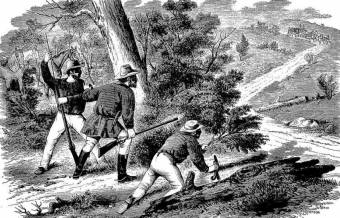 Early bushrangers in the Hunter Valley were mostly men desperate to escape the horror of Newcastle Penal Settlement where they had been sent for colonial indiscretions. Often they suffered severe deprivation in the bush before the inevitable capture by soldiers and black trackers.
Later when the Penal Settlement closed and the Valley was opened for settlement the bushrangers were mostly convicts who escaped from estates and farms or from road gangs. They roamed far and wide throughout the valley, often on stolen horses but also on foot. Police, soldiers and often settlers were relentless in their pursuit and most bushrangers were either shot or captured; few surrendered. Those captured were sometimes sent to penal settlements at Cockatoo Island, Norfolk Island or Van Diemen's Land. The unfortunates died a bushranger's death on the gallows.
A
ALLEN Henry - Newcastle 1838
ALLEN - William - Big River 1839
ANSCOMB Richard - Page's River
ARMSTRONG - Garrett - Newcastle 1811
ATKINS - John - Newcastle and Paterson 1842
ATKINSON William - Dungog 1838
B
BAKER - William- 1844 Peel River
BEARD Henry -Maitland 1833
BELL Samuel Gammon Plains 1833
BELL William - Newcastle 1838
BOWEN - Edward Upper Hunter and Liverpool Plains 1830
BOWERS Joseph Muswellbrook, Scone 1842
BOWSER - Timothy Weary's Creek 1837
BRADISH - Timothy Liverpool Plains 1844
BRANIGAN Edward Liverpool Plains 1844
BROWNE - Morgan - Upper Hunter 1830
BRUIN - Patrick - Maitland- Wollombi - 1843
BURRELL - John and Benjamin - Paterson 1829
C
CASH Martin
CHAFFY - William - Newcastle 1826
CHITTY - Robert
CLARKE - George Liverpool Plains 1831
CLEARY - Lawrence -- Jacob's Mob 1825 Maitland / Hexham
CLYNCH - Patrick - Jacob's Mob 1825 Maitland / Hexham
COLLINS, Michael - Invermein 1835
COLLINS - Thomas - Patterson's Plains 1830
CUFFE - Patrick Greig's Creek 14 miles from Jerry's Plains 1838
D
DAVIDSON - James - Maitland 1849
DAVIS - Edward - Jewboy Gang 1840
DAVIS - James Glendon 1839
DELANEY - Daniel Gammon Plains 1843
DESMOND Thomas - Newcastle/Hawkesbury
DONNELLY - Patrick - Upper Hunter 1830
DONOVAN - John - Upper Hunter 1830
DOOLAN - John Weary's (Werris) Creek 1837
DUFFY - Hugh - Liverpool Plains 1830
E
EDWARDS James ( Stroud) 1844
EDWARDS Thomas (Paterson 1841)
ELGAN Henry (Stroud) 1844
ELLIS - Henry - (alias John Rose, alias Johnny the Native) Big River 1838
EVERETT - John - Jewboy gang 1840
What Might a Bushranger Have Worn?
In 1830 when two elderly men on Sir John Jamison's estate were robbed, Jack Donohoe and his companion were supposed to have been the perpetrators.
Later it was reported that one of them wore a blue jacket, light cord trousers, coloured waistcoat, half boots, white shirt, no neckerchief and a black hat. He was armed with a double barrelled pistol and three pairs of pistols fastened to a belt round his body under his jacket, and the other was dressed in a blue jacket, dark waistcoat and trousers, worn out half boots, white shirt, coloured neckerchief, and black hat
In 1833 an incident took place at Castle Forbes, the estate of James Mudie. Several desperate assigned servants (convicts) revolted after years of being ill nourished, poorly treated and punished repeatedly. They threatened Mudie's son-in-law, robbed the homestead and then took to the bush to join one of their cronies who had already absconded. When they robbed the house, they took with them new sets of clothing for each, hoping it was said, to disguise themselves and make their escape. Their own clothing was poor.
Worn out shoes and probably thin, ragged smocks and trousers. When a notice was placed in the newspaper soon afterwards, it was revealed what the five men had taken with them - John Poole wore white duck trousers; James Reilly wore a white shirt and duck trousers with a white jacket and straw hat; David Jones wore a white shirt, white trousers, duck frock and a straw hat; John Perry wore a white shirt, duck trousers, duck jacket and a straw hat, and another man, unidentified got away with a blue cloth jacket with yellow buttons and fustian trousers.
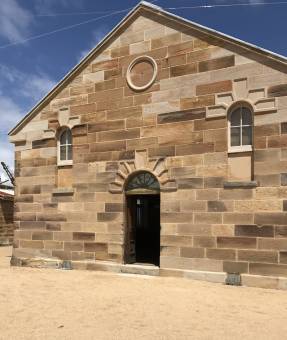 Convict Barracks at Cockatoo Island
F
FARROW -Thomas 1838/ 1840 Dungog/ Liverpool 1838/ 1840 Dungog/ Liverpool Plains
FEENEY, Patrick Upper Hunter 1830
FITZGERALD, John Newcastle 1806
FORRESTER, Thomas (Long Tom Forrester)
G
GIBBONS - James Murrurundi 1839 Murrurundi 1839
GLANVILLE - Richard - Jewboy Gang 1840
GORE, James - (Paterson 1841)
GREEN John 1840 - Gammon Plains 1840
GREGORY - Thomas New England 1848
GRITTEN, Charles - Invermein 1835
H
HALL Ben - Son of Ben Hall of Murrurundi - 1860's - 1860's
HAMILTON Andrew 1833 - Gammon Plains 1833
HARRIS - Benjamin - Cassilis 1843
HAWKER - Thomas1840 Paterson/Morpeth 1840
HICKEY - DanielCaptured on the Bathurst road
HICKS - Richard Miller's Forest 1845
HITCHCOCK - Anthony - Castle Forbes - 1833
HOBSON - John (Opossum Jack) 1839 Merton/ Cassilis
HOLMES - Iram - Dungog 1838
HOWARD - James - Gammon Plains 1840
HUDSON - Thomas Newcastle 1827
HUGHES - Henry Stroud 1844
Hunter River Banditti 1831
Other Clothing Items Bushrangers May Have Worn
Fustian jackets and trousers Fustian jackets and trousers (a mixture of linen and cotton twill) was used for coats and jackets for everyday men's wear because of its hardwearing durability. Colours could range from white and buff to brown and bright blue or red
Neck 'kerchiefs were often cotton and worn during the day.
Nankeen trousers were made from a kind of pale yellowish cloth, originally made at Nanjing from a yellow variety of cotton, but subsequently manufactured from ordinary cotton which was then dyed
Moleskin trousers and Jackets - made from brushed heavyweight cotton
Duck Trousers and jackets - Duck was a kind of waterproof canvas material
Shirts - Checked and red shirts, Regatta shirts, striped cotton shirts, Crimean shirts (after 1856) were sometimes of grey wool and had a simple band instead of a collar. They were often worn outside the trousers Guernsey frocks - a kind of smock used as a coverall
Pea Jacket - A pea coat , or pilot jacket was an outer coat usually of navy coloured wool
Monkey jackets - A monkey jacket was a waist length jacket tapering at the back to a point. Often worn by sailors
Cabbage Tree Hats - broad brim hat woven from palm leaves - often made by convicts
Forage Caps - Small cloth caps worn by soldiers
J
JACOB'S IRISH BRIGADE Lower Hunter 1825
JEWBOY GANG - Hunter Valley 1841
JONES - David Castle Forbes 1833
JONES - George - Muswellbrook, Scone 1842
JONES - John - Upper Hunter - 1830
JONES - John (alias Gibber Jack) - Newcastle 1812
K
KEARNEY - Felix - Paterson 1830
KIEVERS - Thomas - Gammon Plains 1840
L
LITTLE - Robert - Invermein 1835
M
MARTIN James Gammon Plains 1840
MARTIN, William Invermein 1835
MASON - James - Gammon Plains 1840
MASON - John Liverpool Plains 1831
MARSHALL - John - Jewboy Gang 1840
MCCARTHY - William Cassilis 1841
MCGUINNESS - Edward Gammon Plains 1833
MCINTYRE - John Black Creek 1846
MCNAMARA - Francis 1842 - Frank the Poet
MURTAGH - Edward- Port Stephens 1843
O
OWEN - Herbert Glendon 1833
P
PEGG (Pigg) - David Page's River 1831
PERRY - John - Castle Forbes 1833
PHEENY James- Scone 1841
POOLE - John - Castle Forbes 1833
PRICE - Aaron- Jacob's Mob 1825 Maitland / Hexham
PYZER - Joseph Miller's Forest 1845
Q
QUIGLEY - John 1842 Maitland
What Made Men Take to the Bush?
A writer to the Queenslander in 1866 explained it when he wrote of the bushrangers of thirty years previously:
'Bushranging and crime was the rule in New South Wales thirty years ago - the working hands prisoners and freedmen or ticket of leave holders. Your bushranger of the olden times was a much more dangerous character than his modern successor; working hard for his masters for bare food and scanty clothing, with no wages and 2oz or tea and 1lb of sugar per week given as an indulgence, he was frequently driven by hard usage and flogging to take to the bush; sometimes to work for low wages until again driven forth by being discovered, and always finding sympathy and shelter among the convict servants on stations. On the roads he was most desperate, for he had not the lenient laws we have now, and he knew well that if taken with arms in his hands he would be hanged; and they hanged them by scores in those days at the old gaol in George Street - three, four, seven at a time - Monday after Monday. Many a desperate encounter took place, many were shot sooner than yield; civilians were murdered, and the police often wounded and killed, for they were plucky fellows, and always stood their ground, emulating each other in tact and courage. The mounted police were chosen from the regiments serving in the colony with a major commandant in Sydney, and lieutenants of detachments in districts over small parties of three or four mounted men, and one not mounted, including a sergeant or corporal, stationed at remote towns. I was a constant habit of theirs to start singly disguised, and stick to the trail of two or even three bushrangers till they took them. Numerous anecdotes were told of the wonderful deeds of some of these men; and their names are familiar as household words among the old colonists to this day. The ordinary police were foot police and parties of them under a chief constable stationed wherever a Court of Petty Sessions was held, in a village or by the roadside as deemed necessary; and were under orders of the magistrates, and these men also often did good service. A favourite dodge of the police, I remember was to disguise themselves as horse drivers and take a team along the roads'......online'
R
RAWSON - Robert - Gammon Plains 1840
REDDISH - John Newcastle and Paterson 1842
REILLY - James Castle Forbes 1833
RICHARDSON - John- Maitland 1833
RIDEOUT - John - Black Creek 1846
RILEY - Patrick - Jacob's Mob 1825 Maitland / Hexham
RINGWOOD - Samuel Stroud 1844
ROACH - John - Newcastle and Paterson 1842
ROACH - John alias Hugh Duggan, alias Henry Howard - New England 1848
ROSS - John Paterson/Morpeth 1840
ROWLEY - William Dungog/ Liverpool Plains 1840
RYAN - James Castle Forbes 1833
S
SAVAGE - Joseph - Paterson 1829
SHEA - John - Jew Boy Gang 1840
SMITH John - Newcastle 1838
SMITH - William - Maitland 1844
SNEYLL - Richard Newcastle 1827
SPENCER - Thomas Big River 1838
SULLIVAN John Weary's Creek - 1837
SULLIVAN, William Invermein 1835
SUTCLIFFE - Francis Gammon Plains 1844
T
TELFER (Telford), Alexander Glendon 1839
TAYLOR Archibald Glendon 1839
THOMPSON John Newcastle and Paterson 1842
THOMPSON Thomas Page's River 1831
TOOLE - John - Greig's Creek 14 miles from Jerrys Plains 1838
TOOLE - Stephen Patterson's Plains 1830
V
VANE - John - Born at Jerry's Plains. Active in Bathurst 1860s
W
WALKER - Joseph Captured on the Bathurst road
WALKER - Thomas Upper Hunter. Executed 1836 -
WESTBURY - Charles - Upper Hunter 1830
WHITEHEAD - Robert - Stroud 1844
WILSON - Buchanan - Stroud 1844
WILSON - James Gammon Plains 1844
WILSON - George
WILSON - George - Newcastle and Paterson 1842
WOODS - Charles Miller's Forest 1845
Y
YOUNG James - Maitland 1843
YOUNG - Richard also known as 'Gentleman Dick', Big River 1838
Bushranger Terms
Absentee....A runaway prisoner, usually one who had gone missing from assigned service
Approver...A criminal who supplied evidence to prove the guilt of a fellow criminal in an effort to save their own life eg. Edward Doolan at the trial of bushrangers Steele, McGrath and Ryan.
Bail up...Bushranging term meaning to hold up and confine under threat of weapons. See the robbery of Mr Farquar at Clarencetown in 1845
Black tracker...An Aboriginal native employed by the police for his skill in tracking men and animals over great distances. Often used to capture escapees from Newcastle penal settlement
Bolter..An absconder, usually from a government gang To borrow...To 'borrow' was a euphemism for stealing. See SG 17 August 1832
Take to the bush..To Take to the bush was to abscond or run away to a life of crime in the bush
Banditti..Another term for bushrangers. eg. Hunter River Banditti in 1832
Crusher...Slang name for police trooper
Duffer...Stealer of stock eg horses, cattle or sheep
Frying pan...A description of the brand on stolen cattle or hides after duffers have obscured the owner's brand
Gully raker...A person who illegally acquired cattle that had strayed into gullies and isolated places See Sydney Gazette 17 October 1840
Knight of the Road...Another name for a bushranger
Mob....An alternative name for a gang of bushrangers eg. Jacob's mob from the Hunter Valley
Out....To go 'out' was to be at large in the bush. See the Sydney Gazette 7th February 1835
Plant...A place selected by bushrangers as a good place to hide stolen goods
Spring the Plant...To spring the plant was to discover a bushranger's plant or recover articles from the plant
Robbery under Arms..A term used in court to describe charges against bushrangers
Shake...To steal or rob a person
Swag...Loot, plunder
Trap...Prison slang for a law enforcement officer particularly Mounted Policemen
↑