John Fitzgerald
Bushranger
John Fitzgerald arrived on the Convict ship Anne in 1801. He had a difficult and extraordinary life. In his time he associated with the most depraved men in the colony and was a most infamous character himself.
He became a notorious runaway and was first sent to Newcastle in 1806. He absconded with Bartholomew Foley soon afterwards.
These two roamed the lower Hunter when giant red cedars still graced the land and creeks and rivulets ran clear. When flocks of white or black cockatoos with their yellow or red crests, flit across from bank to bank; and innumerable chirping parroquets of most superb and inconceivably variegated plumage are ever and anon hopping about from branch to branch. [1]
Fitzgerald and Foley were captured in May and sentenced to 300 lashes for escaping. This did not deter John Fitzgerald for long and in June 1808 he was sentenced to 200 lashes for absconding once again.
He must have been returned to Sydney as in August 1811 he was sentenced to four years transportation for stealing articles of clothing belonging to Michael Kenny of Vaucluse. He was sent to Newcastle however by September 1811 he managed to abscond again and was believed to be lurking around the Hawkesbury area with Garrett Armstrong and John McCabe two other notorious characters. By October 1811 he had been captured and returned to Newcastle.
He was in hospital in Newcastle when Governor Macquarie visited in January 1812 however absconded a few days later.
In July 1812 he was put on the Lady Nelson bound for Port Dalrymple but once again escaped. He was later captured again and re-embarked on the Lady Nelson, bound for Van Diemen's Land. He absconded again and managed to roam free for nearly a year before being captured and sent to Sydney for trial.
Death
He drowned in 1817 -October 1817 -
In the last Gazette our attention was called to the mention of the death of John Fitzgerald, by drowning, after numerous hair breadth escapes from a different destiny. The following are the circumstances of his death:- The brig Endeavour's anchor becoming so much involved at her moorings abreast of the King's Wharf as to defeat every effort to extricate it by main strength, the deceased, who was esteemed the best diver in the Colony, was employed to go down and examine, and if possible to disengage it.
In prosecution of which object he thrice descended, and re-appearing, reported that the vessel's anchor was entangled with two others. Much enfeebled by exertion, he was assisted into a boat; where, having remained a short time, he avowed a determination to accomplish the purpose in which he had been engaged, and taking the end of a rope to make fast to the vessel's own anchor, went down once more.
He had been before known to remain beneath the surface for three minutes and a half as was reported, but on this occasion he had exceeded all his powers; after disappearing four minutes, he was seen to rise to the level of the water at some distance from the place he went down at, he sunk - to rise no more.
Thus terminated the existence of this extraordinary character. He was a native of Ireland, and had been in the Colony about 16 years, during the last 14 of which he has been distinguished as an incorrigible fugitive and bush ranger, and had repeatedly suffered the severity of punishment, as well for his desertion as numerous petty offences, which were chiefly committed during his periods of absence.
He was never known, however, to commit any very serious offence, or personally to injure either those whom he plundered, or by whom he was afterwards apprehended. Of late years his obduracy had been only punished by confinement, when brought in from his vagrancy to the woods; and on all these occasions he was willing, tractable, and obedient, but seldom missed an opportunity to resume his wanderings, and commit some trifling depredation before he took his leave.
We select from among his numerous irregularities the following recent fact, as descriptive of his general character. Being about 18 months since brought in, and confined as usual to the prison, he attracted the commiseration of a Gentleman, who humanely attributing his irregularities rather to an imbecility of understanding than an inherent inclination to evil, imagined that an easy situation and plentiful diet would induce him to relinquish a course of life that had been a perpetual source of suffering; and determining on the experiment, obtained him as a servant to his farm a few miles from town, with instructions to work as he thought proper, or to walk about the workmen's huts to protect them while they were in the field, and directing at the same time that he should be amply furnished with provisions. In this charge he continued for a few days; when his evil genius appearing to him in the shape of the irresistible daemon, opportunity, which he had no natural inclination to resist, he called a summary muster of all the men's eatables and wearables, and leaving the huts secure from further depredation, once more betook himself to the inner recesses of the woods. He was some time after apprehended, and returned to his town habitation, the Gentleman not choosing further interference with a being, who by an act of needless and wanton ingratitude had confirmed his first opinion of the weakness of his intellect.
He was the companion of Collins at the time he was last apprehended and shortly after executed; but had not participated in the crimes of that atrocious offender. Actuated by the momentary impulse, his depredations were instantaneously conceived and executed, without consulting consequences; and whenever apprehended, the officers of the police had no occasion to interrogate him on the subject of his exploits, as he always became his own biographer, and voluntarily narrated the particulars of his iniquities. That his head was considered as faulty as his natural bent of disposition, was perhaps little to be doubted; and to this consideration alone, it is no less probable, he was so long permitted to escape an opposite destiny to that which has at length terminated his excesses, and brought his self-created difficulties to a period.
John Fitzgerald's Crimes
John Fitzgerald was first mentioned in the Sydney Gazette in December 1803 when he received corporal punishment for disobedience of orders.On 5 January 1806 a Notice was placed to apprehend seven desperate and notorious characters who had escaped from the gaol in Sydney. - John Fitzgerald, Thomas Desmond, Matthew Lee, James Holden, William Russell, William Page, William Reid.
January 1806 - On Thursday last, John Fitzgerald, a prisoner in the gaol gang, escaped from custody; and the day following the farm residence of Mr. H. Kable at Long Cove was robbed of numerous articles, among which was a quantity of wearing apparel, some provisions belonging to the labouring servants, a handsaw with the initials H K cut in the handle, and a musket. A man in a brown jacket, and in other respects answering the description of Fitzgerald was seen near the place the same day; and on Friday the house of John Harris Esq. at the Black-wattle swamp was again plundered of various articles of use and value. Vaucluse Farm was also lately robbed, as is supposed by the prisoners absconded to the woods; and on Monday night Russell and one of his accomplices rushed into the farm house of Griffith Griffiths at Seven Hills, where they staid till day-light, and then decamped with a booty. A party was next day dispatched in quest of the delinquents but returned unsuccessful.
In May 1806 - John Fitzgerald, a bush ranger returned from Newcastle; and Bartholomew Foley, his accomplice, were sentenced to 300 lashes, and to work in the gaol gang till further orders.
August 1806 - It is also necessary to require that John Fitzgerald, who absconded from the County Goal, be secured and returned to custody, and to caution all persons against harbouring or employing him likewise, on pain of the penalties aforesaid. - From recent information he is supposed to be hovering about the Hawkesbury.
March 1809 - Tried for petty larceny. Pleaded guilty and sentence deferred.
April 1809 - Notice placed in the Sydney Gazette - John Fitzgerald absconded from Public Labour
August 1811 - John Fitzgerald was indicted for stealing diverse articles of wearing apparel, the property of Michael Kenny, on the 21st of March last, at Vaucluse, of which offence being found guilty, he was sentenced to be confined four years to hard labour wheresoever it should be His Excellency the Governor's pleasure to direct.
September 1811 Whereas the following Prisoners have absconded from His Majesty's Settlement of Newcastle, and are supposed to be lurking about the lower part of the Hawkesbury; viz J. Fitzgerald, Garret Armstrong and J. McCabe' - three notorious characters; John Moore absconded from the Lieutenant Governor's; Francis Satchell from the Lumber yard and William Bradley from the Boats' crew; and also Samuel Pullen lately employed in the Lumber Yard at Sydney, and by trade a turner. All Persons are hereby strictly cautioned against harbouring encouraging, or maintaining all or either of the said Fugitives on pain pf prosecution and all constables and other persons are hereby required and directed to exert their utmost diligence in apprehending and lodging them in safe custody.
July 1812 - two most notorious Characters, viz. John Fitzgerald and Bartholomew Foley, have effected their Escape from on board His Majesty's Ship Lady Nelson bound to Port Dalrymple, after plundering her of sundry Articles of Slop Cloathing, etc; and also William Fitzgerald, a Sawyer, Henry Joyce, and Thomas Coin who has absconded from Newcastle ; likewise Samuel Morris, alias Worsal Sam, formerly Mr. Dight's Servant. All Settlers and others are hereby cautioned against harbouring or employing any of the above-named Runaways, on Pain of the most rigid Prosecution ; and all Constables and others are hereby returned to use the utmost endeavour in apprehending and lodging them in safe Custody.
1814 - He was eventually sent to Van Diemen's Land where he escaped once again, managing this time to roam free for nearly a year before being captured and sent to Sydney for trial. His companion Bartholomew Foley was executed in Sydney in 1814.
The Lady Nelson's Bell
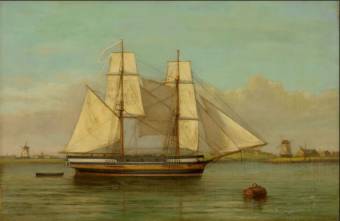
The following article is from the Launceston Examiner - Governor King and the Lady Nelson's Bell -The Lady Nelson was built on the Thames, in England, and on the 13th January, 1800, hauled out of Deadman's Dock into the river. She was a brig of 60 tons, fitted with a lifting keel divided into three parts, and was under the command of Lieutenant James Grant, R.N. She entered Western Port Bay on the 28th March, 1801, and under the command of Acting Lieutenant John Murray, she anchored in Port Phillip Bay on the 15th February, 1802.
Governor King first arrived in the sister colony, from England, as second lieutenant of the Sirius, frigate, under the command of Captain Hunter, who conveyed the first fleet of prison ships to Botany bay, and lost the Sirius upon Norfolk Island. On arrival Captain Hunter was appointed first commandant at Norfolk Island and afterwards relieved Governor Philip as second Governor of Sydney. Lieutenant King subsequently took leave of absence in England for the benefit of his health, and upon his return was appointed Governor in-Chief of New South Wales and its dependencies. He was a very eccentric man, and from his long residence amongst the prisoners of the Crown, acquired an accurate knowledge of their slang, was considered to be ' wideawake' and ' down' to every move on the board.
In the year 1803 he was Governor-in Chief, and had consequently the ordering of the men-of-war on the station at Sydney, amongst them being the brig Lady Nelson. The Governor was afflicted with gout, and his temper was none of the best. It was a general and imperative order that the ships' bells should be struck regularly every half hour during the night. The Governor, whose gouty paroxysms interfered with his rest, did not think that this order was carried out, especially in regard to the Lady Nelson's bell. He determined to play the officers a trick, and ascertain the truth.
He sent for a convict in the gaol at Sydney, named Fitzgerald, a noted bushranger, and told him he wanted him to do a little job at thieving, and promised that if he would swim to the Lady Nelson and bring the bell ashore - this was to be done in irons - he should have two gallons of rum, worth 40 pounds, out of the King's store, and one iron taken off his leg at once, and the other in six months, if his conduct was good. The Lady Nelson was lying about a cable's length from the shore, The convict obtained the bell, and carried it in triumph to Government House.
Next morning a signal was passed for the commander of the Lady Nelson, Lieutenant Cattoyes, to come on shore with the morning report. When presented, this document stated that the bell had been regularly struck.' Mr. Cattoyes,' said the Governor, ' you have presented a false report; the Lady Nelson's bell was locked up nearly all last night in the King's store, where it now lies.' Mr Cattoyes was kept under confinement for fourteen days and then released, with an injunction that he should never forget the Lady Nelson's bell.'[2]
References
[1] An historical and statistical account of New South Wales by John Dunmore Lang[2] Launceston Examiner 29 January 1881
[3] Image: Lady Nelson State Library NSW
↑