
Lieutenant James Grant
Newcastle 1801
James Grant, son of Robert Grant of Boganduie was born in 1772 at Forres, Morayshire, Scotland. He was educated at Aberdeen and in 1793 entered the navy as a captains servant. He was promoted to midshipman in May 1794 and master's mate in September. In 1800 he was appointed Lieutenant and given the command of the Lady Nelson.
The Lady Nelson, 60 tons burthen, was designed by Captain John Schanck for use in survey work in shallow waters. She was one of the first sea going vessels built in England with a centre board or sliding keel system.[1]
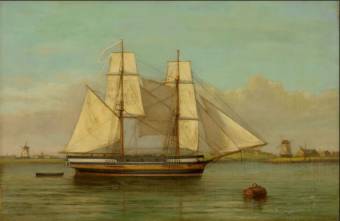
Departure from England
The Lady Nelson took her departure from the River Thames on 13 January 1800 and arrived at Table Bay on 8th July 1800. At the Cape Lieut. Grant was induced to take on board a convict - a Dane, gigantic in his appearance, who had been boatswain of one of the extra ships arrived at the Cape in a state of mutiny. He had been tried and sentenced to transportation to New South Wales. The man was sent on board in irons, from which Grant liberated him and he was found to be an excellent seaman, active, willing and occasioning no trouble. Lieut. Grant recommended his case to the Governor New South Wales and the convict obtained his emancipation soon after arrival.[3] This convict was probably Jorgen Jorgenson.The Lady Nelson departed the Cape on 7th October 1800 and anchored in Sydney Cove on 16 December 1800.
A Narrative of a Voyage of Discovery
James Grant's Narrative of the voyage was published in 1803, however the following account of his survey of the Hunter River was published in the Aberdeen Journal on 30 June 1802 -We are informed by Lieut. Grant who is lately arrived from New South Wales, of the flourishing state of that colony. He left Port Jackson in November last, when the crops were very luxuriant and beginning to be cut down.
Governor King had opened a communication with Otaheite for the purpose of supplying the colony with pork, in which he had been singularly successful.
The most friendly understanding exists between the natives of Otaheite and the settlement of New South Wales. We are happy to hear that the latter country is no longer in want of a staple commodity, the article of coals, of an excellent kind, being found in abundance in Hunter's River, together with plenty of wood, well qualified for the masting of shipping.
Mr. Grant made his passage to the Cape of Good Hope, round Cape Horn, in the brig Anna Josepha, (Hugh Meehan, master) laden with spars for masts, and coals, which latter sold immediately at the Cape at 36 rix dollars per ton (nearly 6 pounds sterling). The above vessel's top masts, top gallant masts, and yards, were of the wood cut in Hunter's River, and answered remarkable well. Mr. Grant had thus an opportunity of being an eye witness of its quality; and that was more particularly proved from the very heavy weather always met with in those seas.
Governor King had formed a small settlement at Hunter's River, for the purpose of working the coal, which is of the same nature with that of Newcastle.
Mr. Grant entered this River in the Lady Nelson, in order to obtain the survey of it. He penetrated, in his boats nearly 70 miles up the same, accompanied by Lieut-Colonel Patterson, without being able, at that time, to discover its source. A wood resembling Fustick had also been found.
Mr. Grant in his passage from England to Port Jackson in the Lady Nelson a vessel of only 60 tons burthen, with three sliding keels was the first that passed through the Straits which separated Van Diemen's Land from New England, and sailed along a great extent of coast to the westward of any land before seen by those who had visited that country, going into no higher latitude than 39.30 South, and observes that the South Cape of New Holland lies in 39.2 south. He found the shore he sailed along bold, with very deep water, wherever he attempted to land; and, in general, he had with a very moderate offing from 50 to 45 and 30 fathoms water, fine sand, and sometimes shells.
By order of Governor King, he returned into those streights, and obtained the survey of the coast from Wilson's Promontory to Western Port, with the survey of that harbour, which is well sheltered, and capable of containing many sail of shipping. There is abundance of wood easily to be got, and plenty of water; though the latter is rather difficult to be procured on account of the distance and form several shoals lying in the way, which rendered it necessary to take advantage of the tide. Mr. Grant gives a very favourable report of that part of the country. The different surveys obtained in the Lady Nelson were executed by Ensign Barralier of the New South Wales corps, who accompanied him for that purpose.
Expeditions
Lieutenant Grant's observations during the voyage and while in the colony can be found in his Journal The Narrative of a Voyage of Discovery, Performed in His Majesty's Vessel Lady Nelson.Below is part of the index listing some of his expeditions, impressions and difficulties -
Garden Island allotted for the Purpose of raising Vegetables for the Lady Nelson. Doctor Brandt is settled there, his Boat lost, and a Search instituted for its Recovery
A fugitive Convict met with, his miserable Situation, and the melancholy Fate of his Comrades
Bugle Horns useful in pathless Woods
Further Objections to the Sea-worthiness of the Lady Nelson
Sail in Company with the Bee Sloop to make further Discoveries. The Sloop being found unfit for the Voyage is dismissed
The Lady Nelson anchors in Jarvis Bay. A Native taken on board; his Surprise at all he sees. Interviews with other Natives. Their Canoes described. The Natives use Paint; one of them adorned with the Ships Paint
Mr. Cayley, a Botanist, collects some rare Plants
A Search after Kangaroos, which proves unsuccessful
Fire-places discovered, with Human Bones scattered round them.
The Surveying Chain lost, and recovered with some deficiency
Marks of the Small Pox observed on the Natives
Speak with the Britannia, a Whaler, from England
An Island discovered, and a Garden planted on it
Dexterity of a Native in striking a small Fish with a Wooden Spear
Euranabie and his Wife Worogan
The Bell Bird
The whistling Duck
The Lady Nelson's Construction found of Use on her being left by the Tide
Margaret Island described
The Bull Frog common to New South Wales
Tracks of Dogs discovered
Difference of the Tracks of the Tyger and the Wolf or Dog
Directions for Western Port; its Importance; with other Observations respecting the Navigation of Bass Streights
The Sliding Keels are lifted up and give Warning of Ground
Arrival at Port Jackson 14th May, 1801
The Lady Nelson is ordered to Hunters or Coal River 10th June
She falls in with the Ship Cornwallis, bringing Convicts from England
Mistake of a Pilot
Budgerie Dick, a Native
A Mine of excellent Coals
The Nettle Tree
The Wild Cat
A Man cast away, found nearly starved to death
A Bush Native
John William Lewin, a Draughtsman
The Cabra, a Worm eaten by the Natives
More Natives - Their Surprise at the Report and Effects of a Fowling-piece
Presents of Tomahawks made the Natives
Discovery of a new and promising Species of Flax
Colonel Patersons Collection of rare Plants destroyed by an Accident
Arrival at Sydney, 25th July, 1801.[3]
Departure
Lieutenant Grant departed Sydney bound for England on 9th November 1801 on the Anna Josepha, however the Anna Josepha had been poorly provisioned in Sydney and when she became becalmed Lieutenant Grant transferred to the American ship Ocean. The Ocean too became becalmed and with little water and hardly any food left, their situation became dire. James Grant remarked that he had but one biscuit remaining.[3]Fortunately a wind sprang up just in time and they made the Cape in a few days. -
I had lived so low for such a length of time that I found myself very feeble and weak; and now being on shore, partaking of a plentiful diet, I experienced violent spasms in my stomach attended with a giddiness and nausea. However as I recovered my strength, these symptoms left me and I was restored to my former good state of health without the help of medicine.[3]
At the Cape he embarked for England on 12th April on board H.M.S Imperieuse.
Naval Service
Lieutenant Grant was employed on the armed cutter Hawke in 1803. He was given a pension in 1806 for wounds received in action while in command of the cutter Hawke off the Dutch coast. [2]Ship News
Yarmouth 27 August
Arrived from the Texel his Majesty's hired armed cutter Hawke, Lieutenant James Grant, which place she left at ten o'clock last night, with dispatches from Captain Cunningham, Senior Officer on that station, and Mr. Kennedy, the Purser of the Princess of Orange, for ships stores. Captain Cunningham had, previous to the Hawke's leaving the Texel, gone close into that port, and discovered eleven sail of ships of war, of various descriptions, rigged and rigging. The Princess of Orange, formerly the Washington, was so close in as to be discerned by the people along the coast; a sight no doubt extremely mortifying to the already miserably humiliated Hollanders - the finest ship the States could ever boast, employed in blockading a port she was originally intended to adorn and protect.
By every account from fishing vessel, neutrals etc., that have been boarded coming from thence, the Dutch look with much confidence for delivery from or amelioration under their despotic Gallic Rulers (whose rapacity is only equalled by their insolence, and whose acts of violence to levy taxes and issue requisitions, dare not now even be made a subject of conversation, much more of discussion) to the general preparations now making in England
Lieutenant Grant, commanding the Hawke, is the same active and enterprising Officer who, in the Lady Nelson of only 60 tons, constructed by the ingenious and scientific Captain Schank, performed a voyage to New South Wales through Van Diemen's Straits, so much to the credit of himself, and admiration as well as advantage of his country. [4]
Notes and Links
[1] Arthur McMartin, 'Grant, James (1772 - 1833)', Australian Dictionary of Biography, National Centre of Biography, Australian National University, published first in hardcopy 1966
[2]. Wikipedia
[3] The Narrative of a Voyage of Discovery, Performed in His Majesty's Vessel the Lady Nelson, of Sixty Tons Burthen: With Sliding Keels, in the Years 1800, 1801, and 1802, to New South Wales
[4] The Morning Chronicle 30th August 1803.
Image: Lady Nelson. John Turner Collection
Colonial Events 1800
George Caley
Hunter River Expedition 1801
John Harris
Early Maritime Explorers
To embed this map in your own website, copy the HTML from the share page and paste it in the source code for your page.
↑