Hunter Valley Bushranger
John Quigley
Convicts were sometimes bound by their common experiences and hardships. When they 'took to the bush' their fellow sufferers were able to sympathise with their plight and supplied companionship, food and other necessities when they could.
John Shea, member of the infamous bushrangers the Jewboy Gang, was only 23 years old when he was hanged in March 1841. Shea had arrived on the Calcutta on 5th August 1837 with 359 other convicts and was soon assigned to John Incledon Pilcher in Maitland. Also arriving on the Calcutta was eighteen year old, John Quigley from Tipperary who had been sentenced to 7 years transportation.
John Quigley was at first assigned to Government service in Sydney. In 1839 a notice was posted in the Government Gazette for his apprehension after he absconded from Hassans Walls Stockade near Lithgow. He was admitted to Sydney Gaol on 14 November 1839. Later he was reassigned to the Maitland district. Here he was re-acquainted with another former shipmate Bernard McIntyre. They would have been aware of the fate of their countryman Shea - the whole colony knew of the 'JewBoy Gang'.
Despite this, in March 1842 just twelve months after John Shea was hanged as a bushranger, Quigley too returned to a life of crime when he stole a waistcoat from Mr. Marshall of Maitland. By June his trial had been heard and for this crime he was sentenced to 2 years in the iron gang. He soon escaped from this servitude and in February 1843, Quigley came to the attention of the entire district when he performed a daring robbery, bailing up the Singleton Mail and driver John Maher.
Departure
John Maher also arrived on the Calcutta in 1837. The Maitland Mercury reported the following incident in February of 1843. The writer gently chastised the victims Messrs. Hentig and Hungerford as well as John Maher for not preventing the departure of the robber, however as Mr. Hentig had initially put up a spirited resistance - and both men had been deprived of their clothes, perhaps the criticism was aimed at John Maher......'On Wednesday the Singleton mail which left Maitland at half past twelve o'clock, was stopped when it had got about four miles from town near the accommodation paddocks, While passing the fences of these paddocks a fellow jumped out of the scrub with a pistol in each hand, which he presented at the coachman, ordering him to pull up or he would blow his brains out. The robber had two more pistols stuck in the breast of his waistcoat. The Coachman drew up and the bushranger ordered him to carry the mail bags a short distance into the bush; when he got them there the robber cut them open with his knife, opened all the letters, and took some cheques and orders out of some of them which he placed in his bosom. Whilst thus engaged, a gentleman named Hentig came up on horse back, and the robber stopped him also, ordering him to turn out his pockets, In doing this Mr. Hentig turned out a pistol, and fired at the robber, but the shot took no effect. The bushranger immediately returned the fire, and the horse upon which Mr. Hentig was mounted started and threw him among some logs, where he lay for some time apparently stunned by the fall; and whilst in this helpless condition the bushranger stripped him of his clothes, taking from him a shooting coat, two pair of 'trowsers', a rough coat, a black waistcoat, a pistol, and 5 or 6 pounds in notes, and about 1 in silver, besides two or three knives. The fellow then reloaded the pistol he had fired which he had taken from Mr. Hentig, and threatened to shoot that gentleman but the coachman begged of him not to do so. Whilst they were there Mr. Hungerford came up and he was also stripped and robbed.
The coachman was kept bailed up for about half an hour and the robber then took to the bush. The coachman then picked up the letters he had left and proceeded to Singleton. Almost immediately after the robbery a mounted policeman and constable Kerr of the Maitland police who were escorting three prisoners to Patrick's Plains were met by Mr. Hungerford and Mr. Hentig, who informed them what had happened and the mounted policeman galloped after the mail, but either from misunderstanding the information or from a wrong description of the locality he searched the bush at a different place from that where the robbery was committed, and this search was consequently fruitless. In the mean time constable Kerr arrived at the spot and found by the road side, a pair of hobbles, a saddle cloth, a belt, a pea coat, a shirt and white jacket which it appears the robber had not had time to remove. The fellow who perpetrated this daring robbery is described as a stout well made man, about six feet in height, very much freckled, and sandy hair; he had on a brown jacket, which he left behind, and which the coachman carried away and it is now in the hands of the police It appears rather singular that even though the fellow was so well armed three men should suffer him to depart so quietly after having been robbed by him, as no attempt whatever seems to have been made to prevent his departure.'
Capture
Perhaps John Quigley let his guard down after this successful robbery. Possibly he was tired and hungry; with wet weather setting in and the prospect of living rough throughout the cold winter ahead he probably indulged in comfort where he could. He probably had not reckoned on the perseverance of Black Creek lock up keeper Henry Smith. Henry Smith was riding into Maitland when he observed from the top of Harpur's Hill a loaded wagon stuck in the mud with a native on top keeping lookout. On further investigation many empty bottles were seen lying about as if a great deal of drinking had been going on. He then observed a man jump from under the wagon and take to the bush. He bravely pursued the bushranger on foot with a loaded pistol in each hand, however after injuring his ankle when his spurs caught in a fence, his quarry escaped. He returned to the wagon where he inveigled the bullock driver Bernard McIntyre (who had also arrived on the Calcutta) to produce the clothes and shoes of the escaping bushranger. Constable Smith returned to Maitland to gather assistance and upon returning to the site observed McIntyre talking to Quigley. McIntyre, upon seeing the Constable and probably hoping to escape conviction immediately seized Quigley. Quigley was ordered to surrender and knowing his time had come, threw down the pistols and surrendered before being secured. His pistols were found to be unloaded. Later he told the Court he had returned and was having a pot of tea with McIntyre.Quigley would have been taken to the Maitland lockup to await his hearing. A few days later he was brought before the Bench and identified by John Maher as the robber of the Singleton Mail. He was then remanded for further evidence. When this was obtained he was fully committed to take his trial for firing at Mr. Hentig with intent to murder, for highway robbery and for having arms in his possession he being illegally at large. Soon after he began the journey to Newcastle gaol arriving at that facility on the 11 March 1843. By the middle of April he had been sentenced to transportation for life to 'such penal settlement as his Excellency might think fit'.
Cockatoo Island
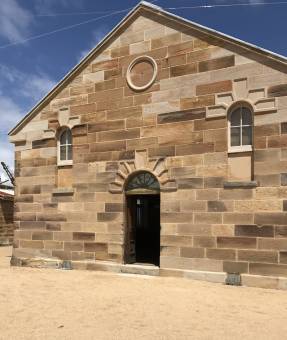
Convict Barracks Cockatoo Island
He was sent to Cockatoo Island on 17 April 1832. He stood by his old friend when he told the Court that McIntyre had taken the charge from this pistols and he would not have been apprehended if not for McIntyre. It was said that Constable Smith had sworn against McIntyre as aiding and abetting Quigley so that he could claim the reward for himself. Quigley's testimony was to no avail. Bernard McIntyre was sentenced to be worked in irons for the next two years.
Notes and Links
1). Bushrangers Bradish and Branigan also arrived on the 'Calcutta' in 1837↑