Hunter Valley Bushranger
Opossum Jack
In January 1841 when Jackey Jackey (William Westwood), was captured by Lieutenant Christie and the Mount Police near Goulburn, he was yet to write his memoirs and his most daring exploits were still to come. A news article at the time, in an attempt to show the extent of his notoriety and daring, referred to him as a former companion of 'Opossum Jack'.
Opossum Jack was the name given to John Hobson, a convict who had arrived on the Layton in 1829. While his name may now have passed into obscurity, in his day he became one of the most notorious bushrangers in New South Wales.
Escape
John Hobson had been assigned to George Blaxland at Merton when he absconded in 1833. He was apprehended soon afterwards in May and sent to No. 3 iron gang at Newcastle from which he absconded on 30th November 1837. He was wanted for several robberies in the Merton area in the following months.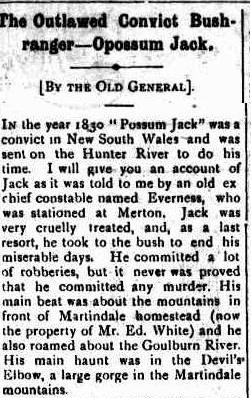
Opossum Jack was suspected of taking part in a daring robbery at Invermein with two others on 7th August 1838 and on 9th August also in company with others, he robbed a property at Gyams Creek in the upper Hunter region. The district was soon in a state of uproar and a correspondent to the newspapers at that time reported that 'bushranging was as bad as ever at New England and it would be some time before the gang were captured unless Government sent a stronger Mounted Police force.
He recommended a force to be stationed at Page's or Peels River to save the several days journey to Cassilis. He feared there would soon be worse accounts from New England, as no one was safe there with bushrangers mustering strong well-armed and mounted gangs and taking every horse they came across.
In 1839 Hobson shot and killed constable Fox of the Cassilis Police at the station of W. C. Wentworth at Cream of Tartar Creek near Gammon.
Magistrate of Muswellbrook Edward Denny Day informed the Colonial Secretary in May 1839 -
I have the honor to report for the information of His Excellency the Governor that Constable Fox of the Cassilis district was murdered on Thursday last at a station of Mr. W.C. Wentworth at Cream of Tartar Creek near Gammon in the county of Brisbane by the notorious John Hobson alias Opossum Jack who was at the time accompanied by two other runaway convicts named Knight and Wilson, the latter of whom fired at and wounded a man named as Bayliss who was assisting Fox in pursuit of the bushrangers. Bayliss I am happy to say escaped with his life but Fox was killed on the spot.
My letter of the 1st November last has already made you acquainted with some portion of Hobson's history and I regret much to find that my anticipations as expressed in that letter have been so fearfully realised.
It may be necessary to add that the exertions of the Police here and at Merton to apprehend Hobson have been most unremitting but unfortunately owing to the feeling entertained towards him by the shepherds and hut keepers who harbour him they have hitherto failed. I would therefore most respectfully suggest that as this is a case of uncommon atrocity and as Hobson's career has been one of almost uninterrupted crime that some extraordinary inducement should be held forth for apprehending him and his associates. The hut keeper at the station where the murder was committed is in custody at Merton. He has made a voluntary statement of the particulars of the offence, the truth of which I can entertain no doubt. He however denies that he was in the habit of harbouring the murderers. - Muswellbrook Court of Petty Sessions, Letter Books, 1838-1851
Reward
After this an extraordinary reward of almost £100 was offered the capture of Hobson and his associates Francis Knight and John Wilson. (annual wages for shepherd around this time were about £10).A description given at the time reveals that Hobson was only 4'11 1/2in with a sallow complexion; light brown hair; and grey eyes. He had various markings, one being a man's bust on his breast. He had been a farm boy in his native Sheffield. There were rumours that another bushranger by the name of James Martin, by most accounts a vicious and callous man, murdered Opossum Jack, as they were known associates. Martin had been seen in possession of the knife, tinder-box, and pistols that had belonged to Opossum Jack who had not again been seen in the district after March 1840.
However in September 1840 it was reported in the Commercial Journal that:-
'Opossum Jack - This notorious bushranger, it appears, lately visited the Mudgee district in company with another of his species, styled 'Blue Cap,' and two others, not known. They were all armed, as the expression is, 'to the teeth,' with guns and pistols. It was only about a fortnight ago that this captain of bushrangers had the impudence to stop the lock up keeper of Bathurst, while on the road leading to that township; and it was with the greatest difficulty that he persuaded the murderous fellows to spare his life. They pursed a man named Dunn, who had, it is said, been the principal means of the capture of Lambert and Brown, two bushrangers; and only through the fleetness of the steed upon which he was mounted, there is little doubt but he would have been murdered, as they vowed vengeance against him. Major Nunn, with a chosen band, ought to be dispatched after these 'murthering vagabonds.' for with his 'nose' he would be sure to scent them out, and it is said he knows the difference between a bushranger in gaol, and a bushranger abroad!
Mounted Police
Major James Winnett Nunn and the mounted police were in pursuit of Opossum Jack and his gang, however they were unsuccessful in capturing them. Later in the court-martial of Lieutenant Sayers of the Mounted Police which was reported in the Sydney Herald, Major Nunn's frustration at being unable to deal with the notorious bushrangers was touched on. Opossum Jack was referred to as Monsieur Tonson of New South Wales. It seems that Opossum Jack managed to make his way north to Gayndah as it was here in 1849 that his luck, such as it was, finally ran out. In 1853, it was reported that Opossum Jack had died four years earlier, his daring exploits all but forgotten by then.Death
It seems he died not at the end of a noose, or shot by troopers as could have been expected, but at the hands of natives, violently and probably alone on an isolated station many days ride north of his former haunts in the Hunter Valley and Liverpool Plains.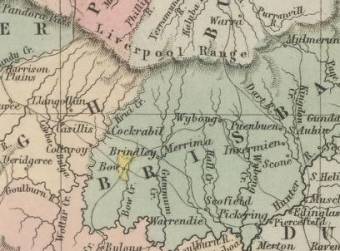
Map showing the districts Opossum Jack and his gang roamed in the 1830's. Cream of Tartar Creek is north-west of Invermein. - Old Maps Online David Rumsey
↑