Hunter Valley Bushranger
James Pheeny
James Pheeny arrived on the convict ship Jane in 1831. The indent stated that he was 22 years of age and a spadesman from Co. Mayo. He was tried on 30 July 1830 and sentenced to 7 years transportation for stealing sheep. He had a scar on the left side of his mouth and tattoos.
On arrival in the colony, he was assigned to William Dangar at Darlington where he was employed as a shepherd on one of Dangar's sheep stations further north.
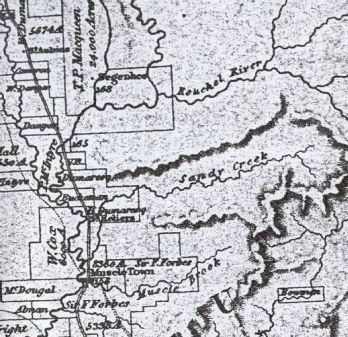
This is an 1837 map showing the location of William Dangar's estate where James Pheeny was assigned when he first arrived in the colony; and the estate of Captain Dumaresq which was robbed in 1834
Charged with Murder
James Pheeny was charged with murdering native Old Jemmy at Liverpool Plains in November 1833. He was taken to Newcastle gaol and then transferred to Sydney gaol before standing trial.He was eventually acquitted of the charge and subsequently returned to the service of William Dangar. Read an account of the trial in the Sydney Gazette
Robbery
When he absconded in July 1834 and robbed the estate of Captain William Dumaresq, a reward of £70 was offered for his apprehension. His description was posted in the Government Gazette - he was 5ft 4 1/4 with a dark ruddy freckled complexion and dark brown hair and hazel eyes. He had a scar at left side of mouth and tattoos - JF and cross on right arm.His accomplices were given as Joseph Lynch and John Crawford. They were part of the gang of bushrangers led by the notorious bushranger John McDonald. Joseph Lynch and John McDonald were shot and killed at the Namoi by two assigned servants of Sir John Jamison - George Biddles and James Archer in 1834.
On 25th November 1841, the Colonial Observer reported the following news:
A runaway convict named Pheeny was taken into custody on Sunday last by Serjeant Canfield of the Sydney police; after his apprehension he voluntarily confessed that he was one of three individuals who stood charged with the murder of a man in the Hunters River district, and for whose apprehension a reward of £200 was offered.
Escape
And on 6th January 1842 came the following account -Country News - From Scone the same complaints continue to arrive. Pheeny the bushranger, who had been lately apprehended here, and convicted at Muswellbrook, contrived to effect his escape from the constables, by whom he and a party of other criminals were being escorted. Both the constables who formed the escort had left the party unguarded, and the arms of one of them within their reach. Pheeny had been handcuffed by one wrist to the other prisoners and when they arrived at the station where the mail changes horses, Constable Brown went inside the hut to boil some tea while the other remained outside to guard the prisoners. While lighting his pipe by the fire he laid down his musket which was then seized by Pheeny who made a rush towards the hut dragging the others with him. Another man took up arms and they then managed to escape, first ordering a nearby drayman to knock off their handcuffs. Two of the prisoners later returned to Muswellbrook and gave themselves up.
Pheeny and his mate were captured the following day by a mounted policeman at a sheep station belonging to Mr. Pringle near Muswellbrook and once again lodged in the Muswellbrook lockup. The two constables from whom they had escaped were committed to take their trial.
Living with the Kamilaroi
It may have been James Pheeny whose story was re-told in the Maitland Mercury in 1881:The Aborigines (by John Fraser BA Sauchie House) Anecdotes about the Kamilaroi Aborigines communicated by Mr. C. Naseby) To free themselves from the severity of penal discipline in those days, prisoners of the Crown working on the public roads, sometimes succeeded in hiding themselves in the bush and then would join an encampment of the blacks. A man named Pheeny, who had been sentenced on a charge of robbery, thus escaped, and lived among the native tribes for seven years, naked as they. His importance in their eyes, was such that he was allowed three wives to wait upon him as servants, and to carry his personal goods from camp to camp.
Soon after Pheeny, zealous in his new office, and proud of his dignity, proved his usefulness by enabling the police to capture fifteen of his former associates. These poor unfortunates the troopers arranged in a file for the march, each pair secured by handcuffs and by a rope from neck to neck, while Pheeny led the way with one end of a long rope round his body, and the remainder of it fastened to the neck ropes of the prisoners behind him. Thus they moved on till they reached the Gwydir at Bingera, three days march. The river was then in a fresh, and not quite safe to cross; but, as the lives of blackfellows were of little consequence, the troopers would allow no delay. Pheeny accordingly entered the swollen stream, his train of natives behind him, and, after some difficulty, reached the other side. Not til then did he discover that the rope was all he had, for the prisoners had managed to free themselves from their neckties and handcuffs, and, favoured by the muddiness of the water, had slipped down the river, diving under, and could not be found!
↑