
Moreton Bay
1823 - 1842
In 1823 the Sydney Gazette reported......
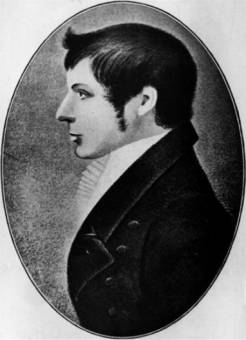
The Surveyor General (John Oxley, Esq) is expected to leave Sydney daily, on one of the government vessels, to proceed Northward as far as Port Bowen, Port Curtis and Moreton Bay. The object of Mr. Oxley's mission is to examine these harbours, and report thereon [1].
Accompanying John Oxley on the government vessel Mermaid captained by Charles Penson was Lieut. Robert Stirling of the 3rd Regiment who had arrived on the Shipley in 1822 and John Fitzgerald Uniacke who arrived in the colony in September 1823 as well as a corporal and privates of the 3rd Regiment.
An account of the voyage of the Mermaid to Moreton Bay published as Narrative of Mr. Oxley's Expedition to Survey Port Curtis and Moreton Bay etc. by John Uniacke in Barron Field's Geographical Memoirs of New South Wales......On Tuesday October 21st 1823, Mr. Oxley, Lieutenant Stirling of the Buffs, and I, embarked on board the colonial cutter Mermaid (Charles Penson, master), about noon, and proceeded down the harbour; but the wind proving unfavourable, we came to under Point Piper, where we remained till the next day at midnight, when a moderate breeze springing up we got under way and ran out of the harbour. Early on the morning of the 25th we came to an anchor off Port Macquarie....continue
By December 1823 the expedition had returned to Sydney -
We are happy to announce the arrival of H. M. cutter, Mermaid, from the Northward, with John Oxley Esquire, Surveyor General of the Territory; and are much gratified to observe that in Moreton Bay a fresh water river has been discovered, which, for extent and depth of water, far surpasses anything hitherto known in New South Wales; and indeed inferior to very few rivers in the old world. The party ascended it about 50 miles, the river preserving its uniform breadth from a quarter to half a mile, and of sufficient depth to float ships of considerable burthen; and, from an adjacent eminence, a view of the interior of the country was obtained, which rendered it probable that it was navigable to a much greater distance, particularly as the tide rose about 4½ feet, and there was no apparent diminution of width or depth in the river
The country on the banks, appeared capable of raising all the different descriptions of produce usually cultivated under the same latitude. The timber was abundant and good; and many various trees, of not generally known kinds, a lofty and elegant one, of the pine species predominated. The Mermaid has been the means of restoring two unfortunate men to civilised life. Their names are Thomas Pamphlet (per Guildford 1812) and John Finnegan.[2]
(*Richard Parsons who accompanied Thomas Pamphlet and John Finnegan to the Moreton Bay area was found a year later.)
Settlement at Redcliffe
John Oxley returned to Moreton Bay in a second expedition in September 1824. At this time a settlement had been established at Redcliffe under Lieutenant Henry Miller of the 40th regiment (arrived on the Isabella the previous December). Also on this expedition was botanist Allan Cunningham, surveyor Robert Hoddle, 14 soldiers, 29 convicts and surgeon/storekeeper Walter Scott.Moreton Bay Visited by Governor Brisbane
In December 1824 Governor Brisbane, Chief Justice Forbes and others reached the settlement after an eventful journey during which the Amity was forced into Newcastle harbour due to contrary winds and lack of provisioning. The following account of their journey to Moreton Bay was reported in the Sydney Gazette:On Saturday morning last H.M. colonial brig Amity returned from the Northern Settlements, last from Moreton Bay, with His Excellency the Governor in Chief, His Honor the Chief Justice, the Surveyor General, Captain McArthur, and Mr. Francis Stephen, all in excellent health.
His Excellency proceeded, by water to Parramatta.
We are happy to inform our Readers that the Amity was only four days returning, while she was 14 days on the passage to Moreton Bay; in which she encountered heavy gales and bad weather. One night in particular, the thunder was so awful, and the lightning so vivid (the wind at the time blowing a gale), as to resemble a storm in the West Indies. His Excellency we believe passed five years of his life in these islands and never witnessed more stormy and alarming weather; the fire balls as it were, danced upon the deck.
The information that we have been able to obtain, is not of a much more interesting nature than that which we have already given to our readers. His Excellency the Governor is amazingly gratified with the excursion; and, from the knowledge he has been able personally to acquire, there can be little doubt but that Australia will at no distant period, derive considerable and lasting benefit. The Amity entered by the Northern, and returned through the Southern entrance. The length of Moreton Bay is ascertained to be 60 and its breadth 20 miles; containing within the basin, no less than 1200 miles! His Excellency and His Honor the Chief Justice with the other Gentlemen went up the Brisbane River only 28 miles. At this extent the breadth of the river is about half a mile. The river preserves its character the length of this distance. The scenery on each side was truly picturesque; on one side high open forest land would present itself, whilst on the other, a comparatively low country, covered with close vegetation, was to be seen; these views were alternate, and from the striking contrast, were of the most engaging description. The pine, with which the country seems to abound holds out prospects of a truly promising kind. Some of the trees measured from 8 to 10 feet in circumference, and in height might be from 90 to 100 feet, without the intervention of a branch to injure their symmetry.
As the natives were particularly troublesome to the New Settlement at Red Cliff Point, by purloining the tools and other useful articles, at every opportunity, the commandant has been constrained to keep them at a respectful distance, owing to which very few were to be seen by the Party. Up to the day preceding that of the departure of the Amity only three natives had been descried, and they were at some distance. On the morning of the Amity's weighing anchor, however, as small party came round a point of land. The Governor, the Chief Justice and other Gentlemen presently landed. One of them quickly recognized Finnegan (the partner of Parsons who had been so many months with them), and evinced extraordinary pleasure. In a few moments the party increased to 15 men and boys, but no females were to be seen. Two of the Hunter's River natives had attended the Expedition, and were on shore with His Excellency but they failed in making themselves understood, other than by gestures - they seemed quite ignorant of each other's dialect. They were very friendly, and betrayed no symptom of fear; indeed one was so extraordinarily gratified as to roll himself in the sand - from pure pleasure. They were in a state of nudity, with the exception of curiously wrought nets which were worn round the neck for the purpose of carrying fish and other food; these were gladly bartered away for tomahawks etc. They were armed with no destructive weapons.[3]
Rescue of the Royal Charlotte
The Amity was sent to the rescue of the shipwreck crew and passengers of the Royal Charlotte in 1825. She came close to being destroyed in the attempt. Select here to find out more about the daring rescueThe The original site at Redcliffe proved difficult and in May 1825 Captain Miller relocated the settlement to the banks of the Brisbane River.
Settlement Re-Located
In August 1825 Captain Henry Miller was succeeded by Captain Peter Bishop also of the 40th regiment.Captain Logan
In March 1826 Captain Patrick Logan of the 57th was appointed Commandant. Captain Logan, wife and family, Lieutenant Thomas Bainbridge and a detachment of the 57th together with 14 convicts embarked on the Amity for for Moreton Bay on 8th March 1826. [4]Captain Clunie
Captain Logan was murdered in 1830 and Captain Clunie of the 17th regiment who arrived on the Forth in April 1830, was appointed Commandant in October 1830. There were 1066 convicts at Moreton Bay at the beginning of Clunie's command. He remained at Moreton Bay until 1834 during which time there were many improvements.Captain Foster Fyans
Captain Foster Fyans of the 4th (King's Own) Regiment took over as Commandant in 1835. The number of convicts at the settlement had fallen to about 700 by this time. During Captain Fyan's command the first steps were taken to open Moreton Bay for free selection.Sydney John Cotton
Sydney John Cotton of the Buffs was Commandant between 1837 and 1839. By May 1839 the number of convicts had been reduced to 94.Moreton Bay Open for Selection
On 31st January 1839 The Australian announced that Moreton Bay was to be thrown open for selection and that a party of surveyors under Robert Dixon were to proceed there to prepare the necessary surveys.Lieut. George Gravatt
Lieutenant George Gravatt of 28th regiment who arrived on the Portsea in 1838, was appointed Commandant in May 1839.Lieut. Owen Gorman
Lieutenant Owen Gorman of the 58th regiment was the last Commandant at Moreton Bay, serving from August 1839 to May 1842Notes and Links
1). Edmund Lockyer - Exploration of the Brisbane River 18252). History of Moreton Bay Settlement - Brisbane Courier 18 November 1869
3). Rev. Christoph Eipper - Missionary
4). W. H. Traill, 'Sketcher. A Curious Old Record. Moreton Bay Penal Establishment Under Captain Logan,' Queenslander, 14 December 1901
5). The convict ship Mount Stuart Elphinstone landed prisoners at Moreton Bay in 1849
6). The convict ship Eleanor conveyed prisoners to Moreton Bay in 1831
7). Lieutenant Robert Stirling was born in 1796. He was the seventh son of Andrew Stirling Esq., of Drumpellier, Lanarkshire and also the younger brother of Sir James Stirling, first Governor of Western Australia. (Stirling Family Tree - Online). He was 27 years of age in 1823. He died in 1829 off the Cape de Verd Islands on board the Benbow, on his way to rejoin his regiment in the East Indies.
8). John Fitzgerald Uniacke was born in 1798. He was 25 years of age when he arrived in New South Wales in September 1823 and joined this expedition soon afterwards. He was appointed Surveyor of Distilleries in February 1824 which proved entirely unprofitable causing him to live from his own resources. In June 1824 he was appointed Sheriff and Provost Marshall on the resignation of John Thomas Campbell. [2] He died in Sydney in January 1825.......
On the 13th inst, of a remittent fever, in the 27th year of his age, John Fitzgerald Uniacke Esq. whose hospitable disposition, whose high and delicate sense of honor, whose good temper and manners, had justly endeared him to the society in which he moved, where his loss will be long and sincerely regretted. The community at large will also do justice to his memory, for his honest feeling heart not only sympathized with the distresses of the poor, but his generous willing hand was ever ready to relieve them. The father of this Gentleman (who represented the borough of Youghall in the Irish House of Commons), married a daughter of the Right Honorable John Beresford, late first Commissioner of His Majesty's Customs in Dublin; Member of the Irish and Imperial Parliament, and Brother to the first Marquis of Waterford.....Sydney Gazette 20 January 1825.
9). Baronetage of England.
10). Sydney Gazette 24 June 1824 - Appointment of John Uniacke
11). Master of the Mermaid Charles Penson was 37 years of age in 1823. He was born in Devon in 1786. He arrived free on the Midas in 1821. He was a nephew of Richard Brooks. When he died in 1828, his family was left destitute.......
We understand that there is a case of real distress existing in the town of Sydney, which we are of the opinion, when mentioned, will excite in the bosoms of the philanthropist those charitable emotions will be followed by substantial consideration. Captain Penson, one of our Colonial Mariners, who has been for several years past in the service, died last week, after a long and painful indisposition. For the purpose of providing for his wife and 4 young children, he kept at sea until within a very few weeks of his death. Poverty, which too often succeeds and accompanies sickness, was the lot of this struggling mariner, and we have been informed if it had not been for the bountiful regard of Mr. and Mrs. Robert Campbell of Bligh Street that the whole family, in all probability, might have perished; and we think it is due to Mr. and Mrs. Campbell to say, that their apparently unnoticed attentions to this now poor fatherless family, with the never failing Howard-like philanthropy of Dr. Bland, has been the means of almost their sole support. To illustrate the forlorn condition to which this family is reduced, we have the pain to state, that a banker even had so little humanity to put in, and keep in, a bailiff at the very time the unfortunate man was on his death-bed ; though the debt itself did not exceed five pounds, some people must have adamantine hearts. Now, however, that the husband and father is gone, we would undertake to present this case to the consideration of the Public in the town of Sydney, who have never yet been appealed to in vain. There is a widow and four young children, the last at the mother's breast, in a state of the most abject poverty, with wolves ready to pounce upon them for the little furniture they possess, and the beds upon which they lie. We feel we need not urge anymore, except by adding that contributions, however trifling, will be gratefully received, and promptly acknowledged through our columns, in behalf of the Widow Penson, and her four children. - Sydney Gazette 24 March 1828
References
[1] Sydney Gazette 16 October 1823[2] Sydney Gazette 18 December 1823
[3] Sydney Gazette 9 December 1824
[4] The Australian 9 March 1826
↑