
Journal of Captain Patrick Logan
Moreton Bay 1827
Patrick Logan:
Birth: Berwickshire, Scotland
Arrival: Hooghley in 1825
Occupation: Military Officer; Commandant
Marriage: Letitia Anne O'Beirne, Sligo 1823
Death: October 1830
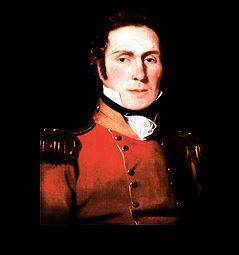 Captain Patrick Logan arrived with the 57th Regiment on the Hooghley in 1825.
Moreton Bay
A year later a detachment of the 57th was posted to Moreton Bay penal colony and Captain Logan was appointed commandant in March 1826. He sailed on the 8th March accompanied by his wife Letitia (nee O'Beirne) and two year old son Robert Abraham Logan.The military detachment consisted of Lieutenant Bainbridge, a subaltern, two sergeants and forty one rank and file with nine women and thirteen children and fourteen convicts. A large contingent for the little vessel Amity, however fortunately the weather remained calm.
There were few buildings in the struggling outpost. In handing over command, Captain Peter Bishop of the 40th regiment reported to Captain Logan that the buildings (situated at the river end of Queens Street) were merely temporary, being built of slab and plaster as their were no skilled builders available.
The buildings were unsuited to the hot climate and some inhabitants were still under canvas. The roads were mere winding tracks between the little dwellings and farm paddocks. Bishop had been beset with difficulties at the settlement but had endeavoured to establish satisfactory relations with the natives. Eighty five acres had been cleared and sugar cane flourished as well as tobacco. Undaunted by the tasks ahead, Captain Logan embarked on an extensive program of building. Hospital, surgeon's quarters, gaol, barracks for convicts and soldiers, Commissariat Stores and Windmill were commenced and he also began extensive exploration of the district.
1827 Expedition
The following journal was kept during an expedition in June 1827.......... Journal of Captain Logan's Pedestrian Tour, in the neighbourhood of Moreton Bay, in the month of June 1827.June 7th - Left the settlement at 4 o'clock in the morning, proceeded up the Brisbane, and arrived at the limestone hills, on the left branch, at 10 o'clock at night; distance, 57 miles.
June 8th - Sent the boat back to the settlement, and proceeded overland; directed my course S.S.W. in the direction of Mount Dumaresq; the country very fine - a black vegetable mould, on a limestone bottom; the timber consisted of several varieties of the eucalyptus, viz, iron bark, blue gum, box, apple tree, and a variety I have not hitherto seen the trunk resembling iron bark, with a broad leaf. This tree is only found on the best soils - at a distance it very much resembles the cork tree; at 2 o'clock came to the banks of the Brisbane; the beauty of the spot, and the men being much fatigued, induced me to halt for the night; distance this day only 13 miles.
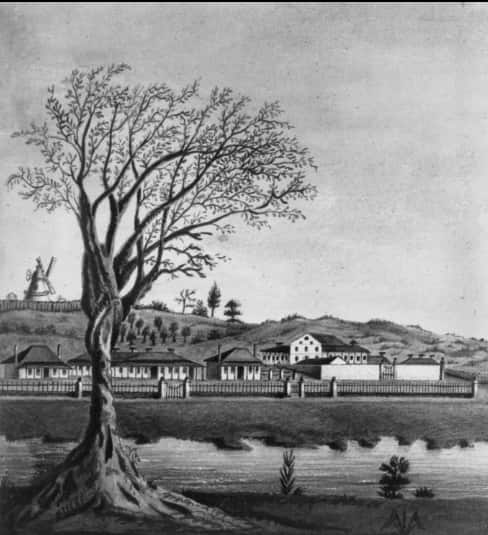
Image: Early drawing of a section of the town of Brisbane, Queensland including the Convict Hospital, 1835. Negative no. 138146. John Oxley Library, State Library of Queensland.
June 9th - Resumed my route at 8 o'clock; the country for 8 miles superior to yesterday; shot two beautiful parrots (a new species), not hitherto found in the Colony; came to a large swamp, several miles in extent, skirted it for some miles and then crossed it; came again on the Brisbane, running N.E; crossed it, and proceeded up the left bank; approached Mount Dumaresq towards evening; the country now exceeded ,in beauty and fertility, anything I had before seen; in the bed of the river I found several specimens of coal and crystal; distance 20 miles.
June 10th - Commenced this day's journey at half past 8 o'clock; crossed a beautiful plain two miles in width and about three in length, very lightly timbered; no preparation requisite for the ploughshare; at half past 9 o'clock entered a thick scrub, at the foot of Mount Dumaresq, which continues to the summit; found several turkeys and a remarkable large pigeon, upwards of three pounds weight; gained the top of the mountain at 3 o'clock; I had a grand and extensive prospect; the limestone hills bore N.N.W; I had traversed the valley of the Brisbane 36 miles, and it appeared about the same in breadth; I may safely rely that there is in this beautiful vale at least half a million of acres, excellently watered, and fit for any purpose to which to which it may be applied. I could likewise distinctly see the windings of the Logan, through an extensive and beautiful country eastward from Mount Dumaresq, and only separated from the valley I had quitted by moderately elevated ground. On descending the mountain, on the southern side, had to encounter a difficult scrub, which I could not clear before sun set; luckily found water in a ravine, where I stopped for the night; distance this day 12 miles.
June 11th - Resumed my descent through the scrub at 8 o'clock; after much difficulty cleared it at 10 o'clock; found a branch of the Logan at the base, running northward; the river here passed through a large swampy plain well adapted to graze cattle; saw a large flock of emus, the first seen in the vicinity of Moreton Bay; the course of the river making a detour to the west, left its banks having changed my course to south in the direction of Mount Shadforth and after a few miles walk, re crossed the Logan, which flowed through a large plain; the grass thereon being on fire, obliged me again to cross the river; proceeded up the left bank for some miles; the mountains, towering on each other on every side reminded me of a Pyreneean valley; at 4 o'clock killed a large kangaroo, which was very acceptable to the men; distance 25 miles.
June 12th - Continued my route to the south; the river branched into several streams; we were evidently near the source; walked for some hours over a hilly country admirably adapted for grazing sheep; came to a creek at the foot of Mount Shadforth, and shot an emu on the bank; ascended the mountain, which was the most fatiguing part of the journey, unfortunately began to rain on my reaching the summit, accompanied by a thick fog, which prevented me from having so extensive a prospect as I expected. I was surrounded by mountains on all sides, but I could not get a view of Mount Warning; to continue my route to the southward would have been very difficult and would have protracted the journey beyond the time intended, I therefore determined to steer eastward, and gain the low country; descended the mountain to the eastward, and halted for the night in a native encampment, which was very apropos, as the rain continued; distance 15 miles.
June 13th - Continued my route eastward, over a very difficult and mountainous country; at length perceived Mount Warning, direct in my course; on approaching the base found the principal branch of the Logan; the stream was so rapid, I had some difficulty in passing; encamped on the right bank and immediately commenced to ascend, in hope of reaching the summit, but could only gain a peak, not more than half way to the top; all attempts appeared hopeless at the east and north sides, and it would have detained me two days longer, to have made a detour to the westward, probably with as little chance of success; I therefore returned to the encampment, with the intention of proceeding on my journey in the morning; distance 14 miles.
June 14 - Made another attempt to ascend the mountain on the north side; got to the top of a peak, considerably higher than yesterday; had a very extensive view; found Limestone Hills, bore due north; recommenced my journey to the east; proceeded for some miles without much difficulty; crossed another river, which washed the S.E. side of the mountain and untied with the other a few miles below; crossed some beautiful valleys, well watered with mountain streams; got into an extensive scrub, which prevented me making way to the east; towards evening made a detour to the N. to clear the scrub and got into an open forest country before sun set; distance 20 miles.
June 15th - Started at sun rise, proceeded east, passed through a fine hilly country covered with most luxuriant grass, to the top of the hills, the soil principally a black vegetable mould; this part of the country is the best I have seen either for sheep or cattle, and is most abundantly watered, each valley possessing a beautiful rivulet; passed several considerable streams which unite with the Logan; towards evening my route eastward was completely terminated, by mountains covered with pine scrubs, to the summit; perceiving a stream running north, I determined to follow its course for a few miles, for the purpose of finding a more even way to cross the mountains to the sea coast; distance 25 miles.
June 16th - Started N.E. over a hilly country, somewhat inferior to yesterday but well adapted to pasturage; distance 15 miles
June 17th - Ascended a ridge of mountains; could see nothing but mountains to the eastward, covered with pine scrubs; provisions were nearly exhausted, and the men's shoes worn out; determined to steer northward, and join the settlement; proceeded down the banks of a river through a rich tract of country; saw several kangaroos, but the dogs were so weak they could not run them down; fortunately before sun set killed one; stopped for the night; distance 20 miles.
June 18th - Continued my route; passed through a rich valley ; towards mid day left the valley on my right; my route now lay over some rocky ridges the worst country I have passed through; the men greatly fatigued; distance 16 miles
June 19th - Continued north the first part of the day, the country was very good; much improved in appearance to that traversed yesterday; towards noon it became swampy; at two o'clock arrived at the Logan not fordable; stopped for the night; distance 20 miles
June 20th - Made several unsuccessful attempts to cross the river; moved up the bank about 8 miles
June 21st - Proceeded up the river about two miles - crossed at a ledge of rocks, steered north for the settlement, the soil principally a light sandy loam; timbered with forest oak; a considerable number of swamps; distance 22 miles
June 22nd - Recommenced my route for Brisbane Town, for a few miles through a swampy country; towards midday arrived at Cowper's Plains, and crossed Cane Creek; reached the Brisbane opposite the settlement at 4 o'clock.'
Extract of a Letter from Captain Logan, commandant at Moreton Bay, addressed to the Honorable Alexander McLeay, Esquire, Colonial Secretary and dated Moreton Bay July 25 1827........
I proceeded up the Brisbane on the 7th of June, as will appear by my Journal, which I beg leave to enclose, with the view of heading the river lately discovered, reaching Mount Warning, and from thence taking the most direct route to the Tweed. However, I found it impossible notwithstanding every exertion to get through the thick scrubs which cover the mountains in that direction; I was, in consequence obliged to return to the settlement without accomplishing the object of my journey. However I have much satisfaction in reporting that the country though which I travelled exceeded my most sanguine expectations, and is everywhere extremely well watered; and I have no doubt, whenever it may suit the views of government to open it for settlers, it will be found the most desirable district for that purpose hitherto found in the colony. After the sailing of the Wellington, I will take an opportunity of proceeding to the spot from whence I saw what I supposed to the the Tweed and from thence endeavour to make a direct route. The distance did not appear to me to exceed 50 miles.....Sydney Gazette Friday August 17 1827.
1828 Expedition
In 1828 he accompanied botanists Charles Frazer and Allan Cunningham on an expedition to Breakfast Creek.Murder of Captain Logan in 1830
Captain Patrick Logan was murdered while on an excursion in November 1830. The facts connected with this melancholy event are stated as follows:Wishing to lay down correctly on his chart, the windings of the river between the Pine ridge - Lockyer's Creek, and the Brisbane mountain, and to ascertain more correctly the course and termination of the Creek striking out of the main river at the foot of the Brisbane mountain in a north easterly direction, and to proceed to the Pumice stone River, and the Glass Houses, and from thence back to the settlement at Moreton Bay, on Saturday the 9th Oct. last, with a party comprising one private (Collison), 57th regt. his servant and 3 prisoners, who were reckoned good bushmen, with two pack bullocks. On Sunday, they travelled 14 miles in a N. E direction, and encamped on the Limestone side of the river. Two or three blacks were seen at the camp place at night.
On the next day, upwards of 200 blacks covered a hill close to where the party had to pass which was on the Lime stone side of the river, and began throwing and rolling down large stones on the party while passing, - but no spears were thrown at this time. Capt. Logan was in advance and finding he could not proceed on account of the natives, he was obliged to fall back and wait the coming up of the party. - Collison his servant seeing what was going forward, fired a shot over their heads to frighten them. This for a time had the effect; and they kept more aloof; but while the party were in the act of fording the river, the blacks closed upon them again. Collison fired another shot which again had the effect of keeping them off. The natives appeared to know Capt. Logan, for as soon as he had crossed, they repeatedly called out 'commidy Water,' (intimating thereby it is supposed, he should got back over the water) they followed at a distance all the day hiding themselves occasionally behind trees and in the long grass.
From this, till Saturday the 17th when Captain L. saying he had accomplished all that was practicable, gave directions for the return of the party to the Lime Stone station, nothing of consequence transpired.
Between eight and nine o'clock on the 17th Captain Logan took a path, which led him away in the direction of Mount Irwin, where being desirous of obtaining some Basaltic formations, he was lost sight of, and his party pushed on, and encamped about four in the afternoon, on the ground previously pointed out by Captain L. - Some time after, the men thought they heard him cry 'Cooey'. Several 'Cooyed' in return, and then waited about half an hour, when they thought they heard him 'Cooey' again. He was again answered, and four or five shots were fired at interval's during the evening. Early on Monday the 18th two men were sent down the creek to follow the tracks of his horse's feet. About twelve o'clock, fifty or sixty blacks appeared armed with spears, shields, and waddies. They hovered about the party, shouting, getting behind trees, and endeavouring to close upon them undiscovered - but no shots were fired. They continued their course, and in an hour or two after, went off towards Mount Irwin, which was the direction Captain L. had taken the preceding evening.
Nothing further of consequence occurred till they reached the Lime Stone Station on Wednesday afternoon. Here, not finding Captain L., Collison, four prisoners, and private Hardacre, 57 regt., started next morning and travelled between thirty and forty miles, when about five o'clock in the evening they descried a saddle lying about thirty yards from a fire. The stirrup leathers were cut asunder, evidently by a stone tomahawk, and the stirrup irons were gone. A space was eaten round where the horse was tethered. There were marks where Captain L. had taken his horse to water, and where he had roasted chesnuts at a fire produced at the stump of a tree. No marks of struggling or other violence appearing, it was inferred that Capt. L. had jumped on his horse bare backed, and made his escape. The party then returned to the Limestone Station. without having seen a black on the whole journey, Disappointed a second time, another party consisting of 5 soldiers of the 57th regt. and 12 prisoners set out, and meeting with a party under Mr. Cowper surgeon, on Wednesday after considerable search found Capt. L's waistcoat, covered with blood, as well as some leaves of his note book.
Next day Mr. Cowper discovered the horse dead in the bottom of a shallow creek, covered with boughs. One broken spear only was found, and about seven or ten yards from the opposite bank Capt. Logan's body was found; - the back of the head much beaten with waddies; in a grave about 2 feet deep where the blacks had buried him with his face downwards. The body was then taken up, and put in blankets and by stages brought to the Limestone Station and afterwards by water to the settlement. We will not pourtray (sic) the sufferings of his agonized widow on receipt of the fatal news. Captain Logan tho' severely strict was on the whole a well disposed man - a man disposed to do impartial justice. 'Captain Logan's body was conveyed to Sydney on the government schooner Isabella. A Funeral service was held on Tuesday after noon 23 November 1830. Despite the inclement weather a large concourse of people assembled to watch the proceedings. A procession was formed in the Barrack square which departed for St. James Church at 4pm. After the Venerable the Archdeacon read the burial service the cavalcade continued its route to the Protestant burial ground where a brick vault had been built near that of Major Ovens. The Australian 19 November 1830 - Online
Lieutenant George Edwards
Lieutenant George Edwards who arrived on the Asia in 1828 with a detachment of the 57th Regiment was stationed at Moreton Bay at this time and it was he who informed Lieutenant Colonel Allan of the 57th regiment of the tragedy.........Murder of Captain Logan 57th Regiment, by the Natives of New South Wales.
Mr. Editor,- The accompanying documents, relating to the melancholy death of Captain Logan, of the 57th Regiment, recently murdered by the Natives of New South Wales, having just reached this country, I beg to put them into your hands for insertion in the United Service Journal. Your obedient servant, 27th May, 1831. T. W. Moreton Bay, 8th November, 1830.
Sir - I have the honour to communicate to you the painful and distressing intelligence of the death of Captain Logan, who was surprised and killed by the Blacks, while on a journey of discovery, about three weeks since.
As the only remaining 57th Officer now at Moreton Bay, I thought it my duty to communicate to you at length the following melancholy particulars of the last days of a much-lamented friend and officer of the regiment. Captain Logan's object on the late journey was, to lay down correctly on his chart the windings of the river betwen the Pine Ridge, Lockyer's Creek, and the Brisbane Mountain, and to ascertain more correctly the course and termination of a creek striking out of the main river at the foot of the Brisbane Mountain, in a North Easterly direction, and afterwards, (if he met with no obstacles,) to proceed to the Pumice Stone River, and the Glasshouses, and from thence back to the Settlement. On Saturday 9th of October, he left this place, and reached the Lime-stone station the same night, distant overland twenty-five miles. The next day (Sunday the 10th) they all set out upon their journey.
The party consisted of Captain Logan, Private Collison, 57th regiment, his servant, five prisoners, (all good Bushmen) with two pack-bullocks. They travelled fourteen miles this day, in a North Westerly direction, and encamped on the Lime-stone side of the river. Two or three Blacks were seen near the camp place at night. On Monday, the 11th, at seven in the morning, the party left their encampment, which was near the river, but they had to proceed four miles further up before they could ford it. On approaching the river bank at the fording place, the Blacks assembled in great numbers, upwards of 200, and covered the hill close to where they had to pass, which was on the Lime-stone side of the river, and at this place they began to show a hostile feeling, by throwing and rolling down large stones on the party on passing, but no spears were thrown.
At this time Captain Logan was in advance, and finding, he could not proceed, on account of the Natives, he was obliged to fall back, and wait the coming up of the party. Collison, his servant, seeing what was going forward, fired a shot over their heads to frighten them: this for a time had the effect, and they kept more aloof, but while the party were in the act of fording the river, the Blacks closed on them again; he fired another shot while in the river, which again had the effect of keeping them off.....continue
Robert Abraham Logan
Robert Abraham Logan son of Captain Patrick Logan was seven years old when his father was murdered at Moreton Bay. He later followed his father into the 57th Regiment. He was appointed Ensign on 26 October 1841; Lieutenant 3 March 1843; Captain 7 March 1851; Major 19th June 1855; and Lieutenant-Colonel on 22nd February 1863. He commanded the 57th regt. in New Zealand to the end of the war in 1861 (and was thanked in General Orders and named in despatches). He Commanded four companies of the 57th, being the main body, which rushed and took the enemy's redoubt at the Kalikari river on 4th June 1863. - New Army List, Colonel H.G. Hart .Moreton Bay
The poem Moreton Bay is attributed to Francis MacNamara (Frank The Poet). Captain Logan who is mentioned in Moreton Bay as well as A Convict's Tour of Hell died two years before Francis MacNamara arrived in the colony.One Sunday morning as I went walking
By Brisbane waters I chanced to stray
I heard a convict his fate bewailing
As on the sunny river bank I lay
I am a native from Erin's island
But banished now from my native shore
They stole me from my aged parents
And from the maiden I do adore
I've Hill and at cursed Toongabbie
At all these settlements I've been in chains
But of all places of condemnation And penal stations in New South Wales
To Moreton Bay I have found no equal
Excessive tyranny each day prevails
For three long years I was beastly treated
And heavy irons on my legs I wore
My back from flogging was lacerated
And oft times painted with my crimson gore
And many a man from downright starvation
Lies mouldering now underneath the clay
And Captain Logan he had us mangled
All at the triangles of Moreton Bay
Like the Egyptians and ancient Hebrews
We were oppressed under Logan's yoke
Till a native black lying there in ambush
Did deal this tyrant his mortal stroke
My fellow prisoners be exhilarated
That all such monsters such a death may find
And when from bondage we are liberated
Our former sufferings will fade from mind
↑