
George Brooks - Surgeon and Settler
Map 1
Birth - 1798 in Edinburgh, Scotland
Arrival - David Shaw 1819
Land Grant - 1280 acres granted to Mary Cowper
Occupation - Surgeon
Marriage - Mary Stephena Cowper
Death - Newcastle 1854
George Brooks was born in Edinburgh, Scotland in 1798. He arrived in Hobart on the ship David Shaw on 16th October 1819. [3] He was appointed assistant surgeon at Sydney by Principal surgeon James Bowman in 1819.
Newcastle
He was appointed to Newcastle in 1822 and promoted to the position of Surgeon in 1829. At Newcastle he resided in a brick built house with out-buildings and a garden. (See Newcastle buildings in 1822)In 1824 he had the burden of running the hospital with untrained female assistants and convicts and probably inadequate supplies.
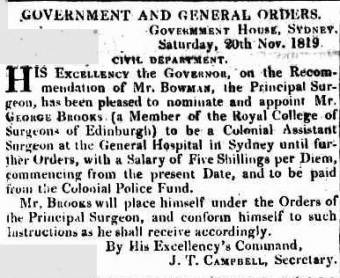
As Magistrate and Doctor in the town, George Brooks' duties probably often overlapped. In 1830, acting as Magistrate he sentenced convict John Mason to 100 lashes for threatening the life of his overseer. One of the surgeon's duties was to witness the flogging of prisoners and he had left instructions that Mason was not to be flogged without his presence. While awaiting punishment at the gaol, Mason died with a noose around his neck and his hands tied. Brooks arrived in time to pronounce him dead and later testified in the Court case that ensued.
Marriage
Mary Stephena Cowper was the daughter of Hannah (Horner) and Rev. William Cowper. She arrived with her father and three brothers Henry, Thomas and Charles and Rev. Cowper's new wife Ann Cowper on the Indispensable in 1809.George Brooks and Mary Stephena Cowper married in 1828.
Land Grant
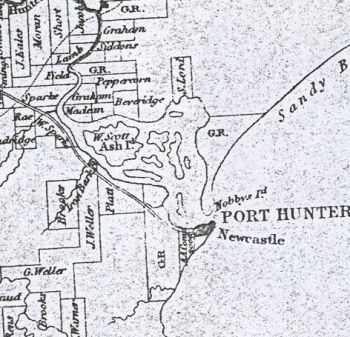
Mary brought to the marriage a land grant of 1280 acres to be named Maryland. They built their family home on land he had purchased nearby. By 1829 George and Mary had a daughter Hannah. John was born in 1833 and Mary in 1837.Map - George and Mary Brooks' land near Iron Bark Creek.....
Social Life
The couple welcomed newly appointed Australian Agricultural Company commissioner Sir William Edward Parry and his young wife Isabella to the district in 1830.In January 1831 George and Mary Brooks accompanied Sir William Parry to Maitland. They called on Captain Aubyn, Mr. Bloomfield and Mr. and Mrs. Wood with whom they dined in their new log hut. They stayed the night at Mr. Bloomfield's property and heard the news of the latest devastating floods, Maitland being in broad sheets of water at the time.
In December that same year George Brooks and Rev. Threlkeld were on board the steamer Sophia Jane when she received the first two tons of coal from the new A.A. Company workings. [1]
In 1836 he accompanied traveller James Backhouse around the settlement, acquainting him with the Christ Church burial ground where convicts could be seen toiling as well as other sights around the town. [4]
Living Arrangements
An interesting article regarding George Brooks' living quarters at Newcastle was published in the Newcastle Morning Herald in 1911 -The Colonial Secretary informed the Police Magistrate at Newcastle on 29th January 1838 as follows:
Sir, - The commanding Royal Engineer having submitted a letter from Lieutenant Lockhart, at Newcastle, representing that his horse which he had placed for a short time while bathing, in the plot of ground in front of the quarters formerly occupied by the Colonial Surgeon, has been impounded by Dr. Brooks with a charge of five pounds as damages, I am directed by his Excellency the Acting Governor, to request that you will inquire and report the circumstances under which the horse was impounded, and how the pound keeper levied such heavy damages, which you will ascertain by calling him before you should you consider it necessary. It appears by the report of the commanding Royal Engineer that Dr. Brooks has no claim on the building or the ground attached to it, he being in the receipt of lodging money and therefore can have no right whatever, to call for any damages'
The above letter was received by the police magistrate on 30th January having evidently been despatched by boat on the day that it was written. The magistrate appears to have shown it to Dr. Brooks or else to have given him a hint of the nature of it for on the 31st January the doctor wrote as follows to the Colonial Secretary:
'Sir, - I beg that you will have the goodness to submit at your earliest convenience this my application to his Excellency the Acting Governor for his Excellency's permission to occupy the garden attached to the surgeons quarters until it is required for the public service. I have been at some expense in improving that garden and my family depend on it for supplies of vegetables; the sick in the hospital have the benefit of it also. Perhaps I may add that the fire which compelled me to leave these quarters has occasioned me a loss of £30 and persons who have no right to those premises have begun to make use of them' The letter was signed 'Geo. Brookes, Col. Surgeon
A corner of the letter had been turned down, and in the Colonial Secretary's hand writing were written the words: 'I know nothing of this matter. Request the report of the police magistrate Febr 2' A letter was accordingly sent to the magistrate requesting him to furnish the colonial Secretary with a report on the circumstances alluded to in the doctor's communication.
That report was submitted, and, so far as the Colonial Secretary was concerned, the matter closed with the despatch of the following letter to the police magistrate on 19th February 1838: 'Sir I have had the honor to receive and to submit to the Acting Governor your letter of the 3rd instant, enclosing communications from Surgeon Brooks and Lieutenant Lockhart relative to the impounding of a horse of the latter gentleman by the former, and in reply I am directed by his Excellency to request that you will inform the parties that although Lieutenant Lockhart does not seem to have used much courtesy to Dr. Brooks on the occasion yet the latter had no right to lay damages for the trespass on property which was not in his charge. The law however, admits of every person impounding an entire horse, if found loose and it is the duty of every constable to do so particularly if found within a town and on Government land without authority. If Dr. Brooks wishes to retain for any time the use of the premises formerly the surgeon's quarters at Newcastle and now in question his Excellency is not aware that there will be any objection to it under the circumstances; but it will be necessary for him to apply and obtain such sanction through the commanding Royal Engineer.'
The building that had been in use as surgeon's quarters in Newcastle was sold and demolished in 1838 as the following letter, dated 6th July 1838 from the Colonial Secretary to the Police Magistrate shows:
Sir, I duly received and submitted to the Governor together with the report of the commanding Royal Engineer thereon, your letter of the 4th ultimo recommending that the contemplated sale of the materials of the late surgeon's quarters may not take place. In reply, I am directed by the Governor to inform you that it appears a portion of the ground on which the building stands encroaches on the line of the street; from which circumstance, in addition to the bad state of the house, his Excellency considers it better that the arrangement already ordered for disposing of the materials should be carried into effect.
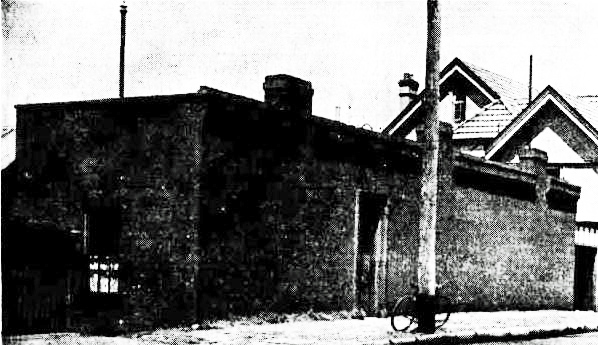
After the surgeon's quarters were demolished George Brooks purchased allotment 83 in Newcomen Street where he built L'Abri (pictured above). The Newcastle Morning Herald included a history of the allotment in 1937 -
L'Abri is the oldest residence in Newcastle, and is one of the last remaining homes still in occupation of those which were built in the early years of the colony. Documents in the possession of F. A. Cadell, show that the site is known as allotment 83 on the town plan, and was originally granted by Governor Gipps to Major John Serocold Jackson on May 29, 1839. Major Jackson was in charge of the soldiers in Newcastle at that time. The grant states that the allotment was promised to Jackson by Sir Thomas Brisbane, and reserves a quit rent of £1/10/ from July 1, 1837, to June 30, 1848, and there forth £15/ yearly for ever.
Jackson sold it in February, 1839, to George Brooks, for £40. Dr. Brooks was the Government Medical Officer in Newcastle then, and he erected the residence on the allotment. He also owned the ad-joining allotments, both in Newcomen and Church Streets, and he mortgaged them for £500 to Ann Clark, of Lemon Grove. The mortgage was paid off by the widow and the devisee of Dr. Brooks, and the allotments were conveyed to her in February 1858." Mrs. Brooks conveyed lot 83 by deed of gift to Hanna Euphemia Kenrick, her daughter, who in February 1873, conveyed it with her husband, Atwill Kenrick, in accordance with the law at the time to Frederic Ash, of Newcastle, founder of the firm of Frederic Ash Ltd., for £900.
The property is still in the possession of the Ash family, they have owned it for 64 years. For many years the Misses Donaldson conducted a School for Girls in the building. The building is still in a good state of preservation, the timber used throughout being of cedar, and shows no sign of decay. At the rear of the land is another old building which was used as a guards house in the time of the convict settlement of the town. L'Abri is known as 55 Newcomen-street. [5]
Community Work
George Brooks was one of the citizens of Newcastle who campaigned to make Newcastle a free warehousing port in the 1840's. Other Newcastle citizens who attended meetings with him were James Henry Crummer, James Reid, Simon Kemp, William Wilton and Mr. Wallace. Around the same time charters of incorporation were issued for Newcastle and Brooks became a member of the district council along with Alexander Walker Scott, William Croasdill, William Brooks, Lancelot Threlkeld, Simon Kemp and Henry Boyce.Death
George Brooks resigned from his position of Colonial Surgeon due to ill health in April 1847. He died in 1854 aged 57 and was buried in Christ Church burial ground where Mary who died in 1859, was also laid to rest.The grave site was described in 1902.......
Close to the gate leading into the church yard there is a grave which links the present with the period when Captain Bingle first became interested in Newcastle. The tomb is that of Dr. George Brooks one of the early colonial surgeons. Although the memorial is fast wearing away the inscriptions can still be plainly read and are as follows - Sacred to the memory of George Brooks Esq., who departed this life May 2 1854 aged 57. Also Mary Stephena, wife of the above and eldest daughter of the Venerable W. Cowper D.D., Archdeacon of Cumberland who died April 17 1859 aged 54.
Notes and Links
Find out more about George Brooks and Mary Cowper at Cowper Family in AustraliaEarly Wallsend - Brooks Family Land - Lowe Farm - Newcastle Morning Herald 17 February 1936
Robert Street Wallsend
Medical Practitioners
Newcastle History
Newcastle Gaol
Newcastle Female Factory
Hunter Valley Place Names
Newcastle in 1828
References
[1] Sydney Gazette 17 December 1831[2] Newcastle Morning Herald 28 March 1902
[3] Hobart Town Gazette 16 October 1819
[4] Extracts from the Letters of James Backhouse
[5] Newcastle Morning Herald 6 March 1937
↑