First Australian Agricultural Company Mine
Newcastle 1831
According to an article in the Newcastle Morning Herald in 1902, in the early years of settlement coal had been taken from the vicinity of the Market Square in Hunter-street, where a small pit had been sunk under the direction of the officers in charge of the settlement. The coal was raised to the surface by means of shearlegs erected above the shaft and a whim which was turned by a number of bullocks.
Another site was at the top of Watt-street. In the early days of the settlement the coal was taken down to the wharf from this site in baskets by convicts. Afterwards bullock carts were used to transport it down the hill. There was also another small shaft where Fraser's coppersmith stood. This was James Fraser who established his business in Hunter-street and later moved to King-street. A tunnel was also driven into the hillside in the vicinity of Varley's foundry in King-street. The location of Varley's foundry can be found on this map.
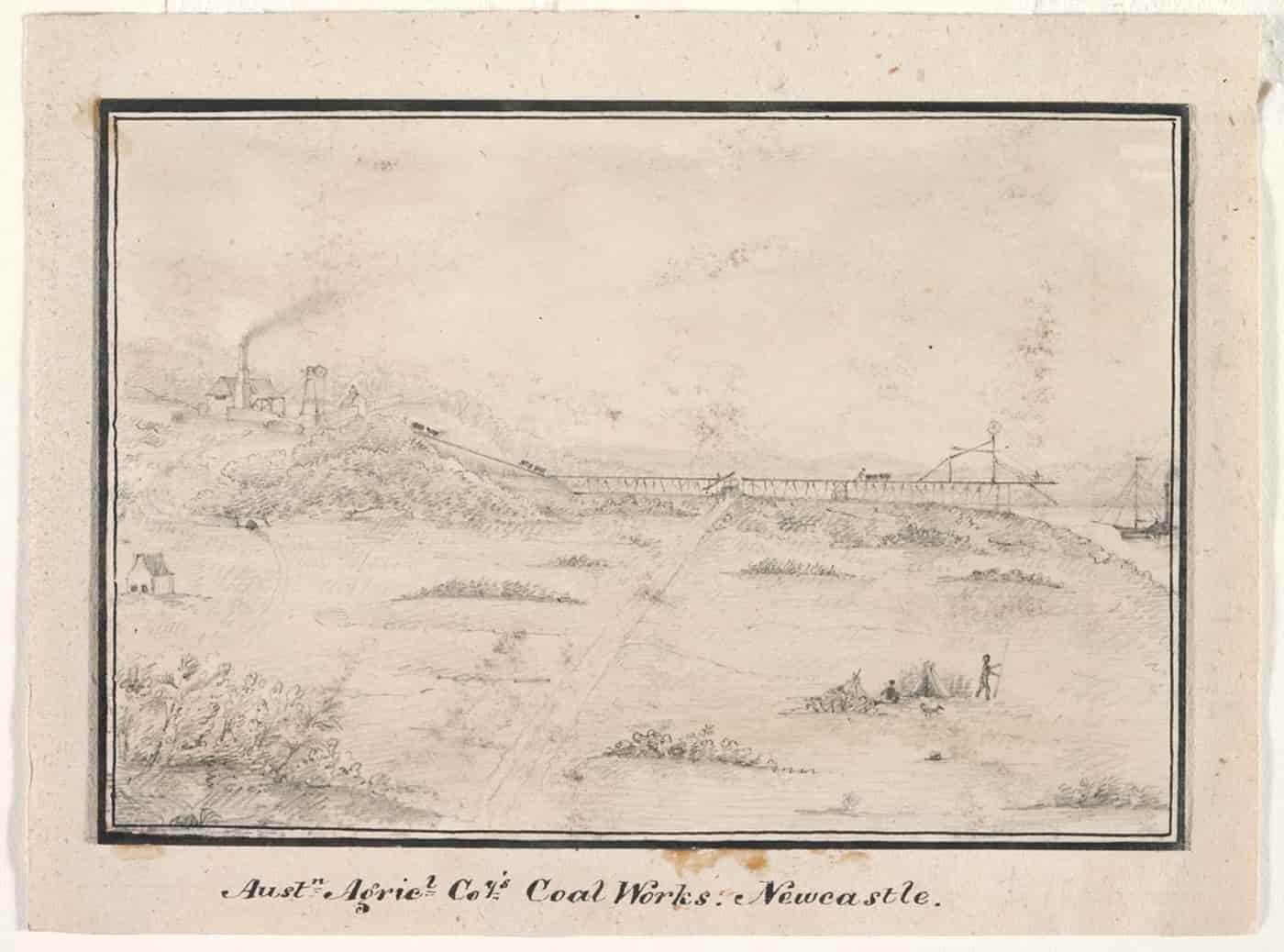
Image above: [1] First A.A. Company Works at Newcastle c. 1833. State Library NSW
1826 - 1827
John Henderson, colliery viewer/manager and James Steele, engineer arrived on the ship Australia in 1826. William Croasdill, colliery clerk arrived on the Waterloo in 18271831
The first shaft for the Australian Agricultural Company was sunk prior to 1831 under the direction of John Henderson and James Steele about 100 yards west of the Steele residence in Church-street at the top of Brown-street. Coal shoots were erected at the same time. From the shaft to the shoots a line of railway was made down the slope and on this the coal was conveyed to the bottom of the hill, as depicted in the sketch aboveThis new mine with its innovative incline plane railway was described in the Sydney Gazette in 1831:
The main shaft or pit by which the coal is raised to the surface, is situated on a commanding hill about one fifth of a mile to the Westward of the present town of Newcastle and a little beyond the limits of the town as originally laid down in the intended plan.
The pit is 9 feet in diameter, and 46 yards in depth to the working seam of coal; the breadth of the seam being between three and four feet. To prevent the necessity of raising the water to the surface, to keep the mine clear, a tunnel has been driven from the shaft through the side of the hill for carrying it off, at the depth of 16 yards from the surface, so that the water is only to be raised 30 yards. The tunnel also passes through a smaller pit, at a short distance from the main one, which has been sunk for the sake of ventilation. The coal as well as the water is raised by means of a steam engine made by Messrs Hawthorn, of Newcastle upon-Tyne, and equivalent to the power of twenty horses, when worked at the pressure of twenty pounds to the square inch upon the piston.
This power is considerably more than these mines can ever require; besides which, a second engine of the same dimensions, and complete in all its parts, is ready to supply any deficiency which may occur from breakage or other accident, so as to prevent any possibility of delay on this account. The coal being raised to the pit's mouth, is hoist into a large clean coal yard, enclosed by a substantial brick wall, and capable of containing between one and two thousand tons of coal. From the gates of this yard an iron railway is constructed the whole way to the end of the new wharf; a distance of three hundred and thirty yards, or nearly one fifth of a mile, of which one hundred and thirty yards next to the pit mouth are on an inclined plane, and has a double railway, and the other two hundred yards are nearly on a dead level to the end of the wharf.
The wagons, each holding exactly one ton, and of which from fifteen to twenty are provided, are lowered down the inclined plains by a rope passing round a very large wheel, the other end being attached to a certain number of empty wagons, which are thus drawn up by the weight of the full ones. The rope is unhooked when they reach the level, and three of them being linked together and pushed to the wharf by one man, the coal is instantly discharged into the vessel's hold by a long shoot, ingeniously contrived to overhang the vessel, simply by knocking out a bolt, and thus dislodging the bottom of the waggon.
Coals may thus be delivered on board as quickly as any ship can receive them, some intervals being requisite for leveling them in the hold. The inclined plane above described is formed by a bank of earth, coated with sods on each side to bind it together; but the level part of the railway is supported on a strong wooden frame of solid timber, elevated from ten to fourteen feet above the ground. As the Maitland road passes under a part of this railway, a sort of drawbridge which one man can lift is so constructed as to enable drays to pass when loaded unusually high.
SELECT HERE to read about the problems this railway overpass caused three decades later after roads had been re-aligned and raised.
The quantity of timber used in the construction of the railway is estimated at 169 loads at 40 cubic feet to each load.
The depth of water in the channel at the end of the wharf, is, in ordinary tides twelve feet at low, and seventeen feet at high water; and to prevent the piles from being eaten by the marine insect, called by the natives cobra which have quite destroyed the old wharf, each pile is sheathed with copper, which, it is expected, will preserve them for many years. With the facilities thus afforded for obtaining coals at Newcastle, in any quantity, and at a moderate price we trust that some competition will be excited among our ship owners in bringing them to the Sydney marker. Two or three vessels from 60 to 80 tons each (which is large enough for Newcastle Harbour), might be profitably employed in the coal trace and would soon have the effect of lowering the price of coals an object which becomes almost daily of greater importance in proportion to the increasing scarcity of wood in this neighbourhood - Sydney Gazette 31 December 1831
Notes and Links
1). First A.A. Company Works at Newcastle c. 1833. State Library NSW2). A. A. Company Mine at Newcastle N.S.W. [picture] Author/Creator: Calvert, Samuel, 1828-1913, engraver. Author/Creator: Cooke, A. C. (Albert Charles), 1836-1902, artist. - State Library Victoria.......
3). A. A. Company Mine at Newcastle, N.S.W. [picture] Author/Creator: Calvert, Samuel, 1828-1913, engraver. Author/Creator: Cooke, A. C. (Albert Charles), 1836-1902, artist. - State Library Victoria.......
4). The Coal Mines of Newcastle - Their Rise and Progress by George H. Kingswell - Lachlan Wetherall
5). Mining Disaster at Newcastle - The Argus 24 June 1889 - A.A. Company mine at Glebe.
6). John Armstrong's Map of Newcastle 1830 showing the location of the Company's mine and intended location of intended wharf
7). See the approximate location of the mine on this map
↑