A Voyage to Newcastle - 1829
To the Editor of the Sydney Gazette,
Sir,
Newcastle presents even a more picturesque and pleasing appearance, when first bursting upon your view, on emerging from the forest scenery that screens it to landward, than on entering from the sea; at least so it did to my feeling, on my present visit; the novelty of its panoramic outline and the contrast presented by its green slopes to the scorched up country I had left behind, probably tending to throw a touch of poetic colouring over it. The more vivid green of the smooth grassy promontory, over which the rural cottages are at random scattered; the whitening beach, with the wave breaking in gentle ripples along it and the deepening blue of the still glassy waters, forming their narrowing or widening convolutions, in accordance with the windings of the opposing shores, imparted to it the semblance of a sea village in England; while ten vessels of various rigs, though of pigmy dimensions, under sail and at anchor, tended in a considerable degree to strengthen the illusion.
Buildings
Several new houses, erected in the interval of my former visit, shewed it to be on a progressive, though a slow increase, the principal being a handsome verandah brick cottage by Mr. Smith, and a large and commodious brick inn by Mr. Huxham. Newcastle contains at present, about fifty inhabited houses, and four hundred inhabitants including the military and prisoners, and has a church, Gaol, hospital, a soldiers and a prisoners' barrack; a lumber yard for the prisoners to work in, and eight inns and public houses, several of them not exceeded by a country Inn in the Colony.A room in the church is at present devoted to the purposes of a school on the Bell system, at which about 30 children attend. A police Magistrate, a Colonial Chaplain, a Commandant of troops, a Colonial Surgeon, a Commissary, and a Superintendent of Prisoners form the more respectable resident society of the town, which is constantly enlivened with the presence of the land holders of the district, in journeys to and from Sydney, by new comers in search of land, and by occasional visitors in quest of health or amusement.
Coastal Traders
The weekly sailings and arrivals, to and from Sydney, of the handsome and commodious little packet, the Lord Liverpool throws, indeed, quite a new life into Newcastle; and those who have not lived here can, in truth, form no conception of the animation which this imparts to the place.Hope being kept constantly on the wing, pleasurable excitement never for a moment flags - a pleasurable excitement too of a double nature to that enjoyed in Sydney, by ship arrivals in the anticipation of spirit stirring news from the capital of both the mother country and of the Colony by every weekly packet that shoots into the harbour. Should a disappointment be the result, still hope cheers you on with the flattering illusion that the enlivening novelties by the next packet will amply make amends for the dullness of the last. The weekly arrival and departure of passengers also to and from the interior and the capital, tend still further to increase the attraction of the place, in the stirring news they communicate, and in the charms their society affords.
Thus Newcastle, in addition to the daily stimulus of business, has a weekly stimulus of even a more pleasing kind, in the arrivals of the packet and the passengers tending to beguile the tedium of the dull routine of ordinary occupations, and to counteract the cares and smooth down the disappointments and vexations to which a too unremitted devotion to them necessarily calls forth consequently, from all the causes which infuse light into Newcastle, a resident here experiences less of ennui than the resident of the capital - the gushes of the healthy ocean breeze, the leapings and sallyings to and fro of the sportive fish in the first shooting of the morning beams, the eddying airy whistles of the eager sea fowl in quest of their tiny prey, and the tranquil aspect of the brightening loops and windings of the river among its dusky islands and sunny beached bays, presenting also in their quest panoramic beauty a charm which even the most moody minds could not resist.
Tradesmen and Townsfolk
To minister to the wants of the inhabitants, Newcastle has three bakers, one regular butcher, and several occasional ones, besides carpenters, shoemakers, masons and nearly every description of useful tradesmen, and is plentifully supplied with provisions and necessaries of every sort at somewhat advanced prices to those of Sydney, owing to the lesser competition and the smallness of the demand. Bread 5d, beef and mutton 4d. sugar 8d tea 3s to 4s and butter 1/6d to 1/8d per lb; fowls 3s per couple, and new milk 5 ½ d per quart, all sterling prices. Many of the wealthier residents however have cows grazed in the town herd at 1s per head a week, with a further charge of 1d per day for milking, from whom an abundance of milk is obtained throughout the year, the pastures in the vicinity furnishing a sufficiency of food during the driest summers and the severest winters.The Weather
From projecting into a bay of the sea, of which Port Stephens Head forms the northern point, Newcastle enjoys a great uniformity of temperature throughout the year, the sea breeze modifying those extreme heats of summer, and those extreme colds of winter to which more inland places are subject, it enjoys in fact, an almost perpetual spring, for you may pick strawberries and have green peas served to table from your garden during almost every month in the year. The south east is the wind most dreaded by the Newcastle gardeners, as the north west is by those in the interior, bearing as it does the fine sea spray along, when blowing strongly, blighting the fruit trees and more tender plants contiguous to the south east aspect of the short. The peach trees, as well as a considerable number of the native shrubs exposed to this blast unable to shoot above the shelter of the high ground to seaward, are seen here pruned down by the cutting vapours until their smooth tufted tops make them seem in the eye of the stranger a well marked specimen of the close clipped grotesque gardening of the Dutch.The Future Brighton of New South Wales
The peninsular situation of Newcastle gives a more thorough exposure to the sea breeze from a greater variety of points than any other sea port town that ever can be founded along this coast, therefore, as a summer residence for valetudinarians, to whom the equable temperature of the sea air and the sea bathing may prove beneficial, it is predestined to rank the foremost in the Colony, its fine shelving and well sheltered sandy beaches pointing it out as if formed by nature for the purposes of a fashionable watering place - to rank in fact as the future Brighton of New South Wales to which (when steam boats afford a quick and certain passage) crowds of Cumberland squires and Sydney citizens will be taking weekly trips for health and amusement, or making it the summer retreat of their families when in pursuit of health or pleasant recreation.Leisure Activities
Its extensive land locked bays, where the wind has free access, and no gulley squalls prevail, render it superior to Port Jackson for boat sailing, while its sea ward rocks abounding with oysters, its waters with fish it interior bays with duck and its island and adjacent brushes with the kangaroo and the wanga pigeon, the sportsman may always find employment for his gun, and pic nic parties never fail to secure a sumptuous repast on any day they may venture out. By a half hour's walk to the Wallabee ground or a ten minutes row to Sandy Island, and putting your dogs into the cover, you will seldom have to wait long for a shot, the kangaroos brushing out into the open ground and perching themselves up in a listening attitude, hearkening to the bay of the dogs, giving you time to take a deliberate aim and tumble them over.Walking Excursions
In rural walks also Newcastle may vie with, if not surpass the metropolis, the interior ones towards the hilly range on the south furnishing during every month of the year a profusion of flowers of varied tints, and of varied odours, to cull a charming beau pot from, and the undulating park scenery of the rising ridges, affording numberless shady arbours to rest from the noon day heat, and numberless commanding sites from whence the whole southern ocean, and the endless forests, and crowded mountains of the continent on which you rest, all lie for a distance of fifty miles within the grasp of your eye. The sea walks, along the high cliff to the southward, or toward the light house point, afford pleasures also from which Sydney is estranged; a cool and bracing sea breeze to nerve the languid step and the joyous and spirit - moving sight of the bay vessels scudding along the rippling surface of the blue waters before you, to and from their destined ports. Beautiful sites for rural villas and pleasure gardens every where abound along the front, and the base of the range before spoken of, which in after times will doubtless be in demand for the above purposes and with the completion of a drive toward Lake Macquarie and a little labour expended on the rural walks at some future day, Newcastle will then excel in pleasurable attractions, as much as it does now in healthy ones, every other town in the Colony.Sea-Side
A more protracted stroll along the southern sea beach will also amply repay the naturalist, or the lover of primitive nature; the cliffs teeming with mineralogical and geological riches, the shore strewed with shells of every shape and every variety of tint, with sponges of curious growth, and animals of singular construction, which preceding tempests had cast forth to perish on the sea beaten coast. In the salt water pools, among the chinks and crevices over which the tide sweeps, may also be seen sea flowers and sea vegetables, of singular form and varying hue, branching out luxuriantly from the sides of the rocks, amid the briny element surrounding them.Hence also a singular predaceous animal apparently of the scuttle fish species, occupies his watery cavern in wait for his prey, with his tortoise formed head, and black goggling eyes, projecting from the hole, and his two long meshy feelers wavering in the water before him, he lies watching intently every object that ruffles the pool, gulping the while through his oozy mouth the waters he lives in, being the species of breathing by which he exists. Putting your finger slily down toward the place of his retreat, he eyes for a moment's space, with eager glance his fancied victim, then protruding suddenly his lengthening body, encircles in an instant with his fringy feelers the object of his desire, pulling with straining grasp in the direction of his den, and vigorous and persevering are his struggles before you can drag the assailer forth. The sea anemones took that singular link between the animal and vegetable kingdom, here shine forth in every variety of tint. Rooted to the subjacent rock, with their filmy saucer- shaped blossoms expanded in the water, and exhibiting every mark of identity, and every varied tint a natural flower can present, there they vegetate as it were, making a prey of every tiny crab or pigmy shell fish that may stumble into the enticing snare, drawing together their sensitive membrane over him like a purse, and ejecting him only from the receptacle in which he is enveloped when every atom of his substance is sucked from the shell.
Burning Cliff
Five miles along the southern beach lies also the burning cliff, where the soil, scorched into a pitchy blackness by the combustion within emits forth streams of eddying smoke from the numerous vent holes with which it abounds, round which the saline particles of the soil forced outward by the heat powder with a snowy efflorescence the black clammy clods they encrust. Thrusting a grass tree reed into one of the smoking apertures you have a speedy match for your segar, neither flame nor incandescent body being visible in any part of the cliff. Several beautiful glens are passed in the way thither, the embouchures of which expanding toward the sea afford delightful sites for rustic cottages and tropical fruit gardens, the soil, the eastern exposure and the mildness of the temperature from their sheltered situation and contiguity to the sea, rendering them peculiarly adapted for such purposes, water being generally accessible at no great distance in pools, in their rocky beds, screened from the summer suns and the thirsty winds by the glossy overhanging foliage that embowers them.Three Bricked Wells
Newcastle is abundantly supplied with excellent water from three bricked wells sunk toward the shelving termination of a white sandy stratum, running into the northern shore of the harbour. This stratum of about 200 yards in breadth extends through the high promontory on which Newcastle is situated south-westerly toward the open sea, and collecting in its spongelike substance every sprinkling of moisture that falls, permits it finally to filter slowly out at the bottom of its shelving descent toward the harbour, where the soil is seen oozing out its contents into bubbling puddles, where cattle occasionally drink. The three wells situated at this point have hitherto furnished an ample supply to the inhabitants, and failing these, more water may be obtained by sinking of fresh ones in the springing puddles contiguous, where the water now drains away to waste.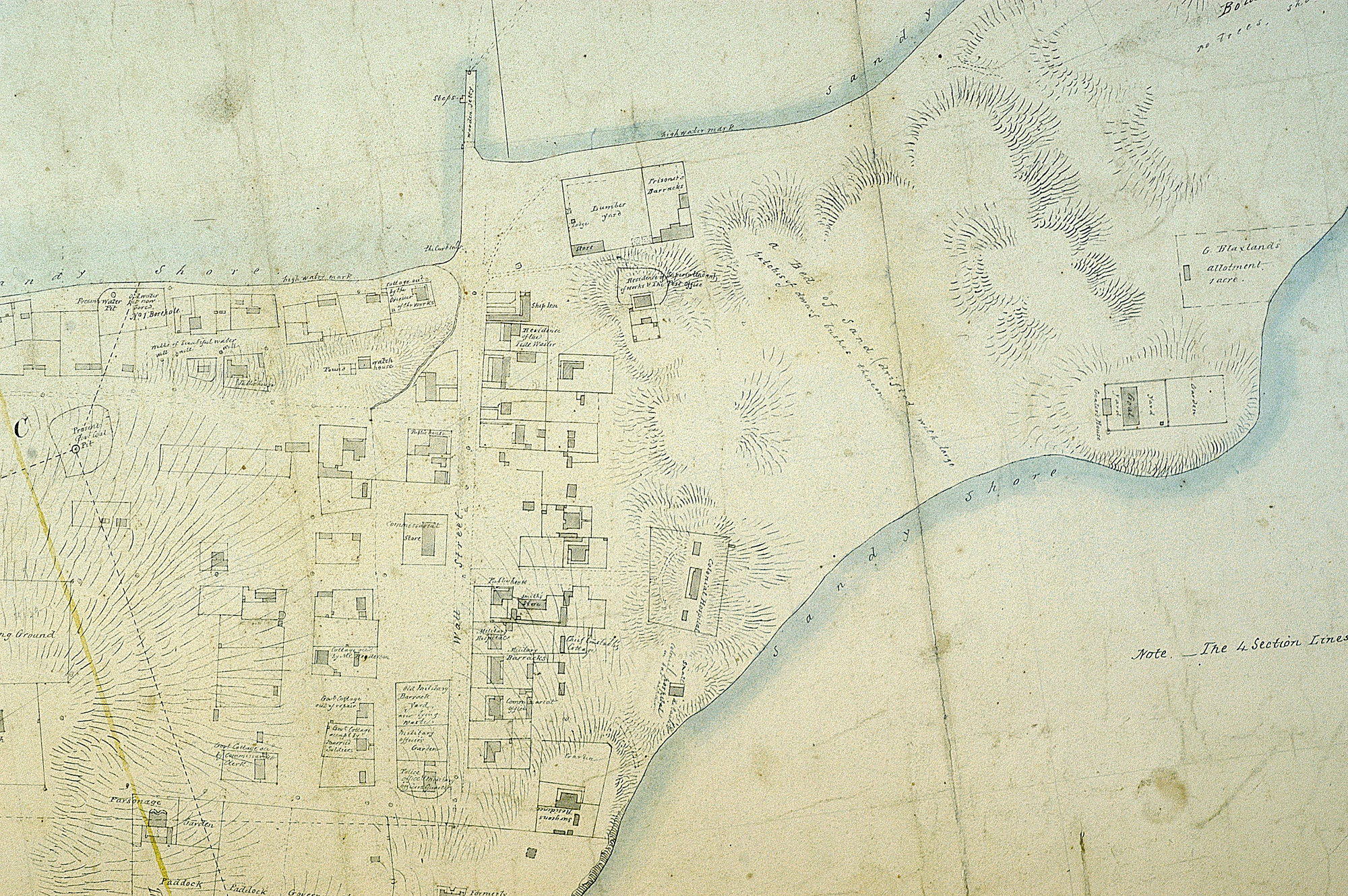 A section of Armstrong's Map of Newcastle c. 1831 showing three wells of beautiful water.
Aborigines' Water Hole
On the sandy flat behind the town, toward the interior the blacks also obtain fine water, by digging to the depth of three or four feet, while in a brick hole at the bottom of a gully facing in that direction, water has been retained through the whole of the drought, only requiring it to be more deeply excavated, and screened from the sun and wind, to form an inexhaustible tank. Newcastle, therefore, will always maintain a superiority over Sydney in the superior abundance as well as superior excellence of this indispensable article, the pure quality of which is as essential to human health as the abundance of it is to human subsistence.Births, Deaths and Marriages
The number of recorded burials in the whole district, during the last nine months have amounted to 24; the number of marriages to 22; and the number of baptisms to 20.Town Reserve
Immediately contiguous to Newcastle lies a large town reserve, extending for two miles toward the interior. It is generally of a sandy nature, mixed with dark vegetable mould, particularly well adapted for the cultivation of vegetables, and many of the swelling knoll and flats toward the interior promising no less favourable for vine cultivation. When this, therefore, comes to be parcelled out in 5 and 10 acres grants among the industrious portion of the prison population, whose services have expired (as wisely recommended by the Commissioner of Enquiry), Newcastle will be beautified as much as it will be benefited by the measure, while the no distant establishment of steam boats between it and the capital, by rendering communication as quick as it be certain and safe, would enable the fertile Hunter to rival the Hawkesbury, in the supply of fruits and vegetables to the Sydney market.Ex-Convicts
The extensive low lands also, with which the outlet of the Hunter abounds as well as the present unoccupied North Shore, both so admirably adapted to the cultivation, particularly of the valuable sea island cotton, might all be most beneficially located by the industrious poor, numbers of whom are now roaming about in quest of a precarious subsistence, and to whom a small grant would be a most welcome as well as a most politic boon. Many of these individuals are at present settled on clearing leases upon the lands of various leading members of this district, and nothing can well exceed the persevering industry they continue to display. They certainly, generally speaking, benefit the community more as tenants than proprietors, from greater exertions being called forth by the rent they have to pay, and from being unable to alienate the land that produces their bread. This latter objection against grants might, however be readily remedied by a clause in the grant, obliging the proprietor to be a bona fide resident for a fixed period under a penalty recoverable by any one who might sue for the same, or in default thereof, the said grant reverting to them, on the same terms that it was previously held. In this way, the small settler, finding he could not raise a credit subsistence, by means of mortgage upon the land itself, would be forced to raise a bona fide subsistence from the produce which his labour extracted from it; for when the trader found he could not command a security upon the land he would be consequently shy of giving credit to the proprietor of it.Crime and Discord
Those who have only known Newcastle as the quondam purgatory of twice convicted criminals, would be surprised at the order and honesty which now exist in the town, not a cabbage leaf or a strawberry being almost ever known to be pilfered from a garden, although destitute of gates or fences of sufficient security to check for a moment the larcenous disposed. Robberies, burglaries, and petty thefts, seem also, in mercantile phrase, to be no longer 'looking up' while the brawls and batteries which occupy so great a portion of the time of other magisterial benches, make but a sorry figure in the Newcastle annals. By removing all the incorrigibles to places where there was nothing worth stealing and consequently nothing to tempt those incorrigibles to rob or to be at the trouble of inducing others to rob for them, and by never permitting an acknowledged bad character to escape without some species of punishment being awarded to damp his larcenous ardour, against whom reasonable grounds of guilt attached, the Police Magistrate has thus managed to keep the greater portion of the felonious population of Newcastle in a passive state of honesty at least, while by smothering rather than feeding the private quarrels, by the lending an eager - all the impassioned circumlocutions to which they give rise, these primarily contentious nothings, from which so much private as well as public mischief proceeds, being deprived of the aiding breath of magisterial meddling to keep their glowing embers in a state of protracted combustion, either yield to the influence of returning reason, or quietly die through a natural exhaustion, or the soothing affluence of friendly interference.Trading Vessels
The trade of Hunter's River is at present carried on by eight or ten small vessels the largest not exceeding 100 tons, but when favourable seasons again recur, three times the above number would barely suffice. the quantity of wool transmitted from this district by the Lord Liverpool alone, in 1827, amounted to nearly 1000 bales, while the immense extent of its alluvial flats to that of any other settlement in the colony, the fine range of pasture land it possesses within its own bounds, as well as from its being the natural outlet of the rich and boundless pastoral territory of Liverpool Plains, and the back settlements of Bathurst, cannot fail of making its trade eventually superior to any of the present located districts we are now acquainted with.The abundance of fine coal also found at intervals along the banks of the Hunter, for a distance of nearly 80 miles interiorly, will ensure a superiority to Newcastle, as a place of trade, to which no other port can lay claim. As timber gradually diminishes, the demand for coal must gradually increase, and from its being an article in request over the whole world, a vessel will never fail of securing a saleable dead weight, to most of the ports in the eastern seas.
Bar to Prosperity
The great bar to the prosperity of Newcastle, as a commercial town, is the difficult access to its fine harbour. This mainly arises from the gap between Nobby's Island and the Light house Point, being in a straight line with the channel of the river, through which the river current, as well as the flood and ebb tides naturally run, by such means forming a yearly accumulating bank in the angle towards the shipping channel, which lying in the eddy of the river current and the tides, every particle of sand or mud that bear along is consequently deposited in it. by completing the breakwater between Nobby's Island and the Light house Point, the strong current and the tides will be forced through the shipping channel, which they will consequently tend to to deepen and widen, while vessels, on rounding Nobby's may then anchor in safety in any weather, what they dare not do now. By narrowing the space in which water runs, you naturally deepen that water, by preventing its shallowing of itself through spreading out, while at the same time this very narrowing of the channel increases the velocity of the current, and thus sweeps away every moveable obstacle in shape of bank or bar gradually before it.When this great work, so essential to the future prosperity of Hunter's river is once completed, the harbour will be completely land locked, and in a few years the channel be even more accessible for ships than it now is for schooners and cutters, while if not early set about, the absolute ruin of the harbour will be ere long accomplished, and the property of the district consequently greatly depreciated. Captain Livingstone being sensible of the channel becoming worse and worse every year, from the accumulation of the sand banks adjoining it.
The Passage to Morpeth
The distance from Newcastle to Illalong, at the Honorable Mr. Close's is 30 miles by water, a narrow band or sand bar, over which there is only six feet at high water, being the only obstacle in the way to prevent vessels of considerable burthen proceeding there. this bar could be readily removed and therefore coasters can have no difficulty of loading in after times at Illalong, which may be called the limits of navigation, because the distance to Maitland by water being twenty miles, while little more than three by land, vessels would not feel disposed to got higher, which indeed it is seldom practicable for them to do.....C,
Newcastle October 10 1829
Sydney Gazette 29th October 1829
↑