
Journey to the Hunter by Steamer
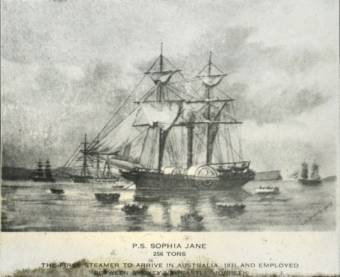
Sophia Jane 1831
In November 1831 a correspondent to the Sydney Gazette took a passage on the new steamer Sophia Jane from Sydney to Newcastle -
Allured by that delightful vehicle of locomotion, the steam packet, we resolved on directing our course to the placid streams and fertile banks of Hunter's river of renown; and having returned with a large stock of health we are inclined to wave politics for a number or two, and employ our leading articles in giving a peep (a mere peep) at the glories of yon 'Bonny banks and braes.'
To begin at the beginning. When the clock is preparing to strike the hour of eight on a Friday night, you find yourself pacing warily up the northern end of George Street - a solitary pass, infested with dogs and footpads. Arrived at the wall enclosing those spacious premises of Robert Campbell, a person of indefatigable industry , strong reason, and great experience, - you enter a wicket, cross a yard not unworthy of the London docks, and descend to that busy haunt of commerce, Campbell's Wharf, alongside which lies the Steamer impatiently awaiting the arrival of her passengers.
Before you is the famous Port Jackson, crowded with shipping from many a clime, their glimmering lights dancing upon the rippling waters, and their hollow toned bells chiming, in quick succession, the high naval hour of eight. The wharf is crowded with a motley group, some about to step on board the steamer, some bidding adieu to their friends ere they launch upon' the great salt sea,' some bearing their masters' baggage, some gazing as idle spectators, and others watching, 'like Patience on a monument,' for what in Botany Bay is well understood by 'a chance'. You ascend the planks stretching, like Mahomet's bridge across the watery abyss between the wharf and the steamer's deck, and find yourself safely lodged within 'the wooden walls of England.' Here all is bustle and seeming confusion. Passengers jostling each other - seamen running to and fro - and the ruler of the roost,
Captain Biddulph, darting from end to end and from side to side, dealing out his orders in double quick time.
To escape the tumult, you descend into the cabin, and find yourself at once in a drawing room - spacious, snugly carpeted, surrounded by a continuous horse hair couch, decorated with looking glass panels, provided with polished mahogany tables, and (mark us well!) disclosing in one sly corner, that sanctum sanctorum, the Steward's buttery. Having reconnoitred the regions below, you return to those above, to enquire how it is the paddles have not begun their travels. You find that a brother-cit, holding no mean function in no mean court, in his anxiety to travel at his ease, had brought with him a horse and in attempting to cross the aforementioned Mahomet's bridge, made a false step and tumbled headlong into the gulph (sic) below to the no small consternation of his learned master, to the great confusion of the skipper and crew, to the chagrin of the impatient passengers, and to the infinite entertainment of the groundlings on the wharf. This little mishap over, the signal is given , the steam is up, the paddles fly and away you scud. Between this and day break, much of your enjoyment depends upon moon and stars. If it be a levee night with the queen of heaven, and the ethereal halls be lit up in all their splendour, fortunate are you, and enchanting must be the scene as you glide down our beauteous harbour, and between our lofty headlands, and along our indented and multiform coast line. But not so fortunate were we.
Below - 'what has become of the horse-hair couch?' Instead of couch you find a double tier of beds lining the drawing room 'walls', instead of the merry group you found at your first visit, you see an 'awkward squad' of land lubbers, some devouring ham sandwitches (sic), some doing homage to brandy and water, some stripping off their jackets, some already snoring and some heaving and straining and disgorging, in sad cadence with the vessel's motions. You are glad to turn in, and throw yourself upon your snug bed.
On ascending the deck in the morning you find yourself rounding Nobby's a fantastic headland, acting as perpetual sentry to the harbour of Newcastle. This insular rock, evidently severed from the mainland by some convulsion of nature, it was thought desirable to connect with the shore by means of a breakwater, which was half completed by the Government, and then abandoned from motives of economy, the expense being enormous, and the utility doubtful. Newcastle is a small, straggling town, many of its houses in a state of decay, and presenting a striking picture of a deserted village. The regularity of steam navigation, together with the coal establishment of which is now actively at work with its steam engines and rail roads, may however, revive its trade, and make it a seaport of some importance. By this time you have worked up the harbour and have cast anchor near the wharf, which is crowded with a motley group, anxiously waiting to welcome their friends, to receive goods, and to pick up news and gossip. You may now step ashore for three quarters of an hour, and get an excellent breakfast at one of the inns, of which there are several. While regaling upon beefsteaks, eggs, toast, and tea and coffee, keep a good look out for the blue peter; for, the moment that is hoisted, you must hasten back to the wharf, and commence your travels up the Hunter.
Having finished your breakfast at Newcastle you return to the steamer, and about 9 o'clock commence your passage up the Hunter. The scenery, though less picturesque than some have described it, is yet interesting, - in some places richly so. Sometimes the river narrows to little more than the span of a canal, its banks fringed with trees which shut out every object beyond; a sudden bend in its channel, like the shifting of a theatrical scene, brings instant relief to the wearied eye, which again range over a noble expanse of water and woodland, hill and dale. The banks of the Hunter, it must be remembered, are as yet nearly in a state of nature, not more than eight or nine years having elapsed since they were first inhabited by civilized man. They will therefore be continually improving. Many a vista will yet be opened, many a fair landscape rescued from oblivion, by the axe of the husbandman; the snug cottage, the neat villa, the lordly mansion, with their attendant meadows and gardens, and orchards, their bleating flocks and lowing herds, will ere long be substituted for monotonous woods and forests. -
Sydney Gazette 19 November 1831
Notes and Links
Links to Newspaper items:Dangerous conditions at Newcastle Harbour - Sydney Gazette 12 February 1831
Tenders called for building a lighthouse - Sydney Herald 24 October 1831
Intention to turn prisoner barracks into a hospital tenders called.. The Australian 15 July 1831
Opening of the New Coal Works at Newcastle - Sydney Gazette 17th December 1831 Sydney Gazette 31 December 1831
Coal-fired Beacon
Convict Pirates
Voyage to Newcastle in 1826
Harbour Lights
Charles Hughes - pilot
Richard Beacher - pilot
Journal of a voyage to Newcastle 1844
Port Regulations 1815
Sea Grave Yard
Signal Flags at Newcastle 1827↑
Map of the township of Newcastle in 1830 showing where various buildings, wells, coal works and roads were located........ Plan of The Town of Newcastle, New South Wales, by John Armstrong, Australian Agricultural Company Surveyor.
Townsfolk at Newcastle in 1831
William Atkinson - Wardsman at the hospital
Francis Beattie - Innkeeper Crooked Billett
Samuel Beckett - Sawyer
Ann Binder - Publican Australian Inn
George Brooks, Colonial Surgeon
William Buchanan - Supt. of Public Works and Postmaster
Private Burtonshaw - 57th regiment
Thomas Buxton - Sawyer and Shopkeeper
Henry Canny - Overseer at the Hospital
James Cox - Sheriff's Bailiff
Henry Croasdill - Superintendent A.A. Co.
William Croasdill - Clerk A.A. Company
John L. Deane - Landing Waiter
Frederick Dixon - Publican
John Henderson - Superintendent of Mining AA Co
John Butler Hewson - Constable
Richard Hill - Schoolmaster
John Hillier - Innkeeper Ship Inn
Charles Hughes - Acting Pilot
Simon Kemp - Innkeeper
Duncan Kennedy - Constable
John Kingsmill - Gaoler
Alexander Livingstone - Harbour Master
John Mayo - Shoemaker
Charles Neville - Deputy Postmaster Landing Waiter
James Pawsey - Landing Waiter, Innkeeper
Alexander Phelp - Baker, Lodge keeper
Edward Priest - Whitesmith
Captain Ranclaud - Gentleman
Peter Reilly - Constable
William Rouse - Constable
John Smith - Publican, landowner
William Smith - Boatbuilder
Thomas Stafford D.A.C.G.
Rev. Charles Pleydell Neale Wilton
Samuel Wright - Commissioner for taking Affidavits
F. Dunbar - 2nd Lieutenant 39th regiment
Convicts at Newcastle in 1831
Daniel Bradburne per Adrian
John Brown per Guildford
William Brown per Canada
George Byford per Marquis of Huntley
Michael Callaghan per Norfolk
Patrick Carroll per Forth
James Close per Grenada
George Delbridge per Lord Sidmouth
John Dent per Vittoria
Samuel Ellis per Hindostan
James Gallagher per Isabella, ticket of leave holder appointed constable in 1831
Mary Ann Green per Princess Royal
Daniel Henry per Countess of Harcourt
John Hanley per Countess of Harcourt
John Hodgkiss per Canada
John Holden per Norfolk
John Jones per Earl St. Vincent
John Jones per Recovery
Thomas Jones per Countess of Harcourt
Gilbert Kelso per Castle Forbes
Daniel Kenna per Prince Regent
William Kilminster Baring
Thomas Light per Midas
Bernard McDaid per Ferguson
John McNamara per Ann and Amelia
John Moore per Minerva
Mary Mullally per Elizabeth
Charles Nash per Minerva
Patrick Rice per Phoenix
Robert Roberts per Florentia
James Rusher per Shipley
William Salisbury per Tottenham
John Smith per Pilot
William Smith per Sesostris
John Surgay per Albion
Samuel Turnpenny per Albion
Alexander Walsh per Earl St. Vincent
Charles Watkins per Speke
Prisoners in Newcastle Gaol 1831
Henry Beard per America
Mary Blackmore per Roslin Castle
George Boddington per Eliza
John Boyle per Guildford
Samuel Brewin per America
William Butler per Norfolk
William Byrnes per Countess of Harcourt
Joseph Carr per Champion
Thomas Coates per Minerva
Thomas Cook per Eliza
Patrick Daley per Henry Porcher
Ann Davis per Forth
William Dunn per Andromeda
Michael Farrel per Sir Godfrey Webster
George Fielder per Norfolk
Patrick Flinn per Prince Regent
Charles Green per Florentia
Edward Green per Midas
Sylvester Grogan per Hercules
John Hancock per Asia
James Howard per Baring
Isaac Johnson per Florentia
William Kay per Norfolk
John Kennedy per Minerva
John Leonard per Edward
John Maloney per Sophia
James Maxwell per Phoenix
Harry McGee per Castle Forbes
Thomas McGraw per Midas
Daniel Meehan per Sir Godfrey Webster
John Millett Scarborough 1790
Christopher Motley per Ann and Amelia
Richared Mottram per England
John Murphy per Phoenix
Eleanor Naughton per Lady Rowena
Patrick Phillips per Phoenix
John Poole per Claudine
William Ross per Dunvegan Castle
Christine Smith
William Smith per Lord Melville
Winifred Stewart per Roslin Castle
Ann Storrit per Princess Royal
John Tapp per Countess of Harcourt
Ellen Weekes per Sovereign
Isaac Wisheart per General Stewart
↑