The Town of Newcastle
1828
There were less than fifty houses in Newcastle in 1828, mostly cottages and houses built by convicts and trades people. Other buildings included government buildings such as the Commissariat, Gaol and Hospital - and there were several inns.
By 1828 it has been estimated that there were about 400 people living permanently in the town, however the population varied because of vessels making frequent trips up the coast, bringing with them supplies and passengers. The cutters Lord Liverpool and Governor Arthur and the schooner Darling all made such trips to and from Sydney. The Governor Arthur left Sydney every Wednesday for Newcastle and returned on Saturday.
Public Houses
To cater for these travellers, several licensed houses were in operation in the town providing various levels of comfort for those wishing to stop over in Newcastle before heading further up the Valley. (In April 1827, four houses had received a license for selling liquor and by the time of the Census in November 1828, there were Seven Publicans listed.) Although one visitor lamented the lack of comfort at the Inns, some establishments at least seem to have been well kept, if not substantial.With increased traffic to and from Sydney calls were made for the introduction of steam vessels, but this wouldn't eventuate for another three years.
Shipwreck
Meanwhile the little schooners and cutters continued to make the sixty mile trip to Sydney or up the coast to Port Stephens. The passage was treacherous in bad weather and in June 1828 the sloop Dove was lost off Port Stephens after experiencing strong winds at Newcastle. Seven people lost their lives in this disaster.The famous Lord Liverpool also ran into difficulties in these June squalls, and if not for the skill of Captain Livingstone, the cutter would have been lost. Long time pilot William Eckford attempted to come to the aid of the Lord Liverpool in his leaky old pilot's boat, ('a cockle shell' that should have been replaced eight months previously) but almost drowned in the process.
Pilot
By August Arnold Fisk had been appointed landing waiter and pilot. In 1829 his large family were left destitute when he died suddenly. An appeal was made and despite the difficult financial times, hundreds of people from all over the colony contributed donations including livestock, to assist the family.School
The Fisk children probably attended the school run in the vestry of Christ Church in 1828. A new school room was soon to be built, however in this year all the students were apparently accommodated in the vestry. Alexander McCauley is entered as school teacher in the 1828 Census (taken in November) however John Gabbage was appointed school teacher in July of that year.Hospital
When whooping cough hit the region early in January 1829, a number of these children may have been affected. Whooping cough had been introduced from the convict ship Morley in March 1828 and spread throughout the colony causing many deaths. In August 1828 Governor Darling's infant son Edward Darling was one of the victims.Dr. George Brooks was resident in Newcastle and employed in the capacity of assistant surgeon since 1822. Henry Canny was employed as Overseer of the Hospital. Dr. Brooks was probably kept busy tending to the many convicts at the Hospital. In 1827, the hospital was considered to be in a state of great dilapidation, so perhaps the shingles, oak and iron bark, lime and cedar, bricks and hardwood that Duncan Forbes Mackay was to purchase in 1828 were to be used to repair the hospital. There was no coroner resident in the township. Settler William Dun was retained for that purpose for the district and although he was granted a town allotment, he resided a considerable distance away at his estate at Paterson. When he was absent from the district or busy elsewhere, message was sent to Sydney for a coroner to travel up the coast to perform inquests.
Christ Church
The spire of Christ Church had been hit by lightning in 1821. Two men were killed in the strike and the church was much damaged. It seems little repair work was carried out and by 1825 the church had fallen into such a state of disrepair that divine service for the prisoners was held in the barracks instead of the church. The grounds had become a thoroughfare because of the lack of a fence and pigs were rooting amongst the graves. However in 1827 a fence was erected around the grounds and the church was repaired and by 1828 Rev. Wilkinson could once again hold services there.Garrison
The New South Wales Veteran Corp was stationed in Newcastle. The garrison commander Captain Robinson had arrived in the colony in September 1826 on board the Orpheus In April 1828 Lieutenant Sweeney's youngest son Edmund was said to have died from the effects of living in an unhealthy cottage in a swamp near Newcastle.(*probably Cottage Creek vicinity) Lieutenant Sweeney's wife had also become ill. The residence of Lieut. Sweeney and his family became controversial during a court case involving Sweeney's commander Captain Robinson and Postmaster and Superintendent of Public Works Duncan Forbes Mackay. The two had met on the voyage to Australia, both on board the Orpheus in 1826 and were on friendly terms until bitterness developed over living quarters. Duncan Forbes Mackay was accused of occupying the best situation in the settlement to the detriment of others. This dispute led eventually to Robinson's court martial and dismissal from the service after being charged with libel by Governor Darling whom he had accused of neglect of duties.Convict Barracks
Whatever the living quarters of Lieutenant Sweeney, they could have been no worse than the Convict barracks that had been used until the end of 1827. They were in appalling condition allowing the rain to pour in and probably bitter winds as well. Convicts were compelled to sleep on the floor although at least some blankets had arrived the year before, many of the convicts would have endured these conditions until the new barracks were set up under the superintendence of D.F Mackay. He converted the building next to the lumber yard which had been used as a carpenter's and wheelwright shop. The upper room was fitted for a sleeping apartment and the lower as a mess. Although they were still not provided with beds or hammocks at least the quarters were dry. The townspeople were probably pleased as the gates of the lumber yard opened directly on to the beach so that the barracks were entirely separated from the town.[3] All but fifty or so better-behaved convicts who were permitted to live out, were accommodated in these new barracks. This would have been close to 100 men! These convicts worked in very difficult conditions in the coal mine, quarry or lumber yard. Other convicts at the settlement were incarcerated in the gaol.Newcastle Gaol
In 1828 the gaoler at Newcastle Gaol was 38 year old James Crofts, a Ticket of Leave holder who arrived on the Lady Castlereagh in 1818. He remained resident in Newcastle for many years. His wife Mary aged 29 also assisted at the gaol. Thomas Donnellan and Patrick Simpson who both arrived on the Ann and Amelia in 1825 were employed as water carriers, perhaps not an easy task as the town water supplies were situated quite a distance from the gaol. William Halfpenny who also arrived on the Ann and Amelia was employed as a cook and James Hennessey as a watchman. John Hooper and Phillip Joseph were both employed as turnkeys. A serious attempt at a mass break out was made by the prisoners in October. They managed to excavate a passage under ground, leading beyond the outer wall of the gaol and must have been close to escape when their plan was uncovered.No doubt they were punished for all their trouble by scourger Robert Young. Forty nine year old Young, a former soldier of the 73rd regiment arrived on the Hindostan in 1809. He was sent to Newcastle as a prisoner in 1814 and by 1818 had been appointed constable. Later, in 1831, Young and turnkey John Hooper spent 10 months in prison after being found guilty of the manslaughter of a prisoner John Mason who had been strangled with a rope after being tied to a pole in the gaol.
Law and Order
Even if the prisoners had managed to escape from the gaol, escape from the settlement was not easy and they would have been pursued by soldiers and the constables of the town. George Muir was chief constable and there were four ordinary constables under him - James Wilkins, Thomas Davids, John Butler Hewson and John Mayo. They had recently apprehended escapees from the settlement who had become lost in the bush. The police were often paid reward money for capturing the runaway convicts and were sometimes assisted by natives from the local tribes who were rewarded with tobacco or perhaps clothing.Law and Order - The Police Force in Newcastle prior to 1862
Newcastle's First Bank
The year ended on an enthusiastic note when merchant Frederick Boucher announced that he was commencing a bank to be known as the Bank of Newcastle. He would issue notes payable on demand and make arrangements to enable holders to get the Notes cashed in all parts of this district, and likewise at Sydney.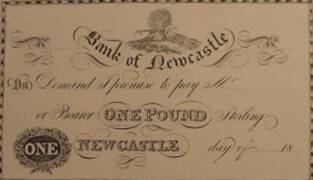
Newcastle Residents in 1828
Alexander Anderson - Assistant Clerk to the Bench Alexander Anderson arrived on the Orpheus in 1826. He was 30 years old. Several other passengers on the Orpheus played a significant role in the administration and development of the district - Parry Long, Lieut. Jonathon Warner and Duncan Forbes MackayFrancis Beattie - Innkeeper - Francis Beattie was tried in Lancaster in 1809. He arrived on the convict ship Indian in 1810 under a sentence of 14 years transportation. In October 1817 he was sentenced to 7 years at Newcastle penal settlement for receiving stolen goods. This seems to have been his only transgression and at the end of the seven years, he was recommended for a land grant by Magistrate Henry Gillman. Three months later he was issued with a license to sell Ale and Spirits. His Inn at Newcastle was known as the Crooked Billet. Francis Beattie died in October 1835 aged 57 and was buried in Christ Church burial grounds.
Samuel Beckett - Sawyer - Samuel Beckett was sentenced to transportation for Life in Stafford in 1819. He arrived on the Earl St. Vincent on 16th August 1820. Nineteen people were executed in the colony in 1821, so Samuel was fortunate when he was convicted of the serious crime of highway robbery that year, that he did not die on the gallows but was instead sent to Newcastle penal settlement. Samuel Becket was employed as a sawyer when he arrived at the settlement. The sawyers travelled far up the river seeking cedar and other valuable timber and although he was likely absent from the township for long periods of time, he found time to meet and marry widow Barbara Styles. Samuel Beckett died in Newcastle in 1853 aged 55 and was buried in Christ Church burial ground.
John Hicks - John Hicks was tried in Surry in 1806 and sentenced to 7 years transportation. He arrived in the convict ship Duke of Portland 27th July 1807. In December 1818 he was sent to Newcastle penal settlement for receiving stolen goods. He received a Certificate of Freedom in 1825, however remained in Newcastle where he was employed by Richard Binder and later by Lieutenant William Hicks. John Hicks was 40 years old in 1828.
Frederick Boucher - Merchant Frederick Boucher came free on the Prince Regent in 1824. On one of his earliest visits to Newcastle he narrowly escaped death while crossing the river in a whaleboat that was swept into the surf at the Oyster Bank. By 1825, he had formed a partnership with Captain William Powditch and together they established store facilities at Newcastle and Wallis Plains. Frederick Boucher's stay in the district was just a few short years but he is remembered as being the first to establish a provincial bank in the colony - the Bank of Newcastle
Thomas Coates - Butcher - Thomas Coates was eighteen years old when arrived on the convict ship Minerva on 19th November 1824. In 1828 he was assigned to Andrew Sparke at Newcastle and employed as a butcher. He received a Ticket of Leave in 1831 and married Margaret Purcell that same year. He was charged with theft in 1833 and cattle stealing in 1834. It is not known whether he or his wife Margaret remained in the district after this
Samuel Dell - Schoolmaster, clerk Samuel Dell was 37 years old when he was sentenced to 14 years transportation. He was one of 156 convicts on the convict ship Neptune when she rounded Sydney Heads on the 16th July 1820. Samuel Dell was sent to Newcastle settlement in March 1821 and was later employed as parish clerk and schoolmaster. In 1828 he held a Ticket of Leave for Newcastle and was employed by Francis Beattie as a clerk.
Frederick Dixon - Government Stock keeper - Frederick Dixon arrived free on the Larkins in 1817. In 1822 he was employed as Superintendent of Government sheep and cattle and by 1824 also held the position of Principal Superintendent of Convicts at Newcastle. He was replaced in this position in 1826 by Duncan Forbes Mackay. In 1833 Dixon was one of the gentlemen who presented an address to the Governor on his Visit to Newcastle. Frederick Dixon received a grant of land in Maitland where he was residing when he passed away on 23 January 1839. He was only 46 and left a wife and five children when he died .
John Erskine - Postmaster and Clerk to the Bench. When the convict transport Sir Godfrey Webster departed Cork on 11th July 1825 few on board would have anticipated the journey would take almost six months to complete. The delay was caused by an extended stopover at the Cape due to ill health. One of the free passengers on the Sir Godfrey Webster was John Erskine who in 1828 was employed as Postmaster and Clerk to the Bench at Newcastle. In 1830 John Erskine moved to Maitland where he was granted land in 1831, however he had departed from the colony by 1839 and his allotment was applied for by Peter Reilly.
Arnold Fisk - Pilot. In August 1828 Arnold Fisk was appointed landing waiter and pilot at Newcastle. Fisk had led an adventurous mariner's life sailing to Fiji and China in search of sandalwood and various other ventures. Later he was involved in a bitter dispute with trader Simeon Lord. He was on board the Harrington when she was Seized by Convicts in 1808 and later became Master of the vessel Favorite before settling to life on the land in Hobart and raising a large family. He later experienced financial difficulties and after losing his property, moved to Newcastle with his wife and 10 children to take up the Pilot appointment in 1828. In 1829 his large family were left destitute when he died suddenly. An appeal was made and despite the difficult financial times, hundreds of people from all over the colony contributed donations including livestock, to assist the family
John Butler Hewson - Constable - Innkeeper - John Butler Hewson arrived on the convict ship Mangles in 1820 under a sentence of 14 years transportation for coining. He was employed as a gaoler at Newcastle Gaol, town constable and later became an Innkeeper at the Union Inn. In 1828 he married Elizabeth Hannell in Newcastle. Elizabeth Hannell was mother of James Hannell, Newcastle's first Mayor. John Butler Hewson was very active in the community and probably knew most of the people in Newcastle in 1828. His name appears often in the early records of Newcastle.
George Muir - Chief Constable - George Muir and his wife Elizabeth arrived on the vessel Jupiter in 1823. George was employed as a wharfinger and constable at Port Macquarie until 1825 when he was appointed Chief constable at Newcastle. In 1830 he resigned from the position to become an Innkeeper at Maitland. When he died in 1834 his wife Elizabeth was left with 7 children to support and she continued running the Family Hotel on her own for many years. Elizabeth out-lived her husband George by 43 years, dying in 1877 aged 88
Captain Samuel Wright - Employed as Superintendent of Police and Magistrate in March 1828, taking over from Francis Allman who retired. Samuel Wright was born in County Cavan around 1788 and joined the 3rd regiment of British Army in 1806 as an ensign with a purchased commission. He fought in the Peninsula Wars and in Canada. He arrived in Australia on the Richmond in 1822 and was granted land which he selected and named Bengalla. Samuel Wright died in 1852 after disappearing from the steamer Rose on the voyage between Newcastle and Sydney.
Francis Williams - Clerk - Francis Williams arrived free in 1806. At one time he was in partnership with Simeon Lord and held important positions in the colony - Trustee of the turnpike road between Sydney and the Hawkesbury, Magistrate in Van Diemens Land, accountant and cashier of the Bank of New South Wales. In 1822 all his privilege disappeared when he was convicted of embezzlement and sent to Newcastle penal settlement under a sentence of 14 years transportation. He was probably treated differently to many of the prisoners at Newcastle and when Captain Henry Gillman took over as Magistrate, Francis Williams became his clerk and confidante. Francis Williams died at Luskintyre, the estate of Thomas Winder in 1831.
John Tremayne Rodd - Superintendent of Convicts - John Tremayne Rodd was appointed Superintendent of Convicts in June 1828. He was granted 1500 acres of land in 1825 which he selected at Wollombi although this was later owned by J.T. Hughes. John Tremayne Rodd died at Wollombi in 1844 aged 72.
James Crofts - Gaoler - James Croft arrived on the convict ship Lady Castlereagh in 1818 under a sentence of Transportation for Life. He was 33 years old. In 1820 he was sent to Newcastle for just one year. By 1822 he was employed as gaoler at Newcastle gaol, a position he held for many years. He must have found the settlement to his liking as he remained there for the rest of his life.
George Brooks - Assistant Surgeon - In 1828 George Brooks had already been living in Newcastle for nine years having been appointed to the position of Assistant Surgeon in 1819 when he was just twenty-two years old. He held the position of assistant surgeon until 1829 when he was appointed Surgeon. George Brooks resigned in 1847 due to ill health, and died in 1854 aged 57. He was buried at Christ Church burial ground where his wife of twenty six years Mary Stephena (Cowper) was also laid to rest five years later
Rev. Frederick Wilkinson - Chaplain Rev. Wilkinson and his wife arrived in Sydney on the Grenada on 23 January 1825. Rev. Wilkinson was appointed Chaplain at Newcastle in May 1827 and also conducted a school there. He was suspended from clerical duties by Archdeacon Broughton in 1830, an act that caused great controversy. Rev. Charles Pleydell N. Wilton was appointed to the position following Rev. Wilkinson's suspension.
Walter Scott - Commissary Clerk - Walter Scott arrived on the Regalia in 1823. He worked in the Commissariat in Sydney and was granted land which he selected in the Hunter Valley. In 1824 he helped establish the new settlement at Moreton Bay. By 1828 he was back in Newcastle and employed as Commissary Clerk. Walter Scott died in London in 1854.
William Cooper - Brickmaker - William Cooper was tried in Nottingham. He arrived in Hobart on the convict ship Lord Melville in 1818 and in 1822 was transported to Newcastle. He married Mary Ann Morley in Newcastle in 1826 and is recorded as a brickmaker in the 1828 census.
James Cook - Carpenter - James Cook arrived on the Atlas convict ship in 1802. He was transported to Newcastle penal settlement in 1821 and in 1828 was employed as a carpenter.
Edward Priest - Blacksmith and Whitesmith -Edward Priest arrived on the convict ship Ocean in 1816, having been sentenced to transportation for Life in Warwick. He was sent to Newcastle penal settlement in 1817 when Captain James Wallis was Commandant. Edward's wife Elizabeth, a currency lass, followed him soon afterwards and together they raised their family at Newcastle, remaining there for the rest of their lives. Edward received a Conditional Pardon and owned a 32 perch allotment in Bolton Street Newcastle. He had one spectacular fall from grace in 1842 when he was sentenced to six months in Newcastle gaol for shooting at Ensign Anthony Ormsby of the 80th regiment as Orsmby stood at a window of the Newcastle Court House. Edward Priest died in April 1847 aged 63 and was buried in the Christ Church burial ground.
Owen Handshaw - Brickmaker - Owen Handshaw (Henshaw) arrived on the convict ship Coromandel in 1820. He was employed as a woodcutter in 1821 and in 1822 was sent to Newcastle under a colonial sentence. In 1828 he was employed as a brickmaker and his housekeeper was Johanna Lane who had arrived on the Woodman in 1823. Owen and Johanna's daughter Margaret was baptised in November 1832 and by this time they were living on Spit Island, one of the islands in the Hunter River estuary. Here they grew vegetables which were taken to Newcastle and loaded on the steamers for the Sydney markets.
Charles Hughes - Fisherman, Pilot, Innkeeper - Charles Hughes was tried at the Old Bailey in January 1817 for committing a felonious assault on the King's Highway. His sentence of death was commuted to transportation for Life and he was one of 245 convicts who arrived in New South Wales on the convict ship Larkins on 22 November 1817. By 1828 he had received a Ticket of Leave for the district of Newcastle which allowed him to work on his own behalf. He was recorded as a fisherman in the 1828 Census and was later appointed to the position of Assistant Pilot.
John Kitchingman - Miller John Kitchingman arrived on the Lord Sidmouth in 1819 under a sentence of 7 years transportation. He was sent from Sydney to Newcastle penal settlement in August 1821 for stealing window sashes. In the 1828 census he was recorded as a miller employed by Patrick Reilly. He was 37 years old in 1828.
Mary Lawson - Shopkeeper - Mary Lawson arrived on the convict ship Nile, the vessel that brought Margaret Catchpole to the colony, on 14th December 1801. Mary was 53 years old in 1828 and having gained her freedom by servitude, worked as a shopkeeper at Newcastle.
Richard Mara - Constable - Richard Mara was sentenced to 7 years transportation in Tipperary in 1819. He was one of 177 male prisoners arriving on the convict ship Minerva in December of that year. The Minerva had departed from the Cove of Cork 26th August 1819. In 1828 Richard Mara was employed as a constable in Newcastle. He was 39 years old.
John Mayo - Barber and Constable - John Mayo arrived on the convict ship Baring on 26th June 1819. In November 1820 he was sentenced to 14 years in Newcastle for robbery in company with two others in George Street, Sydney. His early years at Newcastle would not have been easy, he probably worked in the coal mines or other public works, however by 1828 he was employed as a barber and constable in the township. In 1826 he married Elizabeth Benson, a convict who arrived on the Brothers in 1824 and together over the next thirty years they raised a family and established successful businesses in Maitland - The Maitland Wine Vaults and the Hunter River Hotel. They lived long enough to see their daughter Catherine who was born in Newcastle in 1827, marry a successful free immigrant - Thomas Borthwick in 1851. Elizabeth Mayo died in 1853 and John died in 1860 at the age of 64 years.
John Millett - After being found guilty of burglary at the Old Bailey in 1789, John Millett was ordered for execution, however after favourable recommendations his sentenced was reduced to transportation for Life. He arrived in Port Jackson on the convict ship Scarborough in 1790. John Millett managed to stay out of serious trouble for almost thirty years, until 1819 when he was sent to Newcastle for 7 years for stealing ham and bacon. He was employed by William Eckford at Newcastle and instead of returning to Sydney when his sentence expired, he remained in Newcastle. John Millett died in Newcastle hospital in 1835 and was buried in the Christ Church Burial Ground.
William Smith - Boatbuilder William Smith arrived on the convict ship Larkins in 1817. He was sent to Newcastle in 1818 and by 1821 was employed as Overseer of the Government boatbuilders. He married Christiana Young in 1823 and was granted a town allotment in Newcastle in 1824. In 1828 William was 42 and Christiana 40 years old.
Henry Turbett - Carpenter - Henry Turbett was transported for 7 years for stealing a shawl from Elizabeth Evans as she was walking down the street. He was 18 years old and arrived on the convict ship Mariner in 1816. Henry was employed as a carpenter by Thomas Valentine Bloomfield in Maitland in 1825 and continued to work as a carpenter when he lived in Newcastle three years later. He was granted an allotment in Newcastle - Lot 98 in Newcomen Street which he later sold to Thomas Williams. A publican's license was granted to Henry Turbett for the Carpenter's Arms' in Sussex Street Sydney in 1838.
Some of the children residing in Newcastle in 1828 -
Sarah Cahill age 7
Allen Cheers age 5
John Cheers age 4
Elizabeth Cheers age 2
Eliza Coombe age 12
James Henry Cooper aged 3 days
Jane Christie age 9
Henry Davis age 7
Frederick William Dixon age 3
Peter Eckford age 12
Charles Fisk age 12
Edward McFarlane Fisk age 3
Elizabeth Fisk age 11
Henry Fisk age 14
Juliana Methven Fisk age 5
Mary Fisk age 8
Matilda Margaret Fisk age 9
Robert Collingwood Fisk age 2
Harriett Furner age 5 months
Mary Hallogen age 12
John McClymont age 4
Sarah McClymont age 1
William McClymont age 2 months
Catherine Mayo age 1
Mary Ann Mayo age 3
George Morley age 4
James Henry Morley age 15
John Morley age 2
Thomas Morley age 11
William Morley age 9
Elizabeth Muir age 13
Frances Sophia Muir age 9
Rebecca Muir age 1
James Muir age 3
Mary Ann Muir age 16
Priscilla Muir age 7
Alexander Phelps age 3
John Francis Phelps age 1
Louisa Phelps age 4
Mary Pickering age 10
Frederick William Platt age 11
Jane Platt age 7
John Platt age 18 months
Mary Ann Platt age 5
Robert Platt age 9
Sally Platt age 3
Emmeline Priest age 8
Etheline Priest age 2
James Priest age 1 week
Mary Ann Priest age 10
Susan Priest age 4 Ann
Susan Priest age 12
Edward Priest age 6
Mary Quinn age 3
William Quinn age 18 months
Mary Shepherd age 10
Charlotte Smith age 12
James Smith age 14
Sophie Smith age 11
Eliza Smith age 9
Mary Smith age 6
John Thomas Smith age 4
Matilda Smith age 2
William Henry Smith age 1
Robert Swan age 14
Eliza Turbitt age 5
Harriett Turbitt age 3 months
Henry Turbitt age 4
John Turbitt age 7
Richard Turbitt age 2
References
[1]. J.D. Lang, An Historical and Statistical Account of New South Wales, including a Visit to the Gold Regions, and a Description of the Mines; with an Estimate of the Probable Results of the Great Discovery, 3rd edn, London, 1852, vol. 1, pp.221 - 4[2]. The Australian 14 March 1828
[3]. Sydney Gazette 28 September 1827
[4] 1828 Census
↑