Newcastle Penal Settlement
1810
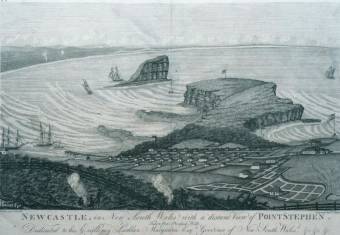
Below - Newcastle in New South Wales with a distant view of Point Stephen, taken from Prospect Hill [picture] / drawn by I.R. Brown; engraved by W. Presston - National Library of Australia....

Lachlan Macquarie took up Commission as Governor of NSW
Lachlan Macquarie was appointed Governor of New South Wales in April 1809. Macquarie and detachments of the 73rd Regiment sailed from Portsmouth in the storeship Dromedary, escorted by H.M.S Hindostan, in May 1809, arriving at Port Jackson in December. Macquarie took up his commission as Governor on the 1st January 1810.
Soon afterwards Lieutenant William Lawson, Commandant at Newcastle, was instructed by Governor Macquarie to liberate all such persons who had been banished to the Coal River settlement subsequent to the removal of Mr. Bligh, the late Governor and Commander- in-Chief of the Colony. George Crossley, Thomas Tate, Sir Henry Browne Hayes and all other persons known by Lieutenant Lawson to be under such circumstances were to be returned to Head Quarters. Later Roger Farrell was also liberated. Some of privations that may have been experienced by deposed Bligh supporters such as Gore, Crossley and Hayes are recorded in Farrell's letter to Bligh in January. Although lawyer Lawrence Davoren was also a Bligh sympathiser, he had not been sent to the River in the aftermath of Bligh's deposition, but for an earlier felony.
Later in January several prisoners were returned to Newcastle and Lawson received advice that it was not His Excellency's wish nor the spirit of the recent Proclamation that every person who had incurred sentence of transportation under the late assumption of Government should indiscriminately be set free; only those who had been sentenced due to unjust causes. In future Lawson was to liberate only those persons whom the governor directed to liberate. Boat builder Thomas Crump and clerk Thomas Brady were found to have been liberated illegally. Lawson stated they had been most useful men and although they had served over five years at Coal River - they were returned, as was Irish lawyer Laurence Davoran.
Others prisoners also sent back to the River on board the Speedwell were Alexander Swift (for 4 months), George Smith, Samuel Cooley, Thomas Cealy (for 4 months), Dan Brady (for 4 months), Charles Seaton (6 months) and Michael Fitzgerald (for 12 months).

Lieutenant John Purcell of 73rd Regiment arrived on the Anne in February 1810. He was appointed Commandant at Newcastle soon afterwards.
In February runaways Johnston and Fitzgerald were returned to the settlement and John Fitzwilliam who was suspected of theft was sent with the instructions that he was to be kept at labour until further orders.
Later in February Lieutenant Lawson was informed that Lieutenant John Purcell of the 73rd regiment was to take Command of the settlement and a detachment of the 73rd arriving on the Sally would relieve the 102nd.
By March Lieutenant Purcell and the detachment of the 73rd were installed and Purcell appointed Justice of the Peace .
Lieutenant Purcell arrived at the settlement with great optimism. He had his own ideas as to how the settlement should proceed and seemed to favour the measure of dividing the bad convicts from the industrious, reliable men. Under his rule, malefactors were given the most servile work and placed in the most uncomfortable houses where they remained until they changed their conduct when they were then moved to the better class.
Purcell was somewhat critical of his predecessors and thought the system of tyranny that had been carried on at the settlement previously would do nothing but force men to take to the bush.
Soon after arrival Purcell chastised his chief overseer for unnecessary cruelty. Undoubtedly this attitude appealed to Governor Macquarie. He approved of Purcell's plans, commenting that the arrangement of separating convicts would probably be attended with good results except on those individuals 'lost to all shame'. No doubt Henry Kennedy who arrived on the Anne in February 1810 and who was sent to Newcastle two months later for robbery was one of those placed in an uncomfortable situation with irksome work. Purcell considered Kennedy a most infamous and undeserving character.
Later Purcell's attitude became more jaded. After months of dealing with recalcitrant, absconding prisoners he came to believe that corporal punishment should be inflicted to deter further escapes.
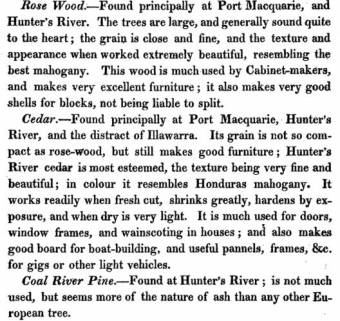
Lieutenant William Lawson was to return to headquarters on the Sally as soon as she loaded with timber, coal and lime. Timber being sent from Hunter River to Head Quarters (Sydney) at this time included a special order of Rosewood for Governor Macquarie which Lieutenant Lawson had been requested to provide as soon as possible. Below is a description of Rosewood and other timber being felled at the Hunter River in 1810.....
An account of the state of agriculture and grazing in New South Wales By James Atkinson (of Oldbury, N.S.W.)

Inhabitants at Newcastle March 1810
General Statement of the Inhabitants in His Majesty's settlement on the Eastern coast of New South Wales, with an Estimate on the remains of Provisions in the Public Stores, 1st March 1810
Civil Department - Superintendent / Storekeeper - 1
Military Department - Lieutenant -1
Serjeants and corporals - 3
Privates - 21
Free Persons Men - 0
Female - 0
Children above 2 years - 3
Children under 2 years - 2
Prisoners - Male - 46;
Females - 16
Children above 2 years - 4
Children under 2 years - 3
Total souls in the settlement - 100
.....Historical Records of Australia, Series 1, volume VII, Governors' Despatches to and From England, January 1809 - June 1813, The Library committee of the Commonwealth Parliament, 1916. p. 280 - 281

Shells for Mrs. Macquarie
Perhaps Purcell had some spare time when he first arrived at the settlement, as Mrs. Macquarie was most grateful to receive a very handsome collection of shells he had sent her. The remainder of the detachment of 73rd had arrived at the river by April, and Purcell then began in earnest to instigate his plans for the settlement.
Firstly he proposed to purchase every private house and pay for them with the produce of the settlement. He approached Sir Henry Hayes with the intention of purchasing his 'excellent house' to use as a hospital and although Governor Macquarie approved of the purchase of Hayes' house he deferred purchasing more houses until further investigations.
Other houses suggested by Purcell for purchase included those belonging to Privates Carter and Brown, however no approval was forthcoming from the governor while Purcell was commandant and he began to turn his energies to improving other more urgent requirements of the settlement.
Pressure from head-quarters to provide lime and cedar to support building projects in Sydney was relentless and plans were devised for improving productivity at Newcastle. Twenty thousand bricks were requested to construct a new lime kiln. Purcell thought two bricklayers, a cooper, two carpenters and sixteen labouring men would be needed to accomplish plans for improvements, although it seems unlikely that this many tradesmen were sent for any length of time.

Plans for a new Wharf and Lime Kilns
Carpenter Joseph Griffin, was sent in May and may have proved useful except the settlement was almost bare of everything and it was with great difficulty that Purcell could carry on the work of the place at all, so finding the equipment and material for Griffin to use must have proved troublesome at the least. In any case, Griffin's sentence expired soon afterwards.
Purcell next turned his energies to the wharf. Constructed in Menzies time, it must have proved inadequate by 1810 as a new wharf was approved by Governor Macquarie early in April. Bolt iron was urgently required for the construction.
Although some of the bricks for the lime kilns arrived one month after Purcell's request and with them a carpenter, bricklayer and pale splitter, he must have been disappointed to find that no labourers arrived on the next vessel. None could be spared from the works in Sydney he was told and he must make do with those he had. Purcell's plans must have been curtailed by this lack of supplies and labour. In addition several men also returned to Sydney as their time had expired - among them Alexander Swift and Thomas Sealy. Daniel Brady who had been mistakenly liberated by Lieutenant Lawson and subsequently returned, finally received his freedom in May and left the settlement forever on board the Lady Nelson.
In place of these men were sent Harry Paul Harry an old man of 60 and unfit for labour, John Morgan who had a bad leg and was probably unable to work to Purcell's satisfaction and Thomas Coyne a bushranger and former soldier who required constant guard to prevent him from absconding. Coyne had run before always taking men with him into the bush and he was to do so again several times over.
Absconders from the settlement were of constant concern to Purcell and the subsequent Commandants. Conditions were harsh. Rations were inadequate and work monotonous and dangerous. To add to their misery, supplies of clothing, shoes and bedding were insufficient. Often, like Coyne, the men would abscond over and over again; despite maltreatment by the natives and punishment when they were captured, they continued to run.

Rewards......
In mid June just two weeks after he was returned to Coal River yet again, Thomas Coyne absconded, predictably taking with him other convicts Ratty and Hutchinson. Another gang escaped at the same time with the express purpose Purcell thought, of robbery. All were captured except one Heywood who was thought to be either in Sydney or the Hawkesbury. Edward Tobin who arrived on the Anne was sent to Newcastle in June and by early July he too had joined the steady stream of absconders. Henry Kennedy who had foolishly robbed Lieutenant-Colonel O'Connell back in April was captured at Reid's Mistake after absconding. Lance Corporal Rainer of the 73rd and Alexander Melville and the party of men who assisted in apprehending the runaways were rewarded for their efforts with a small cedar log.
Despite unrelenting pressure from his superior Commander to provide constant supplies of lime and timber, Purcell sometimes showed care towards the exiled men under his care, often referring to them as 'his people'. As winter set in he requested from Head Quarters slops, particularly shoes as 'some of the men at work procuring oyster shells and cedar are much to be pitied for want of them'. It is unknown if the shoes arrived however later in June, Purcell noted that supplies sent from Stores at Head Quarters were short of one duck frock so perhaps the much needed shoes arrived in that consignment.
Although probably frustrated at the non-appearance of the requested bolt iron to complete the new wharf, and by June with the settlement more deficient in workers than it had ever been since its establishment, Purcell assured Governor Macquarie that he should have no hesitation in dispatching vessels for cedar or coals. He promised that no vessel would be delayed even an hour. By early June the rest of the twenty thousand bricks previously ordered had arrived and with them two requested carts. So work on the new lime kilns continued.

.....and Punishment
When the Lady Nelson was dispatched to Newcastle in July for a load of lime very much needed in Sydney, she was supposed to take with her the captured runaways James Batty, Samuel Hogg and Edward Tobin however the three escaped before reaching the settlement after the Master of the Lady Nelson, Bryan Overhand failed to place the prisoners in irons. This incident was later to be a source of considerable conflict between Overhand and Lieutenant Purcell.
Also on board the Lady Nelson on that trip were two bullocks and harness, the long-awaited bolt iron, tin, fish oil, lamp wicks, lamp oil and nails. Although Purcell had requested steel mills for grinding wheat and maize, none could be procured. Nor was there any flour ready to be sent or carpenters' tools available in either government stores or private shops. The settlement would once again have to make do with what was available.
By July Purcell seemed to be feeling the pressure of running the settlement on minimum supplies and provisions. Early in the month he was close to placing the settlement on short rations of 1/3 the usual allowance if he didn't receive wheat from Sydney. He enclosed a statement to head-quarters of the convict duties by which he thought it could be observed how strained he was to get the public business executed. 'It is to be wondered at how I did it, as my best men are up the river procuring cedar' he wrote. Nevertheless he was procuring some very fine pine - 60 large spars to be used at the new wharf and posts, railings and paling had been procured to fence in the soldiers and prisoners and their gardens which had 'been left in a shameful state by my predecessor'. Cedar logs were procured as requested by head-quarters to be made into dining tables for use at Government House.
As always convicts continued to abscond. In July notorious runaway John Baker was sent to the settlement in irons. Two absconders Brearley and Burgess who were captured by soldiers were more fortunate than most that winter. They were pardoned by Macquarie for their transgressions and returned to Coal River with the instructions they were to receive no punishment.
Purcell received orders regarding treatment of convicts at the settlement and he was required to send quarterly returns of all crimes committed and punishments inflicted. Any corporal punishment was to be inflicted as seldom as possible and always on clear and distinct evidence. Reasonable and fair indulgences were to be granted and convicts who wished were to be allowed to cultivate gardens and rear poultry and pigs. They were to be allowed to receive articles and provisions sent by friends and family in Sydney except Spirits. If they were required to work the whole day they were to be allowed an extra half ration provision or some other adequate compensation.

Disease at the Settlement
The projects in Sydney were almost at a standstill for want of lime by August and the Lady Nelson was dispatched to the settlement with a lime burner - Flaherty - on board with the hope that productivity would be increased. Purcell received instructions that the Lady Nelson was to return to headquarters with as much lime as could be procured.
As well as the work on the new wharf, lime kilns and loading the little boats with as much cedar, coal and lime as he could, Purcell also organised a new boat to be made at Newcastle. It was almost finished by July requiring just a coat of paint to see it ready. It was desperately needed, as no other boats at the settlement were fit to be sent to relieve any vessels in distress. Manpower remained a problem and at this time (July) the settlement was down to one pair of sawyers. The only blacksmith George Davis had served his time and was returning to Sydney as was sawyer Charles Seaton. Soon, Purcell thought, the settlement would 'dwindle to nothing'.
With the new lime kilns constructed production of lime could be increased. and lime burner Anthony Dwyer (Atlas 1802) arrived at Coal River on the Lady Nelson. He was employed as overseer at the Lime burners camp and remained in Newcastle for many years. Two more lime burners were promised and by the end of August lime burner John Anson was sent from head quarters in the hope a full cargo of lime would be ready at all times
Select here to Read a Description of the Lime burner's camp
Throsby's order of 1805 whereby a guard was placed at the wharf to prevent improprieties between visiting sailors and those at the settlement was probably abandoned during William Lawson's command. When Purcell discovered the settlement was suffering under the effects of venereal disease - 'it has raged so here among my people' - he was forced to take active steps to put an end to it by enforcing morality. Newcastle, he thought had been the Hell of New South Wales. He blamed the sailors who entered the harbour to procure lime and cedar for bringing the disease. 'the way they were allowed to go on was worse than the most infamous street in London or Paris'. He regretted that his family had been subjected to the immorality that existed there.... and he attempted to have the females examined by a surgeon, separating them until they agreed to the examination. Purcell requested that sailors be instructed to stay on board their vessel when not on duty.
Here he came into direct conflict with the master of the Lady Nelson, Bryan Overhand, when he accused the officers of that ship with encouraging the crew to enter the settlement when they pleased. He felt keenly the responsibility of so many young soldiers under his command and 'laboured to keep them in their own district' separate from the vices of the seamen and convicts.
Purcell thought Bryan Overhand remiss in his treatment of the convicts when he suffered them to escape en route to Newcastle by allowing their irons to be removed and he complained that Overhand had stolen cedar from the settlement. Purcell was later reprimanded by Macquarie for his unguarded language and conduct towards the Commanders of Government vessels and after this he determined to have no further personal transactions with the Master of the Lady Nelson. Purcell was also in conflict with Richard Horner who was employed as acting assistant surgeon at 3/- per diem. Medicines and surgical instruments were to be sent to Mr. Horner by principal Surgeon Mr. Wentworth in late April and later one of the better-behaved women of the settlement was to be chosen to assist at the hospital. However Horner was dissatisfied and in July he wrote to Purcell requesting his successor be appointed, giving as his reason that 3/- per day was insufficient to support his family of four but also complaining that he was inconvenienced by his government man being taken for the King's works. Horner was later to cause even more difficulties for Purcell.
While Purcell may have had his own grand plans for Newcastle. The settlement was seen by others at this time chiefly as a source of material to fuel Sydney building projects. Prisoners were sent as punishment certainly but also to isolate them from others and primarily to provide labour needed for lime burning and cedar getting. Inadequate supplies, absconding convicts and conflicts with others at the settlement, were to Purcell's superiors mere irritations that he was expected to deal with. Constant pressure from head quarters to provide cedar and lime for Sydney continued. Purcell used every available resource to load the boats with the requested cargo even using his own and others' servants when necessary. (Hence surgeon Horner's complaint) Despite all these difficulties and petty conflicts, Purcell had great confidence that before many months would pass he would be able to make Newcastle what it never was before.
August winds caused a great deal of trouble and soon Purcell was requesting colours be sent, as the principal flag staff colours were carried away by a gale of wind. The natives seized the opportunity for some extra warmth when Mr. Crofts left two great coats unattended on his boat as it lay at Newcome Pipers Reach where the lime was being produced. Later Croft was allowed a cedar log in compensation for his loss but no doubt the missing great coats were lamented in the depths of winter. Although Purcell earlier complained of surgeon Horner's behaviour, he was not pleased when he heard a rumour that surgeon William Evans may replace Horner ' they always have considered themselves the higher rank and interfere with everything at the settlement' he wrote of the naval surgeons. Purcell felt he had worked hard to bring the settlement to what it was and was reluctant to have a newcomer cause quarrels.
The two convicts Brearly and Burgess who had been shown such leniency by the Governor earlier in the year escaped once more. Purcell sent Privates Raymnt and Melville in pursuit of them. He felt punishment was in order this time as a deterrent to others from taking to the bush. He commented that soldiers as well as convicts would soon go through the bush if there was no punishment as Newcastle was 'really as disagreeable to one as to the other'.

Shipwreck
Spring arrived and the gales continued. Two crew men from the Resource were drowned when their sailing boat was carried 10 miles on the North Shore and broken to pieces amongst the breakers. Men were spared from the settlement to accompany the Resource with her cargo to Sydney however this left the settlement short of workers and Purcell begged that they be returned soon. An extra boat was also requested and a pilot was needed for the harbour. Purcell recommended an elderly man James McGuire who arrived on the Fortune and had worked with Joseph Crofts, as suitable for the position of pilot. Vessels often came into difficulties entering the harbour and a 'spying glass' was said to be very much needed.
*James McGuire may have been Newcastle's first appointed Pilot.

A Desperate set of Conspirators sent to the River
Early in October three convicts Harris, Porter and Green were sent to the settlement. Porter being a miner, it was thought he would be useful. Henry Milsom convicted of forgery was sent to be employed in the coal mines as punishment until his 'Excellency's pleasure may be known'. Bridget Moore and John Fitzwilliam joined the settlement in October and James Ratty that notorious offender was apprehended after making his escape once more. He was to be returned to the river in leg irons.
The following week the Lady Nelson brought more convicts - Edward Barns, John McDonald, Dominic McIntyre, James Maxwell and William Cairney. These five men were the principal leaders in a daring conspiracy to make away with the American Brig Aurora. They received three years at Newcastle for their trouble and were considered a most desperate set of men; they were to be strictly watched as they would leave no opportunity of deserting. Samuel Elliott, a private in the 73rd Regiment was also implicated in the bid for escape on the Aurora and he was sent as a punishment to Newcastle to join and remain with the detachment there.

More Prisoners needed at the River
By November absconders increased to the extent that the quantity of lime was reduced necessitating cedar to be sent in replacement to make up the full load on the boat. Three absconders Stanes, Samuel Hogg and McMahon were to be sent back to the river in the Lady Nelson . Runaway James Hutchinson, a notorious and incorrigible character returned to Newcastle for three years. He was to have a log and chain made for him and have it always on him when he was not at work.

Lieutenant Purcell reprimanded
Not all convicts were treated this harshly. Sometimes special allowances were made. Towards the end of December seven prisoners were sent to Coal River to be put to government work. The Governor gave special instructions that these men were to receive no harsh treatment. They had been Court Martialled in 1808 on the Agincourt at Messina - Felix McKenna; Thomas Coplan; Carmen Reago; Edmond Costello; Felix Patcho; Benjamin Grimshaw and Joseph Nealle.
William Skinner who was a weak, elderly man under sentence of 5 years hard labour was shown leniency and was to be employed only in light and easy work.
Governor Macquarie, perhaps becoming tired of the petty wrangling became less tolerant of Purcell's comments and suggestions for improvements towards the end of 1810.
When surgeon Horner complained to the Governor of having been maltreated, Purcell was called on to explain his alleged improper conduct and informed that if an amicable resolution was not found, a public enquiry would take place in Sydney. When Purcell suggested that absconding prisoner Burgess be punished lest soldiers and other convicts follow his course, Macquarie expressed his displeasure. Purcell was chastised and instructed never again to make any comments on His Excellency's mode of treating the convicts, 'it being highly improper and disruptive to do so'. Purcell was reminded that it was the duty of a subordinate officer to obey only and not to make remarks or comments on the orders or measure of his Commander in Chief. If he again presumed to do so it would be taken very seriously.
Lieutenant Purcell remained as Commandant at Coal River until July 1811 when Lieutenant Skottowe took over the position.
Convicts still in the settlement at the end of 1810 included:
George Smith;
Samuel Cooley per Neptune 1890;
Michael Fitzgerald;
John Fitzwilliam per Royal Admiral 1800;
Thomas Coyne, per Anne;
Henry Kennedy per Anne 1810;
Samuel Hogg;
John Baker;
Brierley;
John Burgess;
Anthony Dwyer;
John Waldron;
James McGuire Fortune 1806;
Mark Doolan per Admiral Gambier 1808;
Benjamin Porter;
Henry Milsom;
William Cairney
↑