
Thomas Hollingworth Fowler
Hunter Valley Medical Practitioner
Thomas Hollingworth Fowler was the son of Captain Fowler of Wakefield, Yorkshire [1].
Van Diemen's Land
In the early 1830's he resided in Van Diemen's Land where he met Maria Ramus widow of Captain Henry James Ramus. Thomas Fowler and Maria Ramus were married in Sydney on 30th December 1837.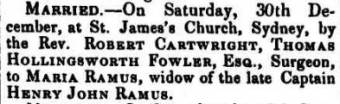 [4]
[4]Segenhoe
In a case held at the Supreme Court in August 1837 Dr. Fowler is referred to by merchant Richard Roberts as Thomas Potter Macqueen's superintendent at Segenhoe.[3] A hospital was established at Segenhoe, and he may have been employed there.Thomas Fowler was often in conflict with Dr. John Goodwin of Scone. In 1847 he testified at the trial of John Goodwin who had been accused of feloniously injuring a patient to such an extent as to cause her instant death and by attempting to deliver her while he was intoxicated.
Dr. Fowler deposed that he was a legally qualified medical practitioner residing in the district of Scone for many years, and had been occasionally practising his profession there the whole of that time. He was called to attend Mrs. Norah Hatherall about 3pm or 4pm on the afternoon of 28th July. He met Dr. Goodwin outside the house and was told by him that the woman had been many hours in labour and he had found difficulty in the case. They then went together into Mrs. Hatherall's bed room and Dr. Goodwin showed him what had been done. They consulted and agreed to give the woman some soothing medicine and mariate of morphine being agreed on.
Dr. Fowler returned to his home and sent back with Job Hatherall six grains of morphine dissolved in four ounces of water in a phial bottle. Dr. Fowler did not immediately return to the house but when he returned in half an hour he saw Dr. Goodwin outside and was told by him to his surprise that the whole of the morphine had been administered to the woman, but that she had thrown off the greater part from her stomach. A second examination afterwards was made by them both and after a brief period the child was delivered still born.
During the latter part of their attendance, Dr. Goodwin was reported to have been so intoxicated that he was hardly conscious of what was going on. Fowler stated that instruments had been used by Dr. Goodwin without administering medicine in a way he would not himself have ventured on and he thought that the woman died from haemorrhage caused by rupture which must have take place some hours before delivery.
Death
Thomas Fowler died in Scone in 1858 -On Saturday the 14th August 1858, Thomas H. Fowler, Esq, Surgeon aged 46 years; for many years a resident of this district, and much respected by the inhabitants.[2]
He was buried in St. Luke's churchyard.
Notes and Links
1). Testimony about the murder of William Marrah at Scone in 1849 - Bell's Life in Sydney and Sporting Reviewer (NSW : 1845 - 1860) Sat 21 Jul 1849 Page 22). William Brett accused of raping Elizabeth Ferry, servant of Dr. Fowler. The Maitland Mercury and Hunter River General Advertiser (NSW : 1843 - 1893) Sat 9 Mar 1850
3). William Brett sentenced to six months in Maitland Gaol for assaulting Dr. Fowler.....The Maitland Mercury and Hunter River General Advertiser (NSW : 1843 - 1893) Sat 9 Mar 1850
4). Treating patients John Burrows and William Fosythe in Scone 1854 - The Maitland Mercury and Hunter River General Advertiser (NSW : 1843 - 1893) Wed 14 Jun 1854
5). For more information about Thomas Fowler see Australian Pioneer Medical Index (Online)
References
[1] Australian Cemeteries - St. Luke's cemetery, Scone[2] Maitland Mercury 21 August 1858.
[3] The Australian 8 August 1837
[4] Colonial Times (Hobart, Tas. : 1828 - 1857) Tue 16 Jan 1838
↑