
Memorials of Rev Edward Griffith
West Maitland and Ipswich
Edward Griffith was born in Bath, Somersetshire on February 13th 1819. He became pastor of the English Independent Chapel at Merthyr Tydvil in 1842.Edward Griffith married Mary, second daughter of Peter Walker of Swansea in October 1842. Two of their sons were born in Merthyr Tydvil. The family then spent a few years in Portishead in the neighbourhood of Bristol where three more children were born.
After accepting a call from the Colonial Missionary Society to found a Congregational Church at Ipswich, New South Wales (Queensland), the couple together with their five children and an unmarried sister arrived in Australia on the Nile in 1854.
The decision to leave her home in England was not an easy one for Mary as
her attachments to her early home were very deep.
She left behind her aged parents, and a loved sister in failing health, whom she never saw again on earth; but, at the call of duty, and trusting in the Divine guidance that had led her safely hitherto, she cheerfully accompanied her husband to the far off land
Maitland
In 1856 it was decided that Rev Griffith would exchange duties with Rev. J.T. Waraker of West Maitland and so 'after taking leave of the many true and sincere friends who had been associated with them in this, their first home in the colonies, Mr. and Mrs Griffiths with their six children and still accompanied by their kind and unselfish sister, started for Maitland, meeting Mr. Waraker and his family in Brisbane on their way to Ipswich.'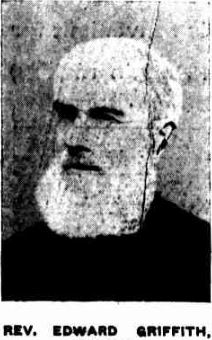
Edward Griffith was 72 when he died in 1891 at New Farm, Brisbane. His wife Mary died a short time later and soon after (in 1892) his daughter Mary Griffith published a book entitled 'Memorials of Rev. Edward Griffith'. The book gives an interesting account of the family's years spent in Maitland.
The following two chapters from the book describe the family's journey on the 'Nile' in 1854 and some of their experiences at Ipswich and West Maitland in 1857:
Chapter III (page 16)
'Where'er we dwell, we dwell with Thee'
Ipswich
'Forty years ago the passage from London to Sydney differed widely in every respect from what it is at the present time, when the beautiful and commodious steamers so constantly starting from either port arrive at their destination at the end of five or six weeks. The good ship Nile was four months at sea, and the passage was on the whole a pleasant one. Very stormy weather was experiences off Cape Finisterre, and afterwards gales were occasionally encountered. ON the first Sabbath at sea, October 9th, the vessel touched the Goodwin Sands, off the coast of Kent; and thus the passengers were exposed to the perils of the deep while still in sight of home. But they were mercifully preserved from harm. Some weeks after this, a ship, the Rose Ellis, passed so nearly across the course of the Nile as narrowly to avoid a collision; but she went on her way, and again the threatened danger was over. One death occurred on board, that of a little girl, and on Mr. Griffith devolved the sad task of committing her body to the deep. He had previously done all he could to relieve her sufferings, by the aid of his early knowledge of medicine. On every Sabbath Day, weather permitting, the passengers and part of the crew assembled for worship, Mr. Griffith reading the church of England Service, and afterwards saying a few earnest words.Both Christmas and New Year's Day came on Sunday this year
A journal kept during this voyage gives a full and interesting account of its various incidents and experiences.
The long journey ended on February 6th, 1854, and a very kind reception was given to the travellers on their arrival in Sydney. Mr. and Mrs. Griffiths became the guests of Mr. David Jones and other kind friends entertained the different members of their family. Three weeks were happily spent in Sydney. Mr. Griffith preached each Sabbath at the different Congregational Churches, and, had it not been for his engagement to proceed to Ipswich, he would probably have been detained for a while at least to supply the pulpit at Pitt Street, left unexpectedly vacant by the sudden illness of Dr. Ross, its esteemed pastor. But the hand of God was very plainly directing his footsteps, and after an uncomfortable voyage of five days in a small and crowded steamer, The city of Melbourne, the family arrived at Brisbane.
There in those early days the only lodgings to be found were most uninviting, but this necessary evil had to be endured, and at last they were able to continue their journey to Ipswich in the very diminutive and remarkably slow steamer, the Hawk, well remembered by the early settlers on the banks of the Brisbane and Bremer. The other steamer, the Swallow, which plied alternately with the Hawk, had unfortunately been wrecked in the river a few days before, causing much inconvenience at a time when travelling was under the best of circumstances difficult and slow. At last, after a day's journey through beautiful scenery, with the serious drawback of intense heat, Ipswich was reached, and the travellers were welcomed by Mr. H.M. Reeve, one of the members of the church to which Mr. Griffith had come to minister. They were accommodated at an inn for the night, and the amount of the bill for expenses the next morning opened the eyes of the new arrivals as to colonial prices.
There was a great deal of romance attached to the experiences of those early days in the colony. The first house which the family occupied was at a little distance from town - then quite in the bush - and the only means of conveyance was by a bullock dray, which also contained the household goods, and provisions, and the slow though short trip was taken in the heat of a summer day. Insect life abounded, and a snake was very soon seen in the house, to the terror of the ladies and children. The aboriginal inhabitants, too, were very numerous in the neighbourhood, which increased their fears. Then it was very difficult to obtain help of any kind, and Mr. Griffith and his sons became for a time 'hewers of wood and drawers of water' The kindness, however, of one good neighbour, and the real practical sympathy shown by her, was always gratefully remembered. But in a few weeks a more convenient house was found in the town, to which the family gladly removed, and then their colonial life fairly began.
The United congregational Church in Ipswich so-called from its consisting of an union between Baptists and Congregationalists, met in a small room in Nicholas Street, and was presided over by the Rev. Thomas Deacon; but Mr. Griffith received a welcome from the good old man, who felt that owing to his increasing age he must resign his post, and the congregation, though few in number, were united in spirit and looking forward hopefully to undertaking greater things for God. A plot of ground, on which the present church is built, had already been secured, tenders were advertised for, a grant of 400 received from the Congregational Church Building Society of New South Wales, and a neat Wooden Church was built which is still in existence as a schoolroom
Although much interest attaches itself to the fact of being, as Mr. Griffith was reminded, 'at the beginning of things' still there are many heart sinkings and discouragements for the pioneer who finds himself cut off from the brotherly communion enjoyed in the old land, and who needs more closely than ever to cling to the unseen arm of Him who 'sticketh closer than a brother'. These words formed the text of the first sermon preached in Ipswich.
The first congregational Church in the district of Moreton Bay was opened free from debt on March 11th 1855, just a year after the minister's arrival; the Rev. Dr. Nelson, Presbyterian minister, preaching in the morning, the pastor in the evening.
During the month of September 1855, Mr. Griffith was invited to Sydney to supply the still vacant pulpit of Pitt Street, the Rev. S.C. Kent, of Newtown, exchanging with him. This pleasant trip was much enjoyed. Maitland was visited on behalf of the Congregational Mission, and five weeks were spent profitably; for in whatever situation this zealous servant of god found himself he always determined to make 'full proof of his minister'. In the winter of the next year, 1856, the Congregational Missionary Society of NSW proposed that Rev. J. T. Waraker of West Maitland, and Mr. Griffiths, should exchange spheres of labour. This plan was carried out, and after taking leave of the many true and sincere friends who had been associated with them in this, their first home in the colonies, Mr. and Mrs. Griffith with their six children, and still accompanied by their kind and unselfish sister, started for Maitland, meeting Mr. Waraker and his family in Brisbane on their way to Ipswich. Here, during the few days of waiting for the southward bound steamer, the family were very hospitably entertained by different kind friends.
Chapter IV (page 21)
'Take my intellect and use Every power as Thou dost choose'Maitland
Arriving at Maitland after a short sojourn with hospitable friends in Sydney, Mr. Griffith found a small congregation meeting in a rather dilapidated place of worship, as the new church, a substantial brick structure, was in an unfinished state. But before long the work was re-commenced, and by the end of the following year - in December, 1857 - the building was completed.During the winter of that year the town was visited by three disastrous floods, which followed in quick succession in the months of June, July, and August. Those who are acquainted with the Hunter River district are aware how rapidly the water rises, and to what an extent it spreads itself over the surrounding country, covering miles of land when at its height, and, after receding, leaving everything covered with a deposit of thick soft mud. The first flood took the family by surprise, unaware as they had been of the near approach of the danger.

The father hurriedly took his little ones from their beds, and carrying them in his arms waded through the fast rising water to the house of a neighbour, which fortunately remained above flood mark until the morning, being on a slight elevation. Boats soon conveyed them to the higher parts of the town, where they were kindly received and entertained by true friends in need, until able to return to their home after some days. The part of the town where they then lived was called the Horse shoe Bend, pleasantly situated near the banks of the river, but too near, as they were proving, to be a convenient or safe residence; for when the second flood came, six weeks after the first, Mr. Griffith was in great danger. Having placed his family in safety he returned to lock up the house, and after doing so, before he had time to leave the garden, being overcome by fatigue and excitement, he fell in a swoon, and lay for two hours unconscious, until aroused by the shout of a passer by, just as the rapidly rising water was creeping around him. His escape was providential indeed, and seemed almost miraculous. After this, Mr. and Mrs. Griffith removed to a small house - the only one to be obtained at the time - above the reach even of the third flood, which quickly followed and was higher than the two preceding ones.
About this time occurred the terrible wreck of the Dunbar, just outside Sydney Harbour. Mistaking the entrance, she was dashed upon the rocks, and only one man escaped to tell the tale. The consternation and excitement caused by this sad catastrophe will long be remembered.
In October of this year the loving parents were called upon to mourn the loss of an infant boy, aged four months. A little brother had died the previous year - also in the month of October, at a time when there was a succession of illness in the family, so that life in Maitland commenced with trial and loss; but, while feeling deeply the removal of their little ones, the fond parents were enabled to say from their hearts - 'It is well with the children' and to realise that they were spared from all the trials of this life, 'Safe in their Saviour's arms'
When the discomfort occasioned by the floods had passed away, and the ordinary occupations of life had again been resumed, the work of completing the church was accomplished; and, it was opened in the beginning of the following year, 1858, but, unfortunately, not free from debt.
Mr. Griffith found Maitland an important centre for many kinds of usefulness, and resolved with the Divine help not only to do the work both of a pastor and an evangelist, but of a good citizen also, and to seek 'the good of the city where the Lord had called him to dwell';
Of his usefulness to the souls of the people under his charge much cheering testimony has been given, and one of those who joined the church during his pastorate wrote in after years to the family then mourning his loss to refer with much affection to the time when, through his instrumentality, she was led to decide for Christ.
He was essentially a public spirited man, and threw his whole energies into the different kinds of work in which he felt called upon to take part. The Maitland Hospital found him a useful member of committee, and he became secretary of the School of Arts and of the British and Foreign bible Society. With the latter noble society he continued to be identified until the end of his life, and ever felt the warmest interest in its welfare
While in this town his two sons attended the High School, then presided over by the Rev. William McIntyre, from which the future Premier of Queensland (Sir Samuel Griffith) proceeded to the Sydney University.
When the Rev. Thomas Binney visited Australia, he made a short stay in Maitland, and, as was usual when he preached, a very large congregation assembled to hear him in the congregational Church.
In August, 1860, Mr. Griffith received two calls - one from Murrurundi in NSW the other from Brisbane, now the capital of the new Colony of Queensland. These he prayerfully considered, and at length was led to decide that it was his duty to go to Brisbane, from which place he had received an unanimous invitation. The Rev. George Wight, the first minister, was intending, after a short but happy pastorate, to return to the old country. A new place of worship had just been built and the prospects of the Church were encouraging. On the other hand, the Rev. R. T. Hills from Victoria, was seeking a new sphere of labour. Preaching at Maitland, he made a favourable impression, and was invited by the people to become their pastor. So the way was made plain; and with many expressions of goodwill and gratitude for past services from the institutions for which he had so cheerfully laboured, and from the attached congregation of the church in High Street, Mr. Griffith quitted Maitland for the sphere in which he was to spend the remainder of his life.
The following is the testimony of a local newspaper to the esteem in which the departing minister was held by his fellow citizens:
'After a residence in West Maitland of upwards of four years, the Rev. E. Griffith took his departure for Brisbane, Queensland on Thursday morning. Mr. Griffith has made himself exceedingly popular in Maitland by his untiring zeal not only as a clergyman but also as a citizen to promote the social and moral well being of the community. The School of Arts and Hospital both obtained a large share of his attention; and his services to these institutions will long be held in grateful remembrance. The Hunter River Auxiliary to the British and Foreign Bible Society also had the benefit of his services, as honorary secretary, and owes its success in a large measure to his continuous labours on its behalf. Mr. Griffith took with him from Maitland testimonials from each of these Institutions of the sense entertained of his services. His parting from his congregation was of an affecting character. The evening previous to his leaving Maitland a concert of sacred music was given in the hall of the School of Arts as a mark of respect to Mr. Griffiths, the proceeds of which will be applied towards reducing the debt on the West Maitland Congregational Church in which Mr. Griffith has, since his residence in Maitland been labouring with much acceptance'
Memorials of the Rev. Edward Griffith, By his Daughter. Hews, R.S., Brisbane, 1892., pp16- 25
Notes and Links
1). Samuel Walker Griffith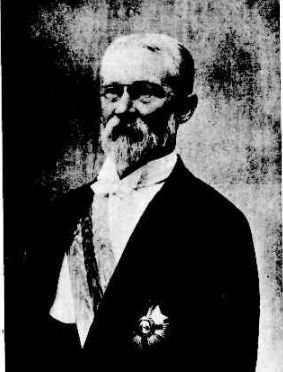
Samuel Walker Griffith (1845 - 1920) was nine years of age when he arrived with his parents on the Nile in 1854. He became Premier of Queensland from 1883 to 1888 and Chief Justice of the Queensland Supreme Court from 1893. A brilliant and hard-working lawyer, he prepared the first draft of the Constitution in 1891. He was appointed the first Chief Justice of the High Court of Australia in 1903. - National Archives of Australia
Image: Mary Griffith....
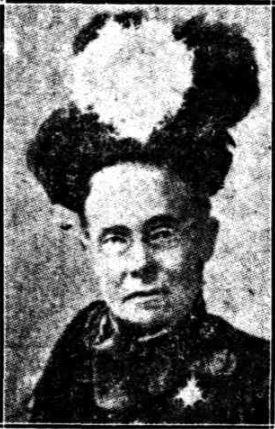
Obituary of Miss Mary Griffith....
Miss Griffith was prominent in religious and charitable work as her distinguished brother the late Sir Samuel Griffith was in the law. Miss Mary Harriet Griffith passed away in Brisbane on July 27. The deceased lady, who was in her 81st year, was a daughter of the late Rev. Edward Griffith, who for some years was the minister of the Wharf Street Congregational Church. She was born at Portishead, on the Bristol Channel. Her father brought the family to Queensland when Miss Griffith was a child, and became the pastor of the pioneer church of Congregationalism in what now Queensland. Thus the family settled down in Ipswich. After a few years there Mr.Griffith took the oversight of the Congregational cause at West Maitland.
The sons attended the High School there, and Miss Griffith also received portion of her schooling at that town. Later still Mr. Griffith returned to Queensland as minister of the Wharf Street Church. Miss Griffith found a congenial atmosphere in the church work into which, she entered with a quiet zeal which characterised all of her after life. She never sought pre-eminence, but her work was marked by unostentation and practicableness. The. spectacular did not appeal to her. Her judgment was sound, while she was not at all obstinate, her opinions once formed, took some convincing to remove. Her entire absence of pride appealed to all who came into contact with her. She was essentially Victorian in her out look on life, religiously and otherwise. Her sympathies extended beyond those of her denomination, and showed the breadth of her view of life. Many public institutions benefited by her wise counsel and practical help. Amongst these may be mentioned the Lady Musgrave Lodge, the Children's Hospital, the Charity Organisation Society, the National Council of Women, the City Mission, the Brisbane Benevolent Society, the Womens' Christian Temperance Union, the Young Women's Christian Association and the Aged Christian Womens' Home. It was at the last named institution that she ended her days. During the war also Miss Griffith was associated with the Red Cross Society and other, patriotic organisations. In 1911 she was honoured with the distinction of Lady of Grace of the Order of St. John of Jerusalem, of which she was the only recipient in this State. The decoration was conferred upon her at Government House by Sir William MacGregor, the then Governor. - The Week 1 August 1930
↑