
Probable Usefulness
Chapter 2
With thanks to the O'Connor family for the following Chapters
John Connor worked in Sydney first, then joined in exploring the area inland from Port Macquarie until he was employed by Captain Rapsey on the old storeship, the St. Michael. Moored at Morpeth, the end of the navigable reach of the Hunter River, the St. Michael was the supply depot for the convicts cutting cedar, the soldiers guarding them, the bush constables and others in the district. As the settlement developed the quantity of stores passing through the St. Michael increased. In 1832 the two steam packets, Sophia Jane and William the Fourth commenced a regular passenger and mail service, plying twice weekly between Sydney and the Green Hills (Morpeth).
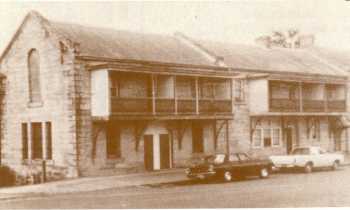
Front of the old Bond Stores at Morpeth
It is worthwhile to quote a description of the site of Maitland as the future Archbishop Ullathorne saw it in those early days:
'Riding at Maitland along the fertile banks of the River Hunter, it was impossible not to admire the beauty of those primitive forests and the fertile abundance produced by the deep and rich alluvial soil. Then there were the varied notes of the birds. I was riding through the woods with Mr. Walker, the chief supporter of our religion in that locality, when I heard at some distance first a whistle, then the crack of a whip, then the reverberation of the lash. I asked: `What road is that over there?' `There is no road,' he replied. `But I heard a man driving, and there again'. `Oh, that's the coachman.' `But a coachman must have a road'. `The coachman's a bird,' he said, and bird it was, exactly imitating the whistle of a coachman and the crack and lashing of his whip. Then the bellbird rang its silver bell, and another species cried like a child in trouble, whilst a flock of parrots made a croaking din, and flights of black cockatoos spread over the fields of maize with a noise like the rusty hinges of an old castle all flapping together in the wind.'
It is well known that the first church built north of Sydney was St. Joseph's Church, East Maitland and the first resident priest, Father Watkins, arrived in 1835. The church had a roof of sorts and an earthen floor, except in the sanctuary, where it was of wood. Often the Mass centre was at one of the larger farm houses, mostly those of friendly non-catholics, for the simple reason that the catholics had for the most part, only small holdings or none at all. The larger properties were worked by assigned convicts, and these were the people to whom the priest went to minister. If the master was in any way friendly he was glad to have the priest offer the Mass at his homestead for it saved the necessity of, his assigned servants going out to Mass.
By 1840, Father Mahony was the resident priest and had set about erecting chapels at three of his centres, namely Hexham, Raymond Terrace and Dungog, as well as organising other centres. When Bishop Polding visited the district in 1840 he was well pleased with what he found. The convicts were clean, groomed and mannerly and their lives had improved greatly in the five years that a priest had been living in the district.
This visit of Bishop Polding seems to have been the first real episcopal visitation of the Hunter Valley and the Bishop's report shows that of a population of 1,160 there were 365 catholics. On 4th October, Sunday, the Bishop celebrated Mass in the church at East Maitland, with a crowded congregation including some protestants. On Monday he celebrated Mass at Raymond Terrace, having travelled there the evening before, about ten miles distant. It rained all the time and Mass was celebrated in a tent, the chapel being not yet completed. The Bishop was well pleased with the exemplary piety and general good conduct of these people. He then went on to Hinton, a further seven miles, where again a large group of catholics eagerly listened to his sermon. He continued on to Cooly Camp and then to Glenham where he arrived at ten o'clock in the night. On Tuesday morning he celebrated Mass for the catholics, about 60 of them in this area, then looked at the site for the chapel. The land for this chapel was given by Mrs. Chambers. The Bishop then went on 25 miles to Dungog where he was given hospitality at the home of W.F. Mackay and next morning celebrated Mass in this mansion with seventy catholics and some protestants, being present. The same day the Bishop and party returned to Maitland arriving there at 10 p.m. These were the people and this the area of which Moses and John Connor were a part.
Alcorn's Inn stood on rising ground where the old and the new tracks met on the Singleton (southern) side of Fal Brook crossing at Dulwich Farm. This was becoming a favourite place for camping and resting the working bullocks. James Glennie's house was on elevated ground upwards of a mile nearer Singleton. The present bridge at Camberwell is 3 miles in a downstream direction from the site of Alcorn's Inn. On lst January 1832 a Post Office was established at Alcorn's Inn, to be the most northerly inland Post Office in the Australian Colonies. Mail was carried up there once a week by the Mounted Police. James Glennie was the contractor in 1832 for the supply of rations and forage to Mounted Police operating in the upper districts, and rations for the lock-ups at Darlington, Merton and Invermein. At Glennie's store travellers could purchase flour, beef and some other necessities.
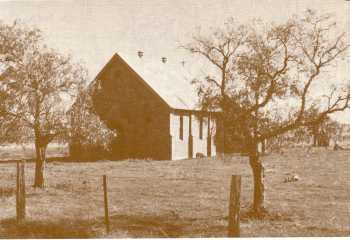
Image: Catholic Church at Glennie's Creek....
Moses Connor married Anne Farrell at Glennie's Creek in 1840 and their daughter Mary Anne was born there 21 March, 1841. Then came John in April 1843 and Michael 22 June 1845. Three more babies were born to them but when John returned from the whaling trip to the Southern Ocean with a group of men from some of the ships that had been trading between Sydney and Morpeth he found Moses and Anne in a sad state. Two of their babies had died and they believed this was due to the bad climate.
They wanted to move further north. John and Moses together procured a horse and dray and began preparations for the journey.
Even then another little boy died and Anne was very distressed. The departure was delayed but Moses felt they must move away from that area. Finally the two men with Anne and the three remaining children Mary, John and Michael set off on the long trek that took them to Ipswich. Ipswich was the free settlement fifteen miles up-river from Moreton Bay, the former Penal Colony, now becoming a busy port.
Ipswich had a newly developed coal mine and was growing as the centre for the large land holdings being taken up in the Brisbane River valley, over the mountains and across the Darling Downs.
It was in Ipswich that John met Mary Murphy, the Irish governess to one of the families he was welcoming to Australia. They were immediately attracted to each other, John felt this was the woman who could, and would as he soon learned, help him to settle down and build a truly Christian home. They were married by Rev. William McGinty who with Father Hanly were the only two priests working in this vast northern section of the Colony. Their marriage was celebrated on 15 August 1854, in Ipswich.
The Connor men were not happy with the work and conditions that they found in Ipswich and did not settle comfortably, so that when they heard of the successful gold findings at Rocky River (Uralla), they once again packed their families and belongings into the dray and traveled south. John having his new bride with him, Mary a little sad at leaving behind her sister, but Ellen was employed in a good family and was content that Mary must go.
The journey would have taken some months for it covers a distance of three hundred and fifty miles or nearly five hundred kilometers. For most of the way the track, now the New England Highway, follows the top of the Great Dividing Range. As soon as they reached Rocky River the men lost no time in staking their claims and then set up their homes. Chapter 3 →
Contact Peter O'Connor mailto:oconnorpr@optusnet.com.au for more O'Connor family details
↑