
Convict Ship Morley (3)
1820
Embarked: 121 women
Voyage: 131 days
Deaths: 0
Surgeon's Journal: yes
Previous vessel: Guildford: arrived 30th September 1820
Next vessel: Almorah: arrived 22 December 1820
Master Robert Railston Brown
Surgeon Thomas Reid
Follow the Female Convict Ship Trail
Convicts and passengers of the Morley identified in the Hunter Valley
The Morley was built on the Thames in 1811[1]. Convicts were transported to New South Wales in 1817, 1818, 1823, 1828 and 1829 and to Van Diemen's Land in 1820 and 1823.
Surgeon Thomas Reid
Image: Elizabeth Fry at Newgate prison -The Morley had been visited by surgeon Thomas Reid and Elizabeth Fry while being fitted up at Deptford.
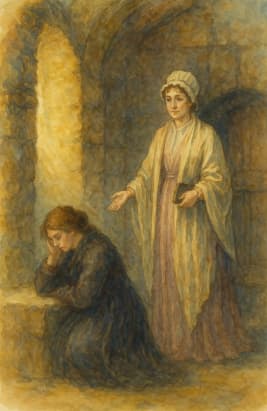
Thomas Reid's Journal began on the 24 March 1820 when the ship was still at Deptford and continued throughout the voyage. In April, when the ship was ready for the reception of female convicts, the Morley proceeded down to Woolwich to remain in the river at anchor in Galleons Reach. Prisoners were being sent from several prisons in England and Scotland and would be boarded at Woolwich -
18th April - four women from Devon Gaol;
21st April, seven women from Horsemonger lane;
22nd April two prisoners from the county gaol of Kent;
23rd April 40 women from Newgate were brought to the ship on a lighter; three more women followed from Exeter and one from the Justitia Hulk at Woolwich.
Later two women from York and three from Winchester were brought up and another three from Newcastle, one of whom was so old and infirm as to require assistance to get up the ships side.
On the 27th three more women arrived from Shrewsbury, two from Carlisle and four from Lancaster. They were all cold and wet and were given dry clothes, refreshment and allowed to retire.
Eighteen more women arrived on the 28th and displayed riotous conduct and mischievous disposition. Most of these were from Lancaster. The women who arrived from Ilchester a few hours later were of a more decent and modest appearance than any yet seen.
On the 29th, eight prisoners arrived from different country prisons. Three or four displayed wild, extravagant and disgusting behaviour which according to Reid's Journal, was readily suppressed as soon as the women boarded.
Thomas Reid drew up a set of regulations similar to those that he had found successful on the Neptune. There was to be no swearing, cursing, fighting or quarrelling. Transgressions would be visited with punishment and disgrace. A Monitor would take care of the management of each mess. Scrupulous attention to cleanliness was to be maintained and proper reserve towards the sailors was to be kept. [3]
Elizabeth Fry and Mrs. Pryor
Mrs. Fry visited the ship occasionally to see that her intentions were fully implemented. When she could not visit the Morley, Mrs. Pryor took her place. The roughest weather or greatest personal inconvenience did not deter Mrs. Pryor from the work of humanity. She gave consoling advice to the unfortunate exiles without reserve and distributed several articles of comfort and convenience to the women. Bibles, sermon books and religious tracts, children's books and straw for plaiting and material for knitting and sewing were also handed out to afford the convicts employment on the long voyage to Australia. Later checked aprons and other necessary articles were also distributed.Free Passengers
Free passengers included were four free women and eleven children permitted to join their husbands and relatives in NSW. Cabin passengers were Rev. and Mrs. Reddall and Mrs. Brown, wife of the captain and their family.Provisions
The extra articles furnished for the female convicts and for the free women and children embarked at the same time were as follows.Navy Office -
A List of Stores shipped on Transport Department, board the Morley 20 April 1820. 3 convict ship, Robert Brown Master, for the use of 120 female convicts, passengers, and 50 children, during their voyage to New South Wales, or Van Diemen's Land, and of clothing for the use of the convicts upon their arrival at the colony.
Articles of Comfort for Use during the Voyage. Mustard, 157 lbs.: soap, 785 : combs, large and small, of each 22 : needles, 1,200 : scissors, 12 pairs : moist sugar, 2,072 lbs.: souchong, 452: preserved meats, 439 and 10 ounces : lemon juice, 252 gallons : sugar to mix with it, 1,792 lbs.: white thread, 12 : coloured thread, 12 : towels, 240.
Articles in case of Sickness. Tea, 31 lbs.: sugar, 157 : chocolate 9 : sago, 18: Scotch barley, 314: ginger, 3/4 : allspice, 6 : black pepper, 3 : red port wine, 94 bottles.
Hospital Furniture. Calico bed-gowns, 8 : petticoats, 8 : cotton hose, 15 pairs : linen pocket-handkerchiefs, 15 : night-caps, 15: towels, 15: linen sheets, 12 pairs: pillow-cases, 24: pewter pans and urinals, of each 2 :, and bucket, of each 2 : spitting-pots, 2 : tin saucepans, 2 : teakettles, 2: ditto to serve as teapots, 21 : knives and forks, 15 of each : bathing tub, 1 : water purifier, 1 : childbed linen, 12 sets : charcoal, 20 bushels : water pails, 3 : airing stove, 1 : half pint tin japanned mugs, 120: swing stove, 1 : spare beds, 12: kegs* (three gallons), 27.
Clothing for the Use of the Convicts upon their Arrival. Brown serge jackets, 120: petticoats, 120: linen shifts, 240: linen caps, 120: stockings, 120 pairs: shoes, 120 pairs: neck-handkerchiefs, 120: beds complete, 170: cots, 4 : hammocks slung, G.
Clothing for 17 Male Children. Blue kersey jackets, 17: waistcoats, 17: raven duck trowsers, 17 pairs: shirts, 51 : stockings, 34 pairs: woollen caps, 17: neck-handkerchiefs, 17: shoes, 17 pairs.
Clothing for 33 Female Children. Brown serge jackets, 33: petticoats, 33: linen shifts, 66: linen caps, 33: stockings, 33 pairs: shoes, 33: neck-handkerchiefs, 33.
Books. New Testaments, 33: prayer books, 46 psalters, 46: Bibles, 12: manuals of instruction and devotion for the use of the prisoners, 11.
Thomas Reid's Attitude Prior to Sailing
Thomas Reid wrote to the editor of the London Times on 1st May regarding the women:Female convict ship Morley, Galleon's-reach
'SIR, - Having lately noticed in several papers various accounts of the refractory conduct of 40 unfortunate female convicts in Newgate on the night previous to their being removed to the Morley, as well as communications to the same effect having been made to me since their embarkation, I think a few observations on the subject may not be unacceptable to the public; and if you think the following worth insertion in your paper, you are at liberty to make them public.
Of the behaviour of these women in Newgate I can say nothing, though I have great reason to believe it was not half so bad as has been represented: of their conduct here I am happy that it is in my power to bear honourable testimony. On first coming on board three or four of them showed some disposition to be unruly; but a timely rebuke, with a positive assurance that all irregularity of conduct would be opposed and punished, put an immediate stop to it. Those who pretend to say that the humane exertions of Mrs. Fry and the committee of ladies have produced no beneficial change on the minds and morals of these misguided creatures, need only visit them here to be convinced of the fallacy of their assertions, by proofs more irrefragable than the most specious arguments of speculative logicians. They will find many of them reading the Scriptures with apparently devout attention, and I firmly believe real advantage. I am not ashamed to acknowledge, that I have given every exertion in my power towards establishing a system of religious behaviour amongst them; and therefore feel no hesitation in putting my name to this statement' (The Times, Wednesday, May 03, 1820; pg. 3; Issue 10923; col D)
Departure
The ship departed London on 22 May 1820.Thomas Reid's Experience on the Voyage
Following is a review and extracts from Interesting Descriptions of the Present Condition of the Colony of New South Wales; Including Facts Relative to the Management of Convicts of Both Sexes written by Thomas Reid and printed in the Morning Post 7 January 1822......'Some of the most curious facts relative to the treatment of the prisoners may here be stated. Previous to their sailing, the Solicitor to the Bank presents five pounds to every woman convicted of uttering forged notes, or having them in her possession!! This practice appears to be more philanthropic than judicious; for the money, according to Mr. Reid, was either misapplied on its receipt, or at the first subsequent opportunity. The Governor of Newgate also visits the ship and gives every woman from that prison half a crown, out of some idea devoted to that charity. This donation also led to quarrels and blows. The prevention and punishment of such misconduct is to tie the pugnacious combatants back to back, and leave them pinioned in this inoffensive attitude till their passions cool. For graver offences, confinement to the hospital, and exclusion from the deck are the awards. The latter is a severe visitation under the circumstances of the voyage.
The conduct of the crew seems to have been most atrocious. Mr. Reid slept with pistols in the prison, to prevent their intrusion; and when thus baulked, they not only threatened his life, but resorted to the most unmanly means of offence; for instant (Mr. R. says);
They amused themselves the whole night with making hideous noises through the grating at the fore hatchway, and endeavouring to provoke my angry feelings by their rude abuse. It was shocking to decency to hear their beastly language, which was much too gross for expression even in writing. The sailors last night continued the noise, with additional circumstances of malicious intent, which argue a determination to persevere: for instance, forcing a cat down to the door of the fore hatchway, fastened by a cord, they contrived to torture the animal, causing it to make the most piteous cries so as to disturb the women's rest. Their daring disposition went much further; for by means of a boathook staff, they broke down two of the bars which enclose the prison at the fore hatchway, making a considerable opening, which might be taken advantage of at that moment, perhaps but that they were apprised of my being on the watch below, determined to fire on any one who should have the temerity to venture in. In this almost defenceless state are the prisoners still obliged to remain, because no other means of security can be devised besides what have been employed, and no resource appears at hand to oppose to outrage, if the sailors choose to be so criminally adventurous.......
.....There were two of the females under my care, whose behaviour during the voyage was so profligate, that, besides the character with which they were handed over at the muster, I was induced to point them out to the notice of the Governor, with a request that they might be separated from the others; to this his Excellency paid immediate attention, and gave orders to that effect. I mentioned the same matter, moreover, to the superintendent of convicts, who made a note of it in his book in my presence; yet, on that very same evening, these wretched creatures were permitted to go at large in the streets of Sydney, where necessity or their own abandoned propensities must have driven them to infamous practices. About one half of the female prisoners were disposed of in Sydney and its neighbourhood, and the remainder were kept in a separate place in the gaol, until an opportunity should offer for removing them to Parramatta, whither the governor had directed they should be sent by water, to prevent improper conversation with straggling prisoners of the other sex, who are continually infesting the rods. It is to be remarked, however, that those whose behaviours or disposition had most frequently incurred censure on the voyage, and consequently least merited favourable report were singled out as the fittest objects for assignment, while many of those whose conduct had been uniformly deserving of approbation, whose names also were conspicuous for excellent character, were left to be transmitted to the Factory!
Connexions too spring up unexpectedly between the female convicts and pretended relatives by whom they are recognized, as it were, on their landing. This practice had grown to such mischievous extent in former years, that it was found necessary to order that no person from the shore should be allowed to visit the ship, or hold communication with the prisoners, without permission signified in writing; and now a guard boat is commonly stationed in the cove, to prevent any unauthorised persons from approaching a convict ship after her arrival, until the prisoners are disembarked. Previously to this order, it was usual for persons from the short to go alongside those ships and even on board, and choose from among the female prisoners, wives, sisters, or other relatives, as circumstances would suit, for themselves and others, and those claims they used afterwards to substantiate on oath; on which the prisoners were accordingly assigned them. [3]
Arrival in Australia
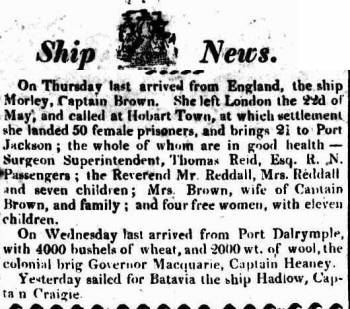
The Morley arrived at Hobart 29 August 1820 and Port Jackson on 30 September 1820.Note of Thanks
The women wrote a note of thanks at the end of their voyage, seemingly at odds with the experience of Thomas Reid as described in his journal above........The following letter from the female convicts on board the 'Mersey' was addressed 'to Mrs. Fry and the Ladies of the Committee, etc.,' Aug. 30, 1820, and shows that the influence exercised by them was still felt by the poor women :
'Honoured Ladies,
Amidst the awful state of feeling which is produced by our forlorn situation, our hearts are filled with thankfulness to that kind and gracious God who gave us mercy by his redeeming Son, and grace by the consoling Spirit which is the Author of all truth, for having preserved us through all the dangers of a tedious voyage.
We intreat your kind permission to present the heartfelt offering of our gratitude for the benevolent zeal you showed in reclaiming us from the ways of sin and error, and for all the care you took of us in prison. We can never make a proper return to Mr. Reid, our surgeon, for his continual watchfulness over our health both of soul and body; for it is to him, under God, we owe the great blessing of being made acquainted with the Holy Scriptures and the sweets of religion, of which most of us had been ignorant all our lives before, or had forgotten through our depraved habits. . . .
We are all in good health, through Mr. Reid's skill and attention, and enjoy an easy and a happy state of mind. We beg leave to assure our good Patronesses that no circumstances whatever shall, by God's grace, make us forget the lessons we have learned on the voyage, by which we hope to avoid guilt in future, and to lead pure and holy lives.
'We fervently pray for your preservation and happiness, and offer our grateful acknowledgments for the feeling attention we experienced at your hands, and remain, 'Ladies, 'Your penitent and dutiful servants,' (Here follow the names of the women.) One of these, Maria Williams, subsequently married a clerk at the Government House, and on receiving a letter from Mrs. Fry, she and her husband acknowledged it jointly, and declare that they ' can hardly find language sufficient to express their grateful thanks.' [2]
Tour of Inspection
Thomas Reid placed an advertisement in the Sydney Gazette in September soliciting the assistance of those willing to promote the Object of collecting natural history, particularly from the Mineral and Animal Kingdoms. Fossil Remains of organic bodies and minerals would be purchased at their proper value and the Kangaroo and Water Mole (platypus) in a pregnant state would be highly desirable.In October Thomas Reid accompanied Governor Macquarie on his Tour of Inspection to the Western and Southern Countries which had been discovered by Charles Throsby.
Governor Macquarie remarked in his Journal.......
Wednesday 25. Octr. Waked quite refreshed - and perfectly free of Headache this morning - Our worthy good Travelling Companion Dr. Reid took his leave of us, and set out on his return to Sydney at Half past 5 this morning - having first taken an early Breakfast. The Revd. Mr. Cartwright and Mr. Meehan gave him a convoy for some miles on the Road. - We all much regret Dr. Reid's departure, as we found him a most agreeable, good humoured and entertaining friend and associate. - He was, however, obliged to leave us here - being afraid of not overtaking his ship (the Morley) at Sydney in case he staid with us any longer
Notes and Links
1). The Morley was one of three convict ships bringing female prisoners to New South Wales in 1820, the others being the Janus and the Lord Wellington. A total of 306 female prisoners arrived in the colony in 1820.2). Read the Journal of the voyage of the Morley in Two Voyages to New South Wales and Van Diemen's Land: ... By Thomas Reid
3). Fifty women were landed in Hobart in September 1820 and seven women from the Janus were taken on board to sail to Port Jackson. They arrived in Port Jackson on 30 September 1820.
4). Convicts and passengers of the Morley identified in the Hunter Valley
5). Read about surgeon Thomas Reid and the voyage of the Morley in the Melbourne Age 12 April 1946
References
[1] Bateson, Charles, Library of Australian History (1983). The convict ships, 1787-1868 (Australian ed). Library of Australian History, Sydney : pp.342-343, 383[2] Visits to Female Prisoners at Home and Abroad edited by Matilda Wrench
[3] Journal of the voyage of the Morley in Two Voyages to New South Wales and Van Diemen's Land: ... By Thomas Reid
↑